CM Bhupendra Patel: Gujarat Leading India's Green Growth Vision
Synopsis
Chief Minister Bhupendra Patel declared on 30 October 2026 that Gujarat, under PM Narendra Modi's leadership, is realising 'Green Growth' through renewable energy expansion — linking clean power directly to farmer welfare via the #KisanKalyanSeRashtraKalyan vision.
Key Takeaways
CM Bhupendra Patel stated on 30 October 2026 that Gujarat is at the forefront of India's renewable energy sector, realising 'Green Growth.' The statement credits PM Narendra Modi's leadership and draws on his legacy of initiating the Gujarat Solar Power Policy in 2009 .
The hashtag #KisanKalyanSeRashtraKalyan deliberately frames renewable energy expansion as a farmer-welfare initiative.
The PM-KUSUM scheme (2019) is the central policy instrument linking solar deployment to agricultural communities in Gujarat.
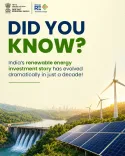
Gujarat's renewable push feeds into India's national target of 500 GW of non-fossil fuel capacity by 2030 .
Solar-wind hybrid project rollout and updated state-level renewable policies are the key developments to watch next.
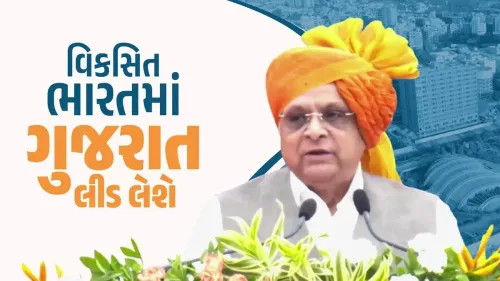
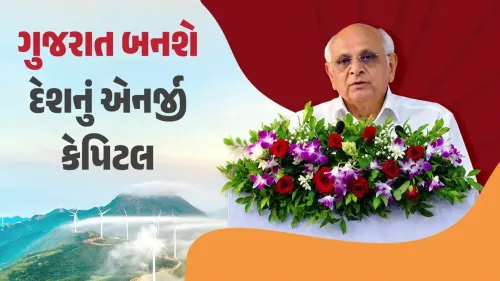
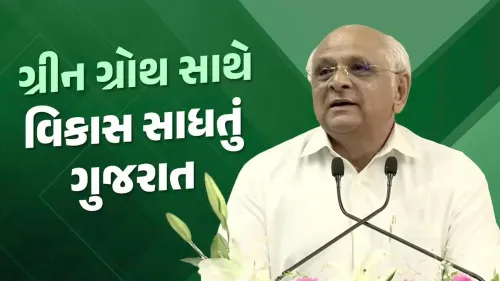
Gujarat is no longer just chasing India's renewable energy targets — it is, according to its own Chief Minister, setting the pace. On Friday, 30 October 2026, the Chief Minister's Office of Gujarat posted a statement attributed to Chief Minister Bhupendra Patel, declaring that under the leadership of Prime Minister Narendra Modi, Gujarat is today giving concrete shape to the idea of 'Green Growth.'
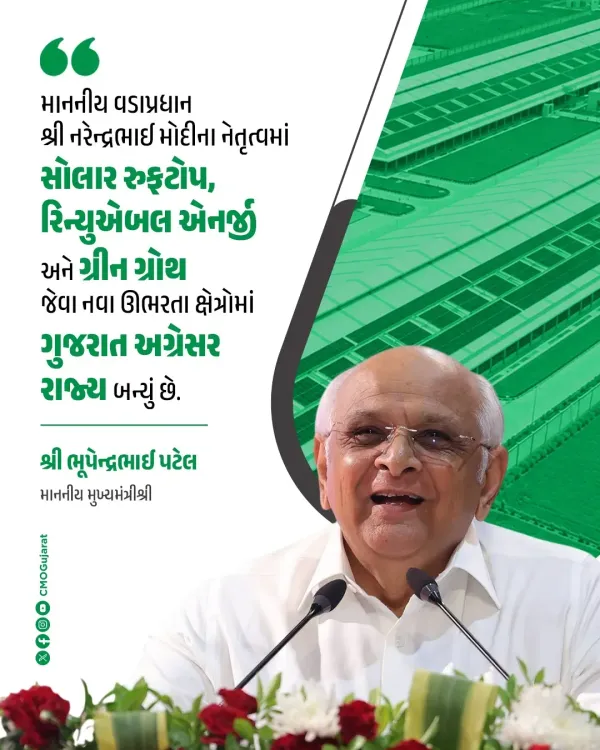
The original Gujarati statement reads: 'માનનીય વડાપ્રધાન શ્રી નરેન્દ્રભાઈ મોદીના નેતૃત્વમાં રિન્યુએબલ એનર્જીના ક્ષેત્રે અગ્રેસર બની ગુજરાત આજે ગ્રીન ગ્રોથની સંકલ્પનાને સાકાર કરી રહ્યું છે' — 'Under the leadership of honourable Prime Minister Narendra Modi, Gujarat, having emerged at the forefront of the renewable energy sector, is today realising the concept of Green Growth.' The statement was tagged with the hashtag #KisanKalyanSeRashtraKalyan — 'From Farmer Welfare to National Welfare' — pointedly linking clean energy expansion to agricultural communities.
From Modi's 2009 Solar Blueprint to Patel's 2026 Claim
The roots of this claim run deep. When Narendra Modi was Chief Minister of Gujarat, his government unveiled the Gujarat Solar Power Policy in 2009 — one of India's earliest state-level solar frameworks, offering developer incentives at a time when utility-scale solar was barely a footnote in national energy planning. That early bet gave the state a structural head-start: dedicated renewable energy parks, established grid infrastructure, and a policy culture oriented toward clean capacity addition.
Bhupendra Patel, who took office in September 2021, has continued that trajectory. His government's framing of 'Green Growth' places Gujarat within the national arc of India's stated goal of 500 GW of non-fossil fuel capacity by 2030 — an ambition that depends heavily on high-output states like Gujarat delivering on solar and wind targets.
The Farmer-Energy Link Behind #KisanKalyanSeRashtraKalyan
The hashtag is not decorative. It signals a deliberate policy bridge: the PM-KUSUM scheme, launched centrally in 2019, has been one of the flagship instruments connecting solar deployment directly to farmers — through subsidised solar pumps, on-farm solar generation, and the ability for farmers to sell surplus power back to the grid. Gujarat has positioned itself as an active implementing state under this framework.
The framing matters politically too. Renewable energy policy in India has historically been sold as an industrial and environmental story. Anchoring it to kisan kalyan — farmer welfare — gives it a rural-welfare dimension that broadens its political constituency well beyond urban consumers and climate advocates.
What Gujarat's Green Ambition Looks Like on the Ground
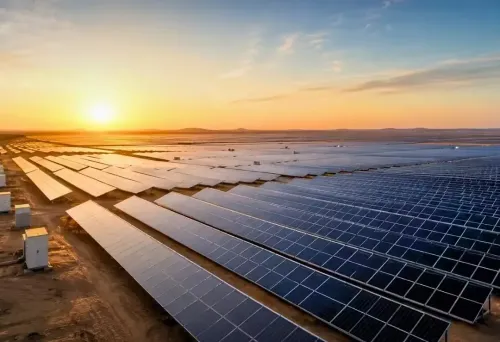
Gujarat carries significant installed solar and wind capacity, hosts large-scale renewable parks, and has been a testing ground for hybrid solar-wind project models. The immediate watch-point is the rollout of new solar-wind hybrid projects in the state and their integration with updated central schemes. As India's 2030 clean-energy deadline approaches, Gujarat's ability to convert political ambition into commissioned gigawatts will be the real measure of whether 'Green Growth' remains a slogan or becomes a statistic.
For now, Chief Minister Patel has drawn the line clearly: Gujarat leads, the model is replicable, and farmer welfare and national energy security are, in his government's telling, the same story told twice.
Point of View
A pattern increasingly visible in how the BJP-led central and state governments market green infrastructure. Gujarat's early-mover advantage in solar, dating to the 2009 policy, gives Patel genuine ground to stand on — though the gap between declared ambition and commissioned capacity will define whether this rhetoric hardens into a governance record or softens into a campaign slogan.
NationPress
30 Oct 2026
Frequently Asked Questions
What did Gujarat CM Bhupendra Patel say about renewable energy?
CM Bhupendra Patel stated on 30 October 2026 that under PM Narendra Modi's leadership, Gujarat has emerged at the forefront of the renewable energy sector and is today realising the concept of 'Green Growth.'
What is the #KisanKalyanSeRashtraKalyan hashtag about?
#KisanKalyanSeRashtraKalyan translates to 'From Farmer Welfare to National Welfare' and is used to link Gujarat's renewable energy expansion — particularly solar schemes — directly to the welfare of farming communities.
What is Gujarat's history in renewable energy?
Gujarat launched one of India's earliest state-level solar frameworks, the Gujarat Solar Power Policy in 2009, under then-Chief Minister Narendra Modi, giving the state a significant head-start in solar and wind capacity development.
What is the PM-KUSUM scheme and how does it relate to Gujarat?
The PM-KUSUM scheme, launched in 2019, promotes solar pumps and decentralised solar energy for farmers. Gujarat has been an active implementing state, using it to bridge renewable energy development with agricultural welfare.
What is India's renewable energy target by 2030?
India has set a national target of 500 GW of non-fossil fuel based power capacity by 2030, with high-output states like Gujarat expected to contribute significantly through solar and wind projects.