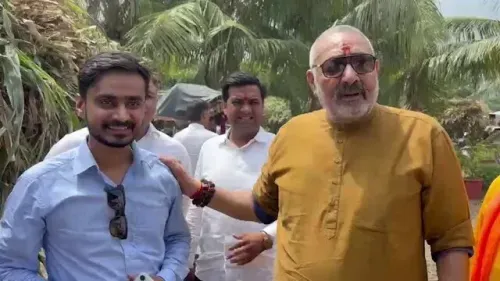
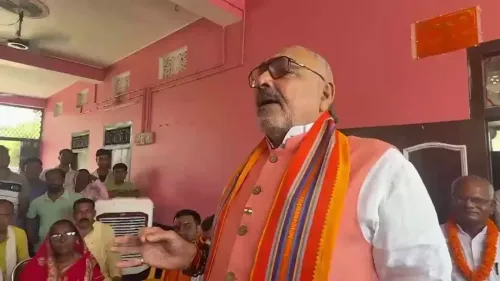
Giriraj Singh calls animal husbandry key to farmer prosperity
Synopsis
Union Textiles Minister Giriraj Singh on 30 October 2026 outlined his vision for rural prosperity anchored in four pillars: healthy livestock, higher milk yields, full utilisation of cattle dung, and continuously rising farmer incomes — framing animal husbandry as the foundation of farm household well-being.
Key Takeaways
Giriraj Singh posted on 30 October 2026 calling animal husbandry the bedrock of farmer prosperity.
His four-point vision covers livestock health, milk production growth, dung utilisation, and rising farm incomes.
The post explicitly highlights gobar (cattle dung) as a productive resource — linking to biogas and organic-fertiliser income streams.
India is the world's largest milk producer but average per-animal productivity remains below global benchmarks, making herd health a live policy concern.
Singh represents Begusarai, Bihar , where livestock is a significant supplementary income source for rural households.
The post uses the word sankalp (resolve), signalling a statement of intent rather than a specific scheme announcement.
Healthy livestock, higher milk yields, zero-waste dung utilisation, and steadily rising farm incomes — Union Textiles Minister Giriraj Singh distilled an entire rural development vision into a single post on X on Friday, 30 October 2026, framing animal husbandry not as a side hustle for India's farmers but as the very foundation of their prosperity.
Posting in Hindi, Singh wrote: 'Pashu swasth rahein, dugdh utpadan badhe, gobar ka pura upyog ho aur kisanon ki amdani mein nirantar vriddhi ho.' ('Let livestock stay healthy, milk production grow, dung be fully utilised, and farmers' income continuously rise.') He called this the 'resolve' behind making animal husbandry the bedrock of farmer well-being.
Why dung economics matter as much as milk
The four pillars Singh names are not rhetorical — they map directly onto a well-established policy logic. Livestock health is the upstream variable: a sick animal produces less milk and less dung, draining a household's twin income streams simultaneously. India is the world's largest milk producer, yet average per-animal productivity remains well below global benchmarks, making herd health a live policy priority. The explicit mention of gobar (cattle dung) is equally pointed. Dung feeds the biogas and organic-fertiliser economy — two channels that convert what would otherwise be waste into cooking fuel and crop inputs, cutting household costs while raising soil quality. For a marginal dairy farmer, that secondary revenue stream can be as consequential as the milk cheque.Animal husbandry as Bihar's rural economic lever
Singh represents Begusarai, Bihar — a constituency where a significant share of rural households depend on livestock alongside crop farming. Bihar has historically lagged in organised dairy infrastructure compared with states like Gujarat or Punjab, making the ambition to 'continuously raise' farm incomes through allied sectors both a national policy talking point and a locally resonant promise. India's broader agricultural policy has long acknowledged that crop farming alone cannot sustain rural incomes through weather shocks and price volatility. Animal husbandry, fisheries, and horticulture are the allied sectors policymakers consistently point to as income buffers — and Singh's post lands squarely in that tradition. The kicker is in his closing word: sankalp — resolve. Not a scheme announcement, not a budget line, but a statement of intent. Whether that resolve translates into programme dollars and state-level rollout is the question Bihar's dairy farmers will be watching.Point of View
And that livestock, dairy, and waste-to-resource chains must be elevated to co-equal status. Coming from a Textiles Minister rather than the Agriculture or Fisheries portfolios, the post reads as a broad BJP ideological signal rather than a departmental announcement. Bihar's relatively underdeveloped organised dairy infrastructure gives the statement local political salience: a senior MP from Begusarai championing livestock economics speaks directly to his constituency's livelihood mix. The real test of the 'resolve' he invokes will be whether upcoming rural development budgets — at the Centre or in Patna — back the sentiment with structural support for veterinary services, cold-chain logistics, and biogas adoption.
NationPress
30 Oct 2026
Frequently Asked Questions
What did Giriraj Singh say about animal husbandry and farmers?
On 30 October 2026, Singh posted that healthy livestock, increased milk production, full use of cattle dung, and continuously rising farm incomes together form the 'resolve' to make animal husbandry the foundation of farmer prosperity.
Why is cattle dung considered important for farmer income in India?
Cattle dung can be converted into biogas for cooking fuel and into organic fertiliser, providing dairy farmers with secondary income streams and reducing household costs beyond the direct earnings from milk.
Is Giriraj Singh related to agriculture or animal husbandry ministry?
Giriraj Singh currently serves as Union Minister of Textiles, not Agriculture or Animal Husbandry; his post reflects a broader BJP policy perspective on rural income rather than a departmental announcement.
How does animal husbandry contribute to rural incomes in Bihar?
In Bihar, a significant share of rural households keep livestock alongside crop farming; dairy income and dung-based products act as financial buffers against crop-season volatility, making animal husbandry a key allied-sector priority.
What is India's position in global milk production?
India is the world's largest milk producer by volume, though average per-animal productivity remains below global benchmarks, making livestock health and dairy-sector investment a continuing policy focus.