CM Bhupendra Patel Credits PM Modi's Vision for Gujarat Semiconductor Ecosystem
Synopsis
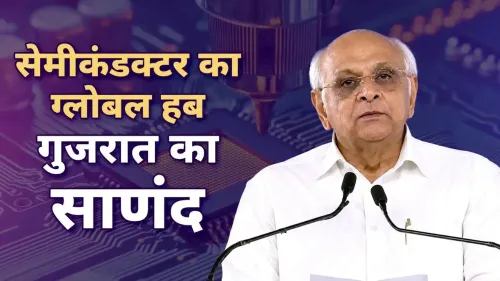
Chief Minister Bhupendra Patel credited PM Narendra Modi's vision for the world-class semiconductor ecosystem emerging in Dholera and Sanand, as Gujarat advances its role as India's primary chip-manufacturing destination under the Rs 76,000 crore India Semiconductor Mission.
Key Takeaways
CM Bhupendra Patel publicly credited PM Narendra Modi's vision for Gujarat's semiconductor ecosystem on 4 July 2026 .
The semiconductor clusters are being developed in Dholera (greenfield smart city) and Sanand (established industrial corridor) in Gujarat.
The India Semiconductor Mission , approved in December 2021 with a Rs 76,000 crore outlay, is the central policy backbone for these investments.
The hashtag #PMinSanand signals PM Modi's direct engagement with the Sanand semiconductor site on the same date.
Gujarat's strategy combines central fiscal support with state-level land, power, and single-window facilitation to attract global chip manufacturers.
The initiative aims to reduce India's dependence on semiconductor imports and integrate the country into global chip supply chains.
Chief Minister Bhupendra Patel on Saturday, 4 July 2026, attributed the world-class semiconductor ecosystem taking shape in Dholera and Sanand to the vision of Prime Minister Narendra Modi, as Gujarat accelerates its push to become India's chip-manufacturing heartland.
Context
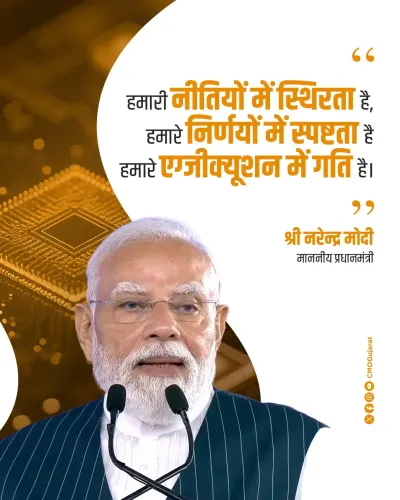
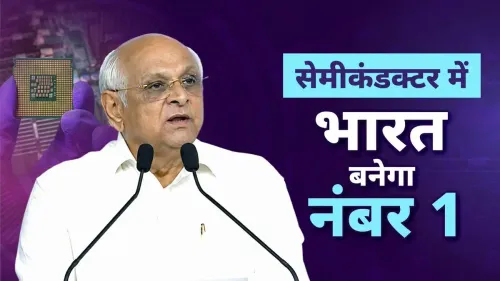
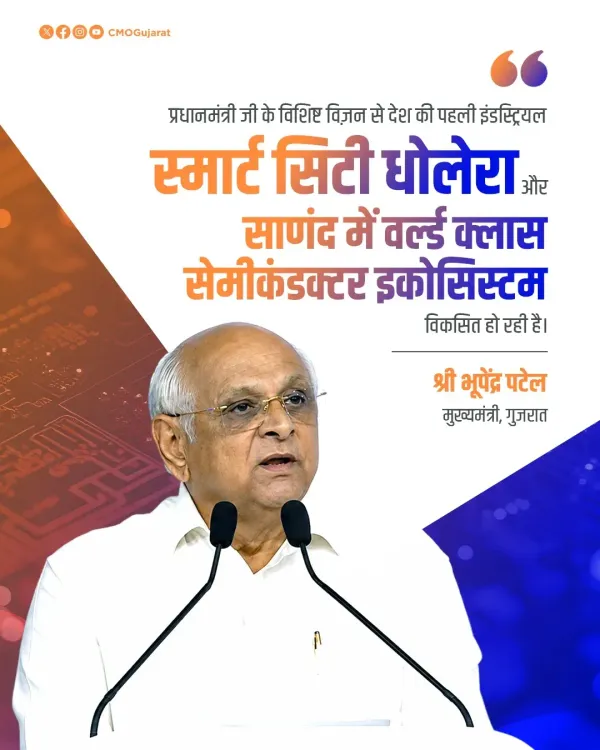
Speaking in the context of semiconductor industry development, CM Patel stated — in Gujarati — that the 'world-class ecosystem for semiconductor industries being developed in Dholera and Sanand is the result of the vision of the honourable Prime Minister.' The remarks were posted by the Chief Minister's Office of Gujarat on X under the hashtags #SemiconHubBharat and #PMinSanand, signalling an active engagement by the Prime Minister with the Sanand semiconductor corridor.
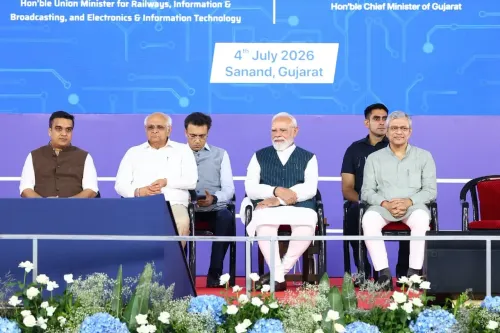
The post's hashtag #PMinSanand indicates PM Modi was present at or associated with an event in Sanand on the same date, consistent with the broader national push to showcase Gujarat's semiconductor credentials on a high-profile platform.
Policy Backdrop
The semiconductor ambitions of Gujarat rest on two pillars. At the national level, the India Semiconductor Mission (ISM), approved by the Union Cabinet in December 2021 with an outlay of Rs 76,000 crore, provides fiscal support for fabrication, assembly, testing, and packaging units. At the state level, the Gujarat Industrial Policy 2020 and subsequent semiconductor-specific incentives have positioned the state to attract major investments.
Dholera, a greenfield smart city developed under the Delhi-Mumbai Industrial Corridor project, has been designated as a dedicated semiconductor manufacturing hub. Sanand, already an established automotive and electronics cluster, is now expanding into advanced semiconductor assembly and packaging, benefiting from existing industrial infrastructure and skilled workforce availability.
India's drive for chip self-reliance accelerated amid global supply-chain disruptions and rising US-China technology tensions, with multiple states competing to host semiconductor units. Gujarat has positioned itself at the front of this race by combining central fiscal support with state-level land allocation, power facilitation, and single-window clearances.
Stakeholders and Impact
The semiconductor ecosystem in Dholera and Sanand stands to benefit a wide range of stakeholders — from global and domestic chip manufacturers seeking a foothold in India's growing electronics market, to the state's engineering and technical workforce that stands to gain high-skilled employment. Local industrial clusters in both locations are expected to see ancillary growth in logistics, precision components, and specialised chemicals.
For India's broader Atmanirbhar Bharat agenda, a functioning semiconductor cluster in Gujarat would reduce the country's dependence on chip imports — a vulnerability exposed sharply during the 2020-21 global chip shortage — and integrate Indian manufacturing into global semiconductor supply chains.
What's Next
Analysts and industry observers will watch for specific groundbreaking ceremonies, capacity-expansion announcements, or investment commitments tied to the Prime Minister's visit to Sanand. Future milestones for the India Semiconductor Mission review and the next Vibrant Gujarat Global Summit are expected to serve as key platforms for further announcements on the state's chip-manufacturing roadmap.
As Gujarat cements its identity as India's semiconductor gateway, CM Patel's remarks underline that the state government intends to keep the national leadership's vision front and centre — both as political framing and as a signal of continued policy continuity for investors evaluating long-term commitments in Dholera and Sanand.
Point of View
Maximising the optics for both state and central leadership. The move fits a consistent pattern in BJP-governed states of framing economic achievements as extensions of the Prime Minister's national vision, reinforcing the party's narrative of technology-led development under Atmanirbhar Bharat. For investors, the high-level political endorsement provides a signal of policy continuity that is often as important as fiscal incentives when evaluating decade-long semiconductor commitments. The broader implication is that Gujarat is actively competing not just with other Indian states but with regional rivals like Vietnam and Malaysia for a seat in the restructured global semiconductor supply chain.
NationPress
3 Oct 2026
Frequently Asked Questions
What is the semiconductor ecosystem being developed in Dholera and Sanand?
Dholera and Sanand in Gujarat are being developed as India's primary semiconductor manufacturing destinations, hosting chip fabrication, assembly, testing, and packaging facilities backed by the central government's India Semiconductor Mission and state-level industrial incentives.
What is the India Semiconductor Mission and how much funding does it have?
The India Semiconductor Mission is a Union Cabinet-approved programme from December 2021 with an outlay of Rs 76,000 crore, designed to provide fiscal support for domestic semiconductor fabrication, assembly, testing, and design-linked units.
Why is Dholera important for India's semiconductor plans?
Dholera is a greenfield smart city developed under the Delhi-Mumbai Industrial Corridor and has been specifically designated as a semiconductor manufacturing hub, offering planned infrastructure, land availability, and power facilities for large-scale chip plants.
What did CM Bhupendra Patel say about PM Modi and Gujarat's semiconductor industry?
CM Patel stated that the world-class semiconductor ecosystem being developed in Dholera and Sanand is the direct result of Prime Minister Narendra Modi's vision, making the remarks during a period when PM Modi was visiting Sanand.
How does Gujarat's semiconductor push fit into India's Atmanirbhar Bharat strategy?
Gujarat's semiconductor clusters are a key pillar of the Atmanirbhar Bharat self-reliance initiative, aiming to reduce India's dependence on chip imports — a vulnerability exposed during the 2020-21 global chip shortage — and integrate Indian manufacturing into global supply chains.