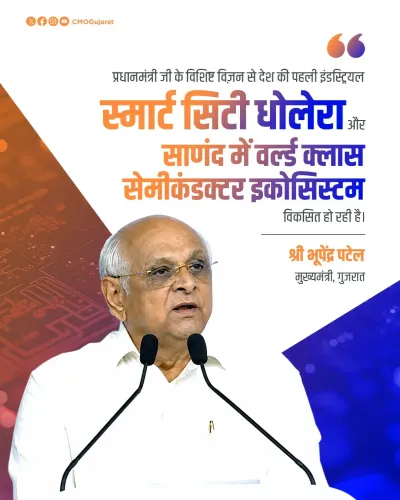
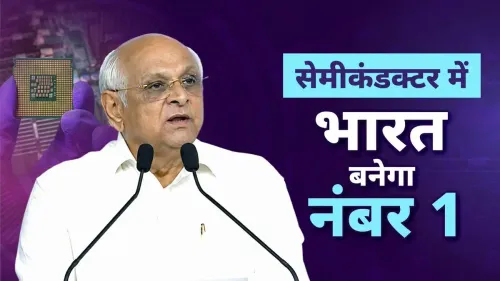
CM Bhupendra Patel Highlights Gujarat's Semiconductor Human Story
Synopsis
Gujarat Chief Minister Bhupendra Patel has spotlighted the human story behind the state's semiconductor rise, noting that young people from tribal and humble backgrounds received overseas chip training and are now employed at a cutting-edge facility in Sanand, reflecting PM Modi's vision for inclusive tech growth.
Key Takeaways
Gujarat CM Bhupendra Patel highlighted on 4 July 2026 that youth from tribal regions and humble backgrounds received world-class semiconductor training overseas.
These trained individuals are now contributing to a cutting-edge semiconductor facility in Sanand, Gujarat .
The initiative is framed as a realisation of Prime Minister Narendra Modi 's vision of empowering India's youth in future technologies.
The India Semiconductor Mission (approved 2021 ) and Gujarat Semiconductor Policy 2022-2027 form the policy backbone of this push.
CM Patel emphasised gender inclusion, specifically noting that 'many daughters' were part of the trained cohort.
Gujarat has positioned Sanand as a leading hub under India's broader Atmanirbhar Bharat and Techade semiconductor agenda.
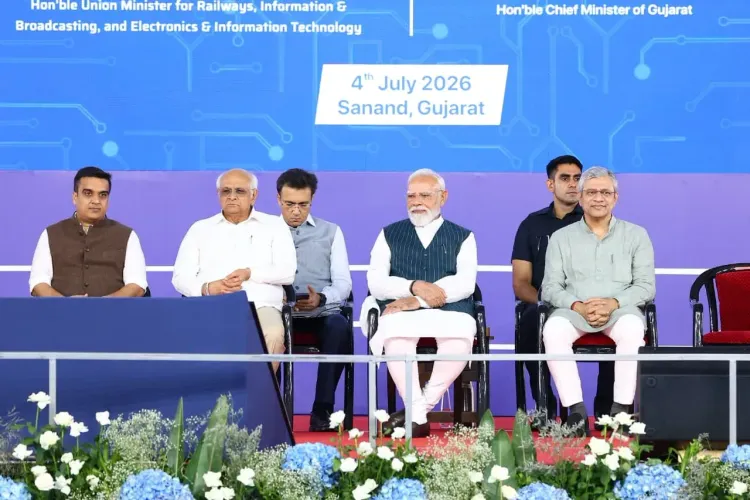
Gujarat Chief Minister Bhupendra Patel on Saturday, 4 July 2026, highlighted the human dimension of the state's semiconductor journey, noting that young men and women — including many daughters — from Gujarat and other states, particularly from tribal regions and humble backgrounds, received world-class semiconductor training overseas and are now contributing to a cutting-edge facility back home.
Context
The Chief Minister's post, shared under the hashtags #SemiconHubBharat and #PMinSanand, coincided with what appears to be a high-profile visit by Prime Minister Narendra Modi to Sanand, the industrial hub in Gujarat that has emerged as a focal point for the country's semiconductor ambitions. Patel described the stories of these young trainees as 'among the most inspiring aspects of this journey,' underscoring the social equity angle of an industry often associated with elite technical talent.
The post credited Prime Minister Modi's vision of 'empowering India's youth with opportunities in the technologies of tomorrow' as the driving force behind the programme, framing the trainees' success as a direct outcome of that national agenda.
Policy Backdrop
India's semiconductor push is anchored in the India Semiconductor Mission, approved in 2021, which provides financial incentives for semiconductor fabrication, assembly, testing and design units across the country. Gujarat complemented this with its own Gujarat Semiconductor Policy 2022-2027, offering capital subsidies and infrastructure support to attract chip-related investments.
Sanand, already home to automobile and electronics manufacturing, has been positioned as a preferred destination under both the central and state-level incentive frameworks. The emphasis on skilling youth from under-represented communities — including tribal regions — aligns with the broader Atmanirbhar Bharat goal of inclusive participation in advanced manufacturing, not just industrial output metrics.
CM Patel also invoked the concept of India's 'Techade' — a term used by the government to describe the current decade as India's technology decade — saying that 'Gujarat will continue to stay at the forefront of innovation, advanced manufacturing and future-ready industries.'
Stakeholders and Impact
The most direct beneficiaries highlighted in the post are young people from tribal regions and economically modest backgrounds across Gujarat and several other states who underwent overseas semiconductor training. Their placement in a domestic facility marks a full cycle: international skilling followed by local employment in a high-value sector.
For the broader semiconductor ecosystem, this signals that India's chip ambitions are beginning to generate measurable human capital outcomes, not merely infrastructure announcements. The reference to 'daughters' is a deliberate nod to gender inclusion in a sector historically dominated by male engineers.
Industry observers and policymakers are watching whether this cohort of overseas-trained workers can form the seed talent pool for further expansion of semiconductor assembly and testing capacity in Gujarat.
What's Next
The immediate focus will be on the scale and pace of additional semiconductor assembly and testing units coming online in Sanand and elsewhere in Gujarat. Formal employment and placement data from the overseas-trained cohorts, once released, will be a key metric for evaluating the programme's inclusive growth claims.
As India seeks to reduce its dependence on imported semiconductors and position itself as a viable alternative in global chip supply chains, the success of skilling initiatives targeting youth from marginalised communities could become a model replicated in other states competing for semiconductor investments.
Point of View
Pivoting the semiconductor narrative from crore-level investments to individual human journeys from tribal Gujarat. By centering 'daughters' and youth from humble backgrounds, the BJP-led state government is broadening the political appeal of its tech agenda beyond urban, upper-middle-class constituencies. The timing around a Prime Ministerial visit to Sanand is also significant — it positions Gujarat as the model state for translating central semiconductor policy into on-ground human capital outcomes. If placement data backs these claims, it could sharpen Gujarat's competitive edge in attracting the next wave of semiconductor investments over rival states.
NationPress
3 Oct 2026
Frequently Asked Questions
What is the semiconductor facility in Sanand, Gujarat?
Sanand is an industrial area in Gujarat that has been developed as a key hub for semiconductor and electronics manufacturing under both the central India Semiconductor Mission and the Gujarat Semiconductor Policy 2022-2027, attracting chip assembly and testing investments.
What is the India Semiconductor Mission?
The India Semiconductor Mission is a central government programme approved in 2021 that provides financial incentives for setting up semiconductor fabrication, assembly, testing and design units across India, aimed at reducing the country's dependence on chip imports.
Who are the youth trained overseas in semiconductors from Gujarat?
According to CM Bhupendra Patel's post, young men and women from Gujarat and several other states — particularly from tribal regions and humble backgrounds — received world-class semiconductor training overseas and are now employed at a cutting-edge facility in Gujarat.
What is India's Techade?
'Techade' is a term used by the Indian government to describe the current decade as India's technology decade, reflecting ambitions to lead in sectors such as semiconductors, artificial intelligence and advanced manufacturing.
What is the Gujarat Semiconductor Policy?
The Gujarat Semiconductor Policy 2022-2027 is a state-level initiative offering capital subsidies and infrastructure support to attract semiconductor and chip-related investments to Gujarat, complementing the central India Semiconductor Mission.