CM Bhupendra Patel Honours Deendayal Upadhyaya on Birth Anniversary
Synopsis
Gujarat Chief Minister Bhupendra Patel marked Pandit Deendayal Upadhyaya's birth anniversary on 25 September 2026, honouring the architect of Antyodaya and Integral Humanism and affirming that his vision of reaching the last person in society remains the guiding principle of BJP governance today.
Key Takeaways
Gujarat Chief Minister Bhupendra Patel paid tribute to Pandit Deendayal Upadhyaya on his birth anniversary, 25 September 2026 .
Patel described Antyodaya — the principle of uplifting the last person in society — as the 'fundamental cornerstone' of good governance and current policy.
Upadhyaya articulated both Integral Humanism and Antyodaya as Bharatiya Jana Sangh president in the mid-1960s .
The Antyodaya Anna Yojana , launched in 2000 , translated his philosophy into a national food-security programme for the poorest households.
BJP governments have consistently used Antyodaya as a governing framework for welfare schemes focused on marginalised communities since 2014 .
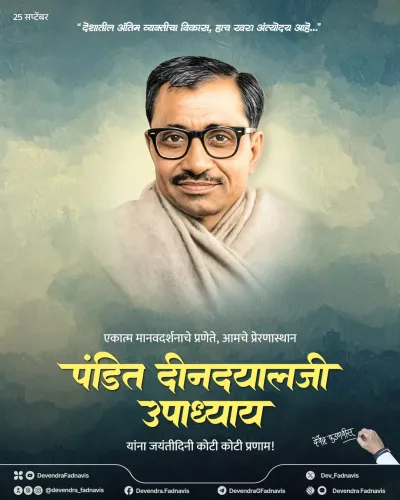
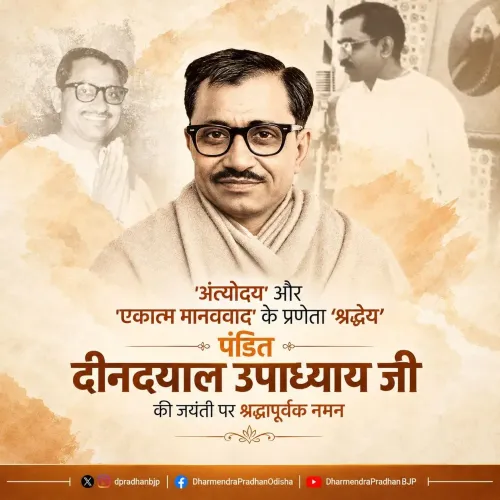
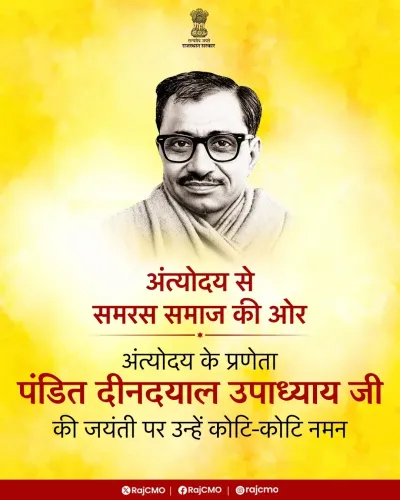
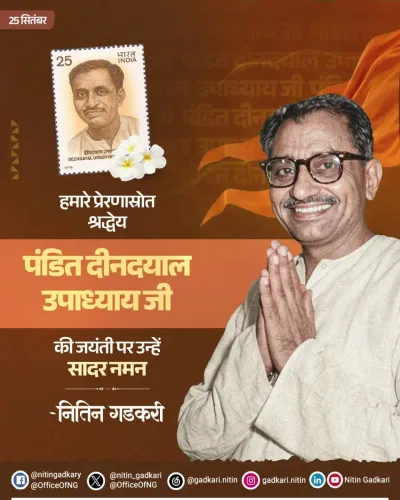
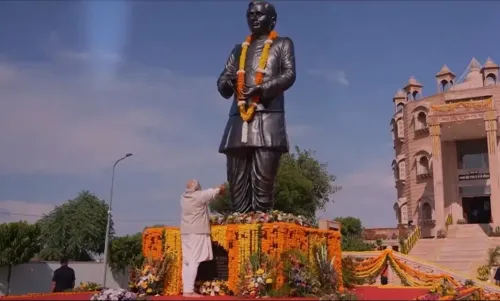
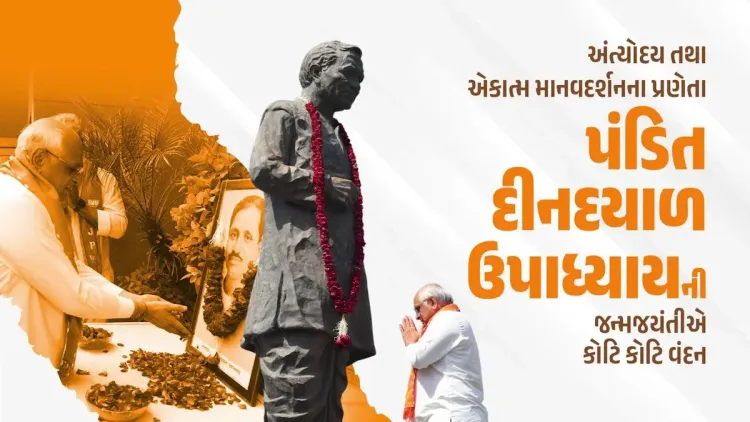
On the birth anniversary of one of independent India's most consequential political philosophers, Gujarat Chief Minister Bhupendra Patel paid tribute to Pandit Deendayal Upadhyaya on Friday, 25 September 2026, calling his Antyodaya framework the foundational pillar of good governance today.
Writing in Gujarati, CM Patel offered 'koti koti vandan' — 'a million salutations' — to the thinker, describing him as a visionary philosopher and the originator of Ekatma Manavdarshan (Integral Humanism) and Antyodaya. 'The idea of Antyodaya that he presented — to ensure the fruits of development and welfare reach the last person at the margins of society — is today the fundamental cornerstone of our good governance and policies,' Patel wrote.
The philosophy that shaped a political movement
Pandit Deendayal Upadhyaya articulated both Integral Humanism and Antyodaya as president of the Bharatiya Jana Sangh in the mid-1960s. Integral Humanism argued for a uniquely Indian model of political economy that centred the individual within family, society, and nation — rejecting both Western capitalism and Soviet socialism as alien frameworks. Antyodaya, literally 'rise of the last', pushed that logic further: development is only real when it reaches the weakest, most marginalised person in society.
These were not purely theoretical positions. The Antyodaya Anna Yojana, launched nationally in 2000, translated the concept into policy by delivering heavily subsidised foodgrains to the poorest households — a direct programmatic inheritance of Upadhyaya's original framework.
Antyodaya as a governing grammar since 2014
Since 2014, BJP governments at both the central and state levels have consistently anchored welfare and development schemes in the language of Antyodaya — housing for all, food security, livelihood support, and last-mile delivery framed explicitly as fulfilling Upadhyaya's vision. Gujarat, under successive BJP administrations, has aligned state-level initiatives with the same principle.
CM Patel's tribute underscores how Upadhyaya remains both a moral reference point and an active policy vocabulary for the party. The anniversary is not a historical footnote — it is a live governing argument about who development is for and how far it must reach.
A life 'dedicated to the upliftment and empowerment of the deprived and to nation-building,' Patel wrote, 'will always inspire us.' The standard set in the 1960s, the Chief Minister suggested, is still the measure by which Gujarat's policies must be judged.
Point of View
The Gujarat Chief Minister frames everyday welfare policy as the living expression of a 1960s philosophical tradition. This rhetorical move serves a dual purpose: it anchors BJP's developmental claims in a moral and intellectual lineage that pre-dates the party itself, and it positions the government as the authentic heir to a non-Congress nationalist vision. On the anniversary of a foundational thinker, the tribute is as much a governing manifesto as a mark of respect.
NationPress
25 Sept 2026
Frequently Asked Questions
Who was Pandit Deendayal Upadhyaya?
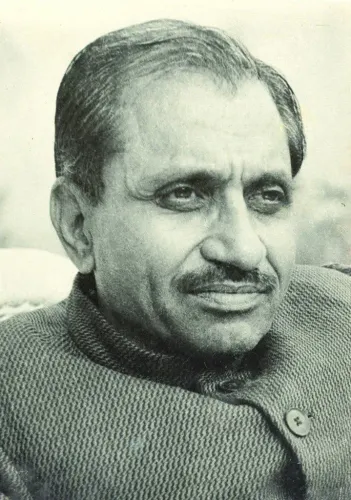
Pandit Deendayal Upadhyaya was an Indian political philosopher and president of the Bharatiya Jana Sangh in the 1960s, best known for developing the philosophies of Integral Humanism and Antyodaya, which emphasised indigenous economic thought and the upliftment of the poorest in society.
What is Integral Humanism?
Integral Humanism is a political philosophy developed by Deendayal Upadhyaya that argues for a uniquely Indian model of political economy, placing the individual within the context of family, society, and nation, and rejecting both Western capitalism and Soviet-style socialism as unsuitable for India.
When is Deendayal Upadhyaya's birth anniversary?
Pandit Deendayal Upadhyaya's birth anniversary falls on 25 September each year. In 2026, Gujarat Chief Minister Bhupendra Patel marked the occasion with a tribute on X.
How has BJP used Antyodaya as a policy framework?
Since 2014, BJP governments at the central and state levels have consistently framed welfare and development schemes — covering housing, food security, and livelihood support — in the language of Antyodaya, presenting last-mile delivery to marginalised communities as the fulfilment of Upadhyaya's original vision.