CM Pema Khandu Reviews Mission Shikshit Arunachal School Plans
Synopsis
CM Pema Khandu met with State Planning & Investment and Education Department officials to overhaul Mission Shikshit Arunachal's next phase, replacing uniform infrastructure templates with school-by-school ground assessments verified by school heads and district records.
Key Takeaways
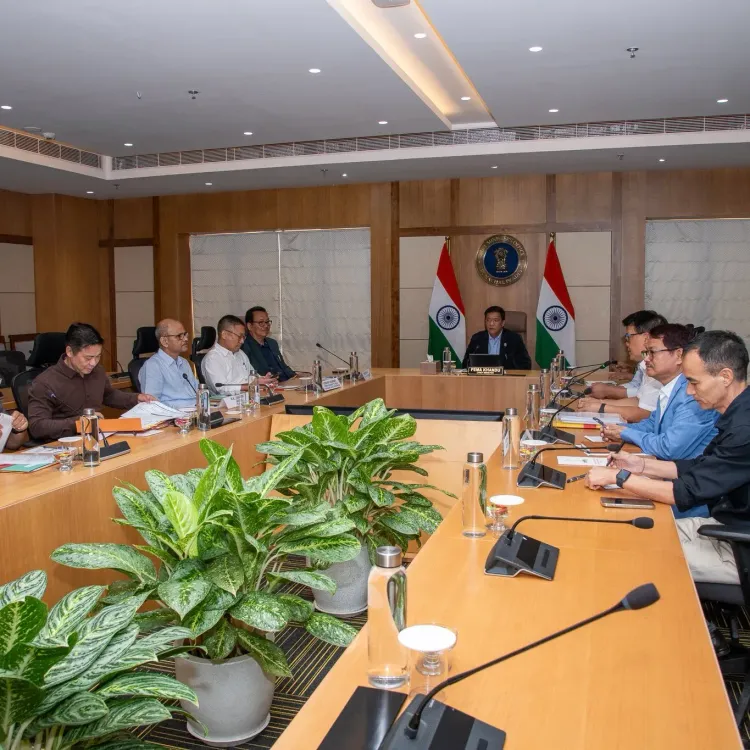
CM Pema Khandu chaired a review meeting with the State Planning & Investment Department and Education Department on October 3, 2026 .
The next phase of Mission Shikshit Arunachal will move away from uniform infrastructure planning toward a school-by-school assessment model.
Infrastructure requirements will be verified on the ground in direct consultation with school heads.
Findings will be cross-checked against existing records to ensure accuracy before any project is sanctioned.
Each district will use the verified data to independently identify and prioritise genuinely required projects.
Before a single brick is laid, Arunachal Pradesh wants to know exactly what each school actually needs. Chief Minister Pema Khandu sat down with officials of the State Planning & Investment Department and the Education Department on Saturday, October 3, 2026, to review the next phase of Mission Shikshit Arunachal — with a sharp new directive at its centre: no more blanket infrastructure decisions.
School-by-School Assessment Replaces One-Size-Fits-All Approach
The core shift is deceptively simple but operationally significant. Instead of applying a uniform template of infrastructure upgrades across schools, the state will now move toward a granular, school-by-school assessment of what is genuinely required. Requirements will be verified on the ground, in direct consultation with school heads, and cross-checked against existing records — a three-layered filter designed to separate real gaps from paper assumptions.
CM Khandu framed it plainly: 'We need to know exactly what every school needs before we decide what to build.' That single sentence signals a pivot from top-down infrastructure planning to demand-driven, evidence-backed investment — a meaningful upgrade in how a frontier state with challenging terrain allocates scarce public funds.
What Mission Shikshit Arunachal Is Built to Do
Mission Shikshit Arunachal is the state government's flagship education reform initiative, aimed at improving learning outcomes and physical infrastructure across schools in one of India's most geographically demanding states. Arunachal Pradesh, with its dispersed population across high-altitude valleys and remote districts, faces unique challenges in school delivery — teacher vacancies, access gaps, and ageing infrastructure compound each other in ways that generic policy rarely captures.
By building the next phase around district-level prioritisation informed by ground-verified data, the government is attempting to make every rupee of school spending count — especially in districts where the cost of construction is high and the margin for error is low.
Districts Get the Final Call on Priorities
Once the school-by-school findings are compiled and verified, each district will use that data to identify and prioritise the projects that are genuinely required — rather than receiving a centrally assigned list. This decentralised accountability is the mechanism's real muscle. It places the burden of evidence at the local level, where the knowledge actually lives, and gives district administrations both the information and the responsibility to make defensible spending decisions.
With school heads consulted directly and records cross-checked, the process also creates a paper trail that strengthens public accountability. In a state where infrastructure investment has historically been hard to monitor across remote terrain, that traceability matters.
The next phase of Mission Shikshit Arunachal will not be built on assumptions. It will be built on data — school by school, district by district.
Point of View
School-by-school assessment under Mission Shikshit Arunachal reflects a broader national trend of moving away from one-size-fits-all welfare delivery toward granular, data-anchored public investment. For a state like Arunachal Pradesh — where remote terrain inflates construction costs and infrastructure gaps compound learning deficits — the efficiency dividend of getting priorities right the first time is disproportionately large. Khandu's insistence on consulting school heads directly also signals a shift in accountability architecture, pushing decision-making closer to communities rather than keeping it locked in Itanagar. If the assessment process is executed with genuine rigour, it could serve as a replicable model for infrastructure planning in other hill states facing similar logistical constraints.
NationPress
3 Oct 2026
Frequently Asked Questions
What is Mission Shikshit Arunachal?
Mission Shikshit Arunachal is the Arunachal Pradesh government's flagship programme to improve school education quality and infrastructure across the state, targeting learning outcomes and physical facility upgrades.
What did CM Pema Khandu announce about school infrastructure?
CM Pema Khandu directed that the next phase of Mission Shikshit Arunachal will use a school-by-school ground assessment — verified with school heads and cross-checked with records — rather than applying uniform infrastructure decisions.
Which departments were involved in the Mission Shikshit Arunachal review?
The review meeting included officials from the State Planning & Investment Department and the Education Department of Arunachal Pradesh.
How will district-level school infrastructure projects be decided in Arunachal Pradesh?
Each district will use ground-verified, school-by-school assessment findings to independently identify and prioritise the infrastructure projects that are genuinely required in their area.
Why is a school-by-school approach better for Arunachal Pradesh?
Arunachal Pradesh's dispersed population and difficult terrain mean infrastructure needs vary significantly between schools; a granular assessment ensures funds target real gaps rather than assumed uniform requirements.