Trump Promises $5,000 to Every Adult if GOP Wins 2026 Midterms
Synopsis
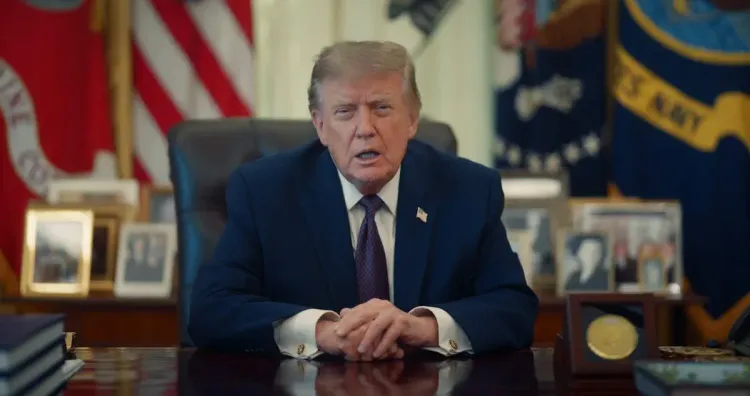
US President Donald Trump has promised a $5,000 direct cash payment to every adult American citizen — but only if Republicans win both the House of Representatives and the Senate in the 2026 Midterm Elections, raising immediate questions about funding, legality, and electoral intent.
Key Takeaways
Trump's pledge: Every adult US citizen receives $5,000 if Republicans win both the House and Senate in the 2026 Midterm Elections .
With roughly 260 million US adults, the total cost of the promise would approach $1.3 trillion — comparable to the entire annual federal discretionary budget.
No funding mechanism, legislative text, or programme framework accompanied the announcement.
The US Constitution grants Congress, not the President, power over federal appropriations — meaning Trump cannot unilaterally 'sign checks' without a new law.
The pledge mirrors pandemic-era stimulus checks structurally but is five times larger per recipient than the last round of COVID payments.
The announcement turns personal financial stakes into a direct midterm mobilisation tool for Republican voters.
A $5,000 check for every adult American — that is the headline promise US President Donald Trump dropped on Saturday, October 3, 2026, in a post that instantly detonated across political circles. The offer comes with one condition: Republicans must win both the House of Representatives and the Senate in the 2026 Midterm Elections.
The Pledge in Trump's Own Words
Trump's post was blunt and unambiguous: 'If Republicans win the House of Representatives and the Senate in the 2026 Midterm Elections, I'm going to give all adult citizens in the United States of America, $5,000!' He closed with characteristic confidence — 'I look forward to signing those checks' — framing the promise as a near-certainty rather than a conditional aspiration.
The announcement is structured as an explicit electoral incentive: a direct cash transfer contingent on a specific partisan outcome at the ballot box. No legislative text, no funding mechanism, and no programme name accompanied the pledge.
What $5,000 Per Adult Actually Means at Scale
The United States has roughly 260 million adults. At $5,000 per person, a universal payout at that level would require approximately $1.3 trillion in federal outlays — a figure comparable to the entire annual discretionary budget of the US federal government. Whether funded through new legislation, existing surpluses, or deficit spending is entirely unspecified in the post.
The promise echoes, in much larger form, the direct stimulus checks issued during the COVID-19 pandemic — payments of up to $1,400 per adult that required full Congressional legislation and Treasury Department logistics to execute. A programme five times that size would demand far greater statutory scaffolding.
The 2026 Midterm Stakes
The 2026 Midterm Elections are the first major federal electoral contest of Trump's second term. Republicans currently hold majorities in both chambers, but midterms historically test the sitting president's party. By tying a massive cash promise to a GOP sweep, Trump is effectively turning the midterms into a referendum not just on his presidency but on voters' wallets.
The political calculus is sharp: a promise of direct personal financial benefit gives low-enthusiasm Republican voters a visceral, tangible reason to turn out — while forcing Democratic candidates to respond to or rebut a headline number that every voter can immediately picture.
Legal and Constitutional Questions
Presidential promises of cash transfers bypass a fundamental constitutional reality: Congress controls the purse. A president cannot unilaterally authorise or 'sign checks' of this magnitude without an appropriations bill passed by both chambers and signed into law. Critics will argue the pledge is either performative or a preview of a future legislative push. Supporters will read it as Trump's governing intention if given a full Republican majority. Either way, the legal path from this post to an actual cheque is long.
The announcement is certain to trigger scrutiny over whether linking electoral outcomes to personal financial payouts raises ethical or even constitutional concerns about the use of public funds as electoral motivation — a debate that will run well into the campaign cycle.
Whether the pledge becomes law, legislation, or campaign lore, one thing is clear: Trump has set the 2026 midterms on a new axis — and every candidate running in November now has to answer for a number that fits in a single sentence.
Point of View
000 pledge is a textbook base-mobilisation gambit that converts an abstract midterm into a personal financial transaction for every American voter. By conditioning the payout on a full Republican sweep, he simultaneously raises the stakes for low-turnout GOP constituencies and forces Democrats to campaign against a headline number rather than on conventional policy ground. The constitutional reality — that Congress controls appropriations and no executive can unilaterally distribute trillions — means the promise is as much a legislative intent signal as an actual programme, previewing what a fully Republican Congress might be asked to pass. The move fits a pattern of Trump using direct-transfer rhetoric to collapse complex governance questions into a single, emotionally resonant figure.
NationPress
3 Oct 2026
Frequently Asked Questions
Will Trump actually give $5,000 to every American?
Trump has pledged to do so if Republicans win both the House and Senate in the 2026 Midterm Elections, but any such payment would require an act of Congress since the President cannot unilaterally authorise federal cash disbursements of this scale.
How much would Trump's $5,000 promise cost in total?
With approximately 260 million adults in the United States, a $5,000 payment to each would cost around $1.3 trillion — a sum comparable to the entire annual discretionary federal budget.
When are the 2026 US Midterm Elections?
The 2026 US Midterm Elections are scheduled for November 2026, when all 435 House seats and roughly one-third of Senate seats will be contested.
Is Trump's $5,000 check promise legal?
The US Constitution gives Congress — not the President — control over federal spending. Trump could not sign such checks without legislation passed by both chambers, making the pledge a statement of intent rather than an executive action.
How does Trump's $5,000 promise compare to COVID stimulus checks?
COVID-era stimulus payments reached up to $1,400 per adult and required full Congressional legislation and Treasury logistics. Trump's proposed $5,000 payment is more than three times larger per person and currently has no legislative backing.