Trump Urges House Republicans to Pass Budget Resolution
Synopsis
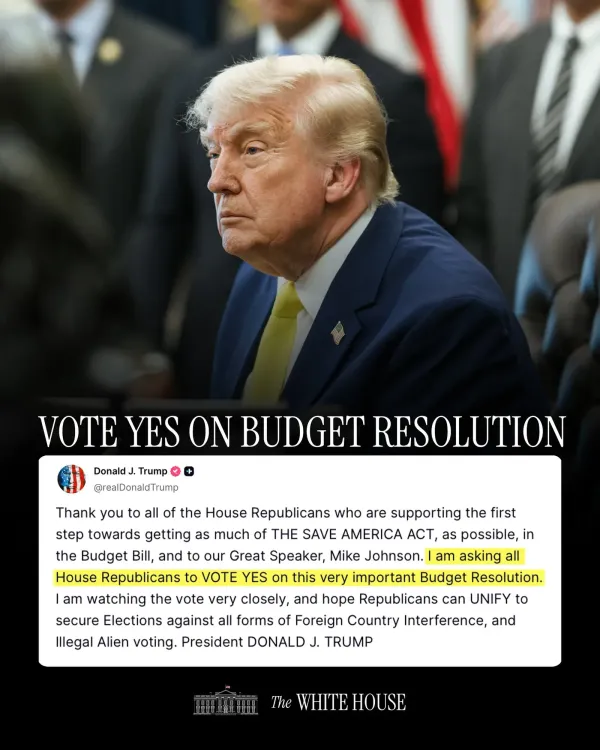
President Trump, in a statement shared by The White House on 21 July 2026, called on all House Republicans to vote yes on the Budget Resolution, framing it as essential to election security and preventing non-citizen voting. The appeal signals a high-stakes unity test for the Republican majority.
Key Takeaways
President Trump publicly urged every House Republican to vote yes on the Budget Resolution on 21 July 2026 .
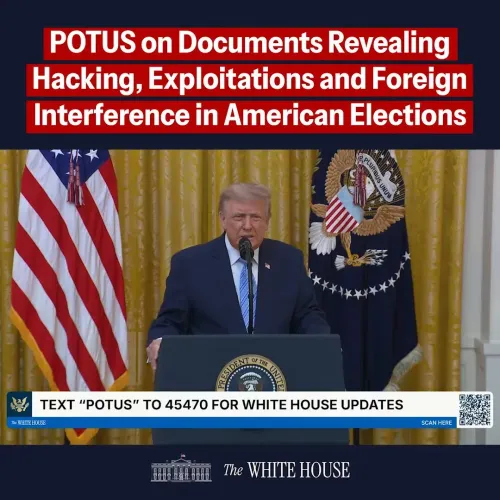
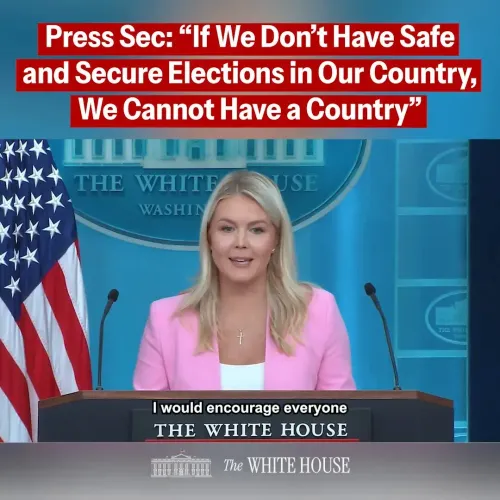
Trump tied the fiscal measure to preventing 'Foreign Country Interference' in elections and stopping 'Illegal Alien voting.' The President stated he is 'watching the vote very closely,' framing it as a test of Republican unity.
Using must-pass budget measures to advance election-integrity and immigration provisions is a pattern from prior congressional cycles.
Downstream Senate consideration and possible conference negotiations will determine whether election-related provisions survive into law.
Election administrators nationwide could face new federal mandates if the resolution's provisions are enacted.
The White House on Tuesday, 21 July 2026 shared a direct appeal from President Donald Trump calling on all House Republicans to vote in favour of a pending Budget Resolution, linking the fiscal measure to election security and restrictions on non-citizen voting.
Context
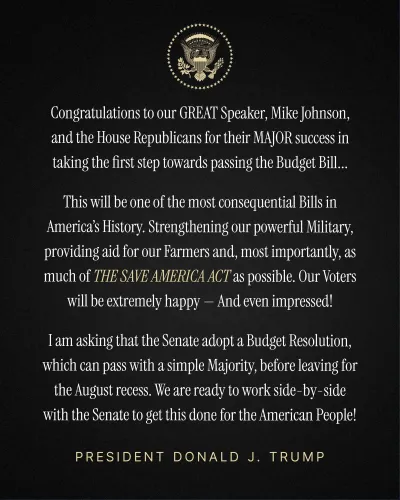
In the statement shared by The White House, President Trump declared: 'I am asking all House Republicans to VOTE YES on this very important Budget Resolution. I am watching the vote very closely, and hope Republicans can UNIFY to secure Elections against all forms of Foreign Country Interference, and Illegal Alien voting.' The appeal was accompanied by the American flag emoji, underscoring its nationalistic framing.
The Budget Resolution is an annual congressional blueprint that sets discretionary spending levels for the federal government. While not itself a spending bill, it can incorporate policy provisions — in this case, provisions tied to election integrity and immigration enforcement.
Policy Backdrop
President Trump has consistently prioritised election security since his first term. In 2017, he established the Presidential Advisory Commission on Election Integrity to examine vulnerabilities in voting systems, a body that drew significant political controversy before its dissolution.
Following the 2020 presidential election, multiple Republican-led states enacted election-integrity statutes that strengthened voter identification requirements and added citizenship verification steps. The current appeal continues that legislative arc, now at the federal level through a fiscal vehicle. Using must-pass spending measures to advance immigration enforcement and voting rules has become a recurring strategy in budget and appropriations negotiations.
Stakeholders and Impact
House Republicans, who hold the majority in the chamber, are the immediate audience for Trump's call to action. The President's explicit statement that he is 'watching the vote very closely' signals he views this as a loyalty and unity test for the caucus.
Election administrators across the country could face new federal mandates if provisions on foreign-influence prevention and voter-roll verification are embedded in the resolution and eventually signed into law. The linkage of a fiscal measure to election rules also sets the stage for a contentious fight with Senate Democrats, who have historically opposed such riders.
What's Next
Attention will now turn to the House floor vote on the Budget Resolution and any amendments specifically addressing voter rolls or foreign-influence provisions. A successful House passage would send the measure to the Senate, where bipartisan thresholds and procedural rules could complicate or strip out the election-related provisions.
The outcome of this vote will likely shape the contours of subsequent appropriations negotiations and signal how unified House Republicans remain behind the Trump administration's dual agenda of fiscal discipline and election-integrity enforcement heading into the remainder of 2026.
Point of View
Raising the political stakes of what is ordinarily a procedural vote. By declaring he is 'watching closely,' Trump converts the Budget Resolution into a loyalty metric for the House caucus, a tactic that has historically tightened Republican discipline but also sharpened Democratic opposition. The explicit linkage of spending legislation to voter-roll and foreign-interference provisions continues a pattern of using must-pass vehicles to advance contested policy, a strategy that has repeatedly generated gridlock in the Senate. How House Republicans respond will reveal the durability of Trump's grip on the caucus heading into the second half of 2026.
NationPress
20 Oct 2026
Frequently Asked Questions
What is the US Budget Resolution Trump wants House Republicans to pass?
The Budget Resolution is an annual congressional blueprint that sets discretionary federal spending levels and can include policy provisions; Trump wants it to carry election-security and non-citizen voting restrictions.
Why is Trump linking the Budget Resolution to election security?
Trump has made election integrity a signature issue since 2017 and is using the must-pass budget measure to advance restrictions on foreign election interference and non-citizen ballots.
What does 'Illegal Alien voting' mean in Trump's statement?
Trump uses the term to refer to votes allegedly cast by non-citizens; federal law already prohibits non-citizens from voting in federal elections, but Republicans seek stricter verification mechanisms.
What happens if the Budget Resolution passes the House?
It would move to the Senate, where procedural rules and bipartisan thresholds could complicate or strip out the election-related provisions before a final version is agreed upon.
How does this Budget Resolution vote affect India?
While the vote is a US domestic matter, its outcome on foreign-interference provisions could affect diplomatic and tech-sector dynamics, as India is a major partner in US election-infrastructure supply chains and cybersecurity cooperation.