Akhilesh Yadav fires 12-question salvo at India's banks
Synopsis
Samajwadi Party president Akhilesh Yadav extended a pointed 12-question public questionnaire on Indian banking, tagging the Department of Financial Services and adding a data-leak charge — challenging the government's claim that public sector banks have been strengthened.
Key Takeaways
Akhilesh Yadav posted a follow-up banking critique on 20 October 2026 , continuing a 12-question questionnaire started a day earlier.
All 12 questions use the same rhetorical frame: 'If banks have been strengthened, then why…?' targeting government claims after the 2019-2020 bank mergers .
The post is tagged directly at @DFS_India , the Department of Financial Services under the Ministry of Finance .
Issues raised include rural branch and ATM closures, cyber fraud refund delays, CIBIL score penalisation of youth, unmet demands of bank employees, and lack of digital-literacy help counters for the elderly.
A new data-leak question added on Tuesday broadens the indictment to banking system security.
The structured format mirrors a parliamentary cross-examination, placing pressure on the government to respond with specific data.
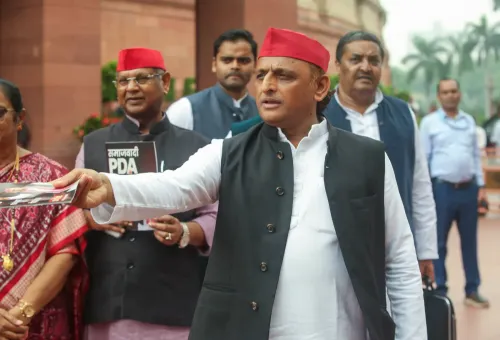
If the banks are stronger, why is your data leaking? That is the needle Samajwadi Party president Akhilesh Yadav jammed into the government's banking narrative on Tuesday, 20 October 2026, extending a sharp 12-question public questionnaire — tagged directly at the Department of Financial Services (@DFS_India) — that he had first fired a day earlier.
The latest post opens with a blunt follow-up: 'Gatank se aage…' ('Continuing from the previous instalment…'), before adding a thirteenth pointed question on customer data leaks to the original dozen. The rhetorical architecture is identical throughout — every question opens with the same concession, 'Banks have been strengthened,' and then pivots into a 'then why?' — a device that forces the government to either defend its own benchmark or answer the charge.
The 12-point charge sheet against the banking system
Yadav's questionnaire covers the full width of the banking experience for ordinary Indians. On privatisation: if banks are strong, why are they being sold? On rural access: why are branches and ATMs in village areas being shut, leaving people scrambling for cash? On credit: why are farmers, students and small shopkeepers still unable to get loans without middlemen and guarantors?
On digital fraud: why does a poor person who falls victim to a cyber scam have to run between police stations and bank counters for weeks before seeing a rupee returned? On home and education loans: why are interest rates so punishing that 'aam aadmi ki kamar toot rahi hai' ('the common man's back is breaking')? On CIBIL scores: why is a minor credit slip enough to brand a young person a defaulter and wreck their financial future?
The list also lands on bank employees — understaffed branches, unmet wage demands, recruitment freezes — arguing that worker overload is directly destroying customer service quality. And it calls out the absence of dedicated help counters for elderly and illiterate customers trying to navigate UPI and online banking fraud.
The merger promise versus the street-level reality
The government's claim of a stronger banking sector rests on real structural ground: between 2019 and 2020, the Centre consolidated ten public sector banks into four larger entities to reduce fragmentation and shore up capital. Official statements in the years since have repeatedly cited improved balance sheets and reduced non-performing assets as proof of the exercise's success.
But opposition leaders, including Yadav, have argued that headline consolidation figures tell only part of the story. Persistent gaps in priority-sector lending, rising digital fraud complaints, rural branch rationalisation and frozen bank recruitment have provided recurring ammunition for that counter-narrative. The 12-question format itself — structured like a parliamentary supplementary, each question building on the last — is a deliberate rhetorical choice, designed to read less like a press statement and more like a cross-examination the government must answer.
DFS in the crosshairs — and what comes next
By tagging @DFS_India — the Ministry of Finance wing that oversees public sector banks and financial inclusion schemes — Yadav is not merely posting for his followers. He is creating a public record that demands an institutional response. Whether the Department engages directly, routes a reply through Parliament, or stays silent will itself become the story.
The data-leak addition on Tuesday sharpens the indictment further: banking system security is now explicitly in the dock alongside access, affordability and staffing. Yadav's audience — UP's vast rural electorate, young first-time borrowers, cyber-fraud victims and anxious bank employees — maps almost precisely onto the constituencies that decide elections in India's most populous state.
Twelve questions, one data leak allegation, and a government agency tagged by name. The ball is squarely in New Delhi's court.
Point of View
He uses the administration's success narrative as the very lever to expose gaps. The tactic shifts the burden of proof onto the ruling establishment rather than positioning the SP as simply being in opposition. Coming against the backdrop of the 2019-2020 consolidation drive, this intervention keeps banking accountability alive as a mass-contact issue — rural credit access, digital fraud, and job creation in bank recruitment resonate deeply across Uttar Pradesh's electorate. The public tag of @DFS_India transforms a social media post into a formal accountability demand, making official silence itself a political headline.
NationPress
20 Oct 2026
Frequently Asked Questions
Why is Akhilesh Yadav asking 12 questions about Indian banks?
Akhilesh Yadav posted a 12-question public questionnaire challenging the government's claim that Indian banks have been strengthened, tagging the Department of Financial Services and demanding answers on issues from rural ATM closures to cyber fraud refunds.
What were the 2019-2020 bank mergers in India?
Between 2019 and 2020, the central government merged ten public sector banks into four larger entities to improve capital efficiency and reduce fragmentation, citing a stronger banking sector as the outcome.
What is the Department of Financial Services (DFS) India?
The Department of Financial Services is a wing of India's Ministry of Finance responsible for overseeing public sector banks, financial inclusion schemes, and the regulatory framework governing banking operations.
What banking problems did Akhilesh Yadav highlight for farmers and students?
Yadav questioned why farmers, students, and small shopkeepers are still unable to access loans without middlemen and guarantors despite government claims of a strengthened banking sector.
What did Akhilesh Yadav say about bank data leaks?
In a follow-up post on 20 October 2026, Yadav added a question on customer data leaks, asking how such breaches are occurring if the banking system has genuinely been made stronger.