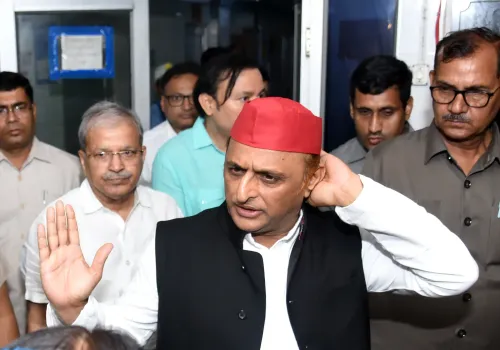
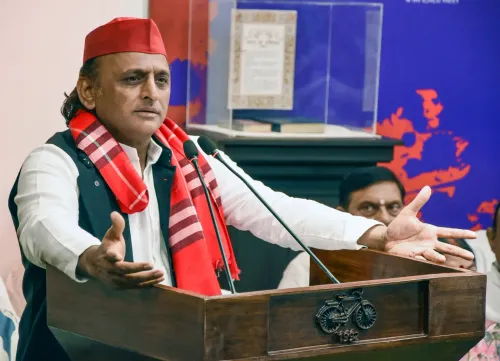
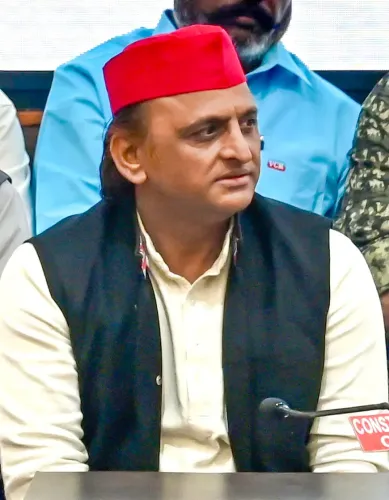
Akhilesh Questions SIT Visit, Demands Temple Donation Audit
Synopsis
Samajwadi Party president Akhilesh Yadav challenged a BJP leader's sudden Ayodhya visit on 19 June 2026, alleging it was arranged to shield the party politically and to influence a disputed SIT. He demanded a full public accounting of all Ram Mandir donations, including gold, silver, and jewellery.
Key Takeaways
Akhilesh Yadav questioned why a senior BJP leader's programme in Ayodhya was arranged at short notice on 19 June 2026 .
He alleged local BJP legislators pushed for the visit to protect the party's political ground in the Ayodhya division and across Uttar Pradesh .
Yadav warned against using a physical visit to influence the SIT , which he described as already under suspicion due to its membership and reputation.
He demanded a transparent accounting of all Ram Mandir donations — cash, precious stones, gold, silver, and jewellery — citing public expectation.
The post signals that Ram Mandir trust transparency is a key Samajwadi Party plank ahead of the 2027 Uttar Pradesh assembly elections .
Samajwadi Party president Akhilesh Yadav on Friday, 19 June 2026, sharply questioned a high-profile visit to Ayodhya by a senior BJP leader, asking why the programme was arranged suddenly and whether it was designed to influence an already-contested Special Investigation Team (SIT) inquiry linked to the Ram Mandir donation accounts.
Context
In a pointed post on X, Yadav raised a series of rhetorical questions about the tone and timing of the day's speech, writing — translated from Hindi — 'Aaj ke bhashan mein bayaan kam, dhamki adhik kyun thi?' ('Why were there fewer statements and more threats in today's speech?'). He asked whether the programme was arranged on the same day the SIT was constituted or only later, and why sources indicated that local BJP legislators and office-bearers had pushed for the visit at short notice.
Yadav alleged that the rush was intended to 'save BJP's political ground', warning that without such manoeuvring, the party faced a wipeout not just in the Ayodhya division but across Uttar Pradesh. He cautioned that physically visiting the site should not be used to influence the SIT's work, describing the panel as already 'under a cloud of suspicion due to controversial members and a tarnished image.'
Policy Backdrop
The Ram Mandir was inaugurated on 22 January 2024 in Ayodhya following the Supreme Court's landmark 2019 verdict. A specially constituted trust was empowered to receive public donations — cash, precious stones, gold, silver, and jewellery — and is required to maintain auditable accounts of all such contributions.
Opposition parties in Uttar Pradesh, including the Samajwadi Party, have repeatedly questioned the composition and independence of investigative and oversight panels linked to Ayodhya projects, arguing they are structured to protect ruling-party interests. This pattern of procedural challenge has intensified as both parties position themselves ahead of the 2027 Uttar Pradesh assembly elections.
Stakeholders and Impact
Yadav's post directly invokes the public as a stakeholder, citing what he called popular sentiment: 'Doodh ka doodh, paani ka paani' — the common Hindi idiom for 'the truth shall be separated from falsehood' — but sharpening it to demand accountability for gold and silver as well: 'Sone ka sona, chaandi ki chaandi' ('gold must be accounted as gold, silver as silver'). He stated that an accounting of donated money, precious stones, valuable metals, and jewellery 'will have to be given.'
The remarks target BJP legislators and party functionaries in the Ayodhya region, as well as the members of the SIT, whose credibility Yadav has placed under public scrutiny. Temple donors and Uttar Pradesh voters — particularly in the politically significant Ayodhya division — are the broader audience for this accountability demand.
What's Next
The release of any SIT findings on donation accounting will be closely watched by both parties. Any debate on the SIT's composition or mandate in the next Uttar Pradesh assembly session could sharpen the political contest further. With the 2027 assembly elections approaching, Akhilesh Yadav's repeated framing of Ayodhya governance as a transparency issue signals that temple trust accountability is set to remain a central opposition campaign theme.
Point of View
He attempts to link procedural optics with substantive governance failure. The 'gold and silver' idiom is a deliberate escalation, broadening the audit demand beyond cash donations to the full spectrum of temple offerings. With 2027 approaching, this positions the Samajwadi Party as the party of institutional accountability in a state where Ayodhya remains the BJP's most potent political symbol.
NationPress
18 Sept 2026
Frequently Asked Questions
What is Akhilesh Yadav demanding regarding the Ram Mandir?
Akhilesh Yadav is demanding a full public accounting of all donations made to the Ram Mandir in Ayodhya, including cash, precious stones, gold, silver, and jewellery, saying the public expects complete transparency.
What SIT is Akhilesh Yadav referring to in his post?
Yadav refers to a Special Investigation Team (SIT) linked to Ayodhya-related matters. He has described its members as controversial and its image as tarnished, and has alleged that a BJP leader's visit to Ayodhya was intended to influence its work. The exact mandate and composition of this SIT are part of the ongoing political dispute.
Why did Akhilesh Yadav question the timing of the BJP visit to Ayodhya?
Yadav alleged that local BJP legislators and office-bearers arranged the visit suddenly to protect the party's political standing in the Ayodhya division, warning that without such moves the BJP risked being wiped out across Uttar Pradesh.
What does 'sone ka sona, chaandi ki chaandi' mean in Akhilesh's post?
The phrase — meaning 'gold must be accounted as gold, silver as silver' — is Yadav's sharpening of the common Hindi idiom for truth and accountability. He used it to demand that precious metals and jewellery donated to the Ram Mandir be fully and transparently audited.
How does this post connect to the 2027 UP elections?
By targeting Ram Mandir donation transparency and SIT credibility, the Samajwadi Party is building an accountability narrative against the BJP in Uttar Pradesh ahead of the 2027 assembly elections, seeking to contest the BJP's dominance in the politically significant Ayodhya region.