Tejashwi Yadav uses Dussehra to target Bihar's governance failures
Synopsis
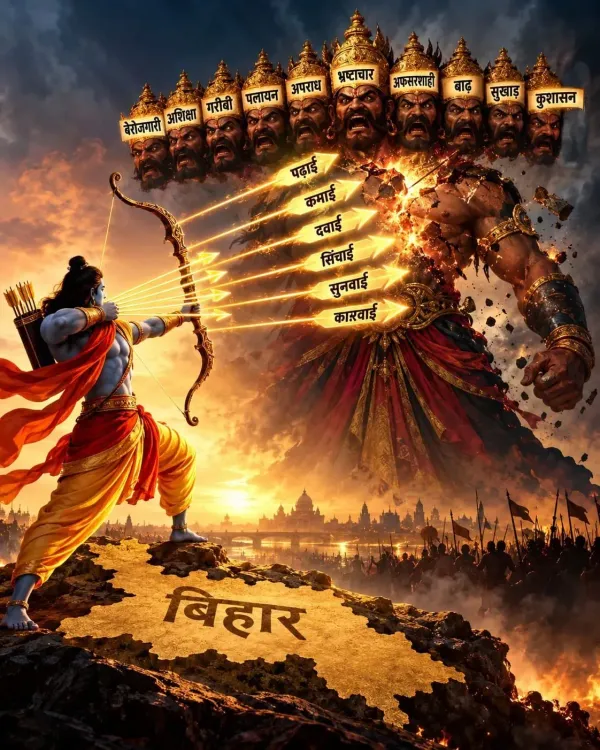
On Dussehra 2026, RJD leader Tejashwi Yadav framed Bihar's unemployment, poverty, migration, anaemia, and law-and-order failures as a ten-headed demon, and pledged a six-point governance alternative built around education, health, livelihoods, irrigation, and accountability.
Key Takeaways
RJD leader Tejashwi Yadav issued his Dussehra 2026 message as a direct indictment of Bihar's governance record under the ruling coalition.
He named ten 'demons' afflicting Bihar: unemployment, illiteracy, poverty, out-migration, crime, corruption, bureaucracy, floods, drought, and misgovernance.
Citing government records, he claimed approximately 4 crore Bihari residents migrate annually due to lack of local employment.
He alleged Bihar's women have the highest anaemia rates and Bihar's children the highest stunting rates in India, citing poor nutrition and healthcare access.
His counter-vision rests on six pillars: padhai, dawaai, kamaai, sinchaai, sunvaai, kaarvaai — education, healthcare, livelihoods, irrigation, grievance redressal, and accountability.
National Family Health Survey data across multiple rounds has consistently placed Bihar near the bottom on maternal anaemia and child stunting indicators.
On the festival that celebrates the triumph of good over evil, RJD leader and Leader of the Opposition Tejashwi Yadav turned Dussehra into a pointed political audit — naming unemployment, illiteracy, poverty, migration, crime, corruption, bureaucratic excess, floods, drought, and misgovernance as Bihar's ten-headed demon on Tuesday, 20 October 2026.
Bihar's ten-headed demon: what Tejashwi actually charged
Wishing citizens 'Vijayadashami aur Dussehra ki hardik shubhkamnayein' ('heartfelt greetings on Vijayadashami and Dussehra'), Yadav drew a deliberate parallel between the ten-headed demon-king Ravana of mythology and what he called the ten chronic afflictions hollowing out Bihar from within. The list — unemployment, illiteracy, poverty, out-migration, crime, corruption, bureaucracy, floods, drought, and misgovernance — is a condensed indictment of the state's development record under the ruling coalition.
He went further. Citing government records, Yadav claimed that roughly 4 crore Bihari residents migrate every year in search of work — a figure that, if accurate, would rank among the largest internal-migration flows in the world. He also alleged that Bihar's women record the highest anaemia rates in the country and that Bihar children suffer the highest rates of stunting, linking both directly to inadequate nutrition and a dysfunctional public health system.
Per capita income and the infrastructure deficit
Yadav described Bihar as 'the most backward state in the country in per capita income,' arguing that a large section of the population remains cut off from basic services — schools, roads, and hospitals. National Family Health Survey data across multiple rounds has consistently placed Bihar near the bottom of national rankings on maternal anaemia and child stunting, lending weight to the broad thrust of his nutrition and health claims, even if the precise figures he cited are drawn from government records NationPress has not independently verified.
The law-and-order charge was the sharpest edge of the message. Without naming specific incidents, Yadav said recent attacks on women on public roads had 'exposed the funeral of law and order before the entire country' — a formulation that signals he intends to press the issue in the coming assembly session.
The counter-vision: 'padhai, dawaai, kamaai'
Yadav's Dussehra message was not only an attack; it carried a programmatic counter-pledge. He called on all Bihari citizens to resolve this festival to 'burn the Ravana of unemployment, illiteracy, poverty, migration, crime, corruption, bureaucracy, floods, drought and misgovernance' and to lay the foundation of a system built around six pillars: padhai, dawaai, kamaai, sinchaai, sunvaai aur kaarvaai — education, healthcare, livelihoods, irrigation, grievance redressal, and accountability. The six-point formulation has the cadence of a campaign manifesto, not just a festival greeting.
'Har haath ko kaam mile aur har ghar phoole-phale' — 'let every hand find work and every home flourish' — was his closing aspiration, addressed to what he called the 'godlike people of Bihar.'
Festival messaging as political strategy in Bihar
This is a well-worn but effective play in Bihar's political calendar. Opposition leaders across India routinely use festival addresses to reframe festive goodwill into governance accountability, but in Bihar — where development gaps are both stark and documented — the tactic carries unusual traction. Yadav, who served as Deputy Chief Minister of Bihar from 2022 to 2024 during the RJD-JD(U) grand alliance, is sharpening his opposition credentials ahead of the next electoral cycle. Every metric he names today is a potential campaign benchmark tomorrow.
Whether the Bihar government responds with counter-data on migration, nutrition, or public safety will be worth watching when the winter session of the state assembly convenes.
Point of View
Making the ruling coalition answer for every metric he names. The six-pillar counter-pledge — education, health, livelihoods, irrigation, grievance redressal, accountability — reads less like a festival wish and more like a pre-campaign manifesto, each plank chosen to address a documented Bihar deficit. With the RJD out of power since 2024, this kind of festival messaging is how Yadav keeps his political narrative dominant between elections. The sharper question is whether his charges on anaemia, stunting, and migration will be tested by real data in the assembly's winter session — or remain unanswered in the public square.
NationPress
20 Oct 2026
Frequently Asked Questions
What did Tejashwi Yadav say on Dussehra 2026?
Tejashwi Yadav used his Dussehra 2026 message to compare Bihar's governance failures — unemployment, poverty, migration, crime, corruption, floods, drought, illiteracy, bureaucracy, and misgovernance — to the ten-headed demon Ravana, pledging to 'burn' them and build a system based on education, healthcare, livelihoods, irrigation, grievance redressal, and accountability.
How many Biharis migrate every year according to Tejashwi Yadav?
Tejashwi Yadav cited government records to claim that approximately 4 crore Bihari residents migrate every year due to lack of local employment, though NationPress has not independently verified this specific figure.
What is Bihar's per capita income ranking in India?
Bihar has consistently ranked at or near the bottom among Indian states in per capita income. Tejashwi Yadav called it 'the most backward state in the country' on this metric in his Dussehra message.
Why does Bihar have high anaemia and stunting rates?
National Family Health Survey rounds have repeatedly recorded high rates of anaemia among women and stunting among children in Bihar, linked to inadequate nutrition, limited healthcare access, and persistent poverty. Tejashwi Yadav cited these as evidence of the state government's governance failures.
What is Tejashwi Yadav's six-point governance plan for Bihar?
Tejashwi Yadav's counter-vision centres on six Hindi-language pillars: padhai (education), dawaai (healthcare), kamaai (livelihoods), sinchaai (irrigation), sunvaai (grievance redressal), and kaarvaai (accountability action).