CM Pinarayi Slams Rahul Gandhi Over Israel Remarks

Synopsis
Kerala CM Pinarayi Vijayan publicly attacks Rahul Gandhi for allegedly advocating India-Israel arms ties at the University of Chicago, calling it a betrayal of Nehruvian foreign policy and 'indefensible' given the ongoing Gaza conflict.
Key Takeaways
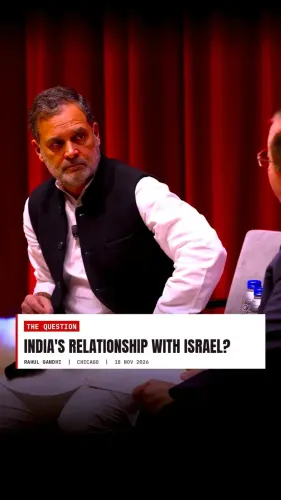
Kerala CM Pinarayi Vijayan accused Rahul Gandhi of hypocrisy for reportedly backing stronger India-Israel ties, including arms purchases, at a speech at the University of Chicago .
Vijayan described Gandhi's stance as a 'pro-imperialist position' that undermines the legacy of Jawaharlal Nehru , who championed Palestinian self-determination within the Non-Aligned Movement.
India recognised the State of Palestine in 1988 under a Congress-led government, making Vijayan's critique an argument that Gandhi is repudiating his own party's record.
CPI(M) has consistently opposed expanded India-Israel defence procurement since the 1990s , positioning this as an intra-opposition clash rather than a ruling-vs-opposition dispute.
India's foreign policy has shifted significantly toward Israel since 2014 , expanding security and technology ties — a trend the Left has repeatedly criticised.
The specific remarks attributed to Gandhi at the University of Chicago have not been independently confirmed; Vijayan's post represents his characterisation of the event.
Kerala Chief Minister Pinarayi Vijayan has launched a sharp political broadside at Congress leader Rahul Gandhi, accusing him of hypocrisy for reportedly advocating stronger India-Israel ties — including arms purchases — at a speech at the University of Chicago, even as the conflict in Gaza continues to claim thousands of civilian lives, including children.
What Vijayan Said — and Why It Stings
In a post on X on Saturday, 21 November 2026, Vijayan did not mince words: 'His attempt to strike a diplomatic balancing act in the face of this catastrophe is indefensible.' He went further, accusing Gandhi of a 'pro-imperialist position' that he argued betrays the foreign-policy legacy of Jawaharlal Nehru — India's first Prime Minister and the architect of a non-aligned stance that placed the country firmly in solidarity with Palestinian self-determination. The closing line landed like a verdict: 'There can be no balancing act when humanity is on trial.'
The attack is pointed precisely because it comes from within the broader opposition ecosystem. CPI(M), Vijayan's party, has maintained a consistent position against expanded India-Israel defence procurement since the 1990s — making this less a ruling-versus-opposition clash and more a fault line running through the anti-BJP bloc itself.
Nehru's Shadow and the Palestine Question
The invocation of Nehru is deliberate and historically loaded. Nehru's government in the 1950s and 1960s backed Palestinian rights within the framework of the Non-Aligned Movement. India formally recognised the State of Palestine in 1988 — under a Congress-led administration. Vijayan's argument, in essence, is that Gandhi is repudiating his own party's foundational foreign-policy commitments.
That historical record gives the critique its sharpest edge: it is not an outsider attacking Congress, but a fellow traveller of the Nehruvian tradition holding Congress to its own stated inheritance.
India's Shifting Israel Policy — the Bigger Frame
The exchange lands against a well-documented shift in Indian foreign policy. Since the 1990s, and accelerating sharply after 2014, India has expanded security, technology, and defence procurement ties with Israel. Opposition parties rooted in the Nehruvian tradition — the Left most loudly, and sections of Congress more quietly — have periodically pushed back, arguing the shift abandons earlier solidarity with Palestine.
What makes this moment different is that the criticism is now directed at the Congress leader himself, not at the BJP government. If Gandhi did advocate arms purchases from Israel at a major American university, it would mark a visible departure from Congress's historical public posture — and Vijayan is making sure that departure is on the record.
Note: The specific remarks attributed to Rahul Gandhi at the University of Chicago have not been independently confirmed; Vijayan's post represents his characterisation of those remarks.
What Congress Says Next Will Matter
The ball is now in Congress's court. A formal clarification of the party's current position on India-Israel defence ties and the Gaza conflict would resolve some of the ambiguity — but silence, too, will be read as a position. With parliamentary sessions on external affairs on the horizon, the question of where India's largest opposition party actually stands on Palestine is unlikely to stay buried for long.
Vijayan has drawn the line in unmistakable terms. Whether Gandhi chooses to cross it, walk it back, or redraw it entirely will define the next chapter of this intra-opposition confrontation.
Point of View
Forcing Congress to publicly define its position on Gaza and Israel-India defence ties. By anchoring the critique in Nehru's legacy, CPI(M) is effectively contesting the Congress party's claim to the Nehruvian inheritance — a battle over ideological ownership that runs deeper than any single speech. The episode also reflects a broader tension within the Indian left-liberal space: as India's defence and technology partnership with Israel has grown across successive governments, the question of where to draw the line has become impossible to evade. If Congress does not respond with a clear position, Vijayan's framing risks becoming the dominant narrative.
NationPress
21 Nov 2026
Frequently Asked Questions
What did Pinarayi Vijayan say about Rahul Gandhi and Israel?
Vijayan accused Rahul Gandhi of hypocrisy for reportedly advocating stronger India-Israel ties and arms purchases at a speech at the University of Chicago, calling the position 'indefensible' given the ongoing Gaza conflict and arguing it betrays Nehru's pro-Palestine foreign policy legacy.
What did Rahul Gandhi say at the University of Chicago about Israel?
According to Vijayan's post, Gandhi advocated stronger ties with Israel and arms purchases from the country. The specific remarks have not been independently confirmed; Vijayan's characterisation is the basis of the controversy.
What is India's historical position on Palestine?
India formally recognised the State of Palestine in 1988 under a Congress-led government, and Nehru's administration backed Palestinian rights within the Non-Aligned Movement in the 1950s and 1960s.
What is CPI(M)'s position on India-Israel defence ties?
CPI(M) has consistently opposed expanded India-Israel defence procurement since the 1990s and has supported Palestinian causes, making Vijayan's criticism consistent with his party's longstanding stance.
How has India's Israel policy changed in recent years?
Since the 1990s, and significantly after 2014, India has expanded security, technology, and defence procurement ties with Israel, a shift that Left parties and some Congress voices have criticised as departing from earlier solidarity with Palestine.