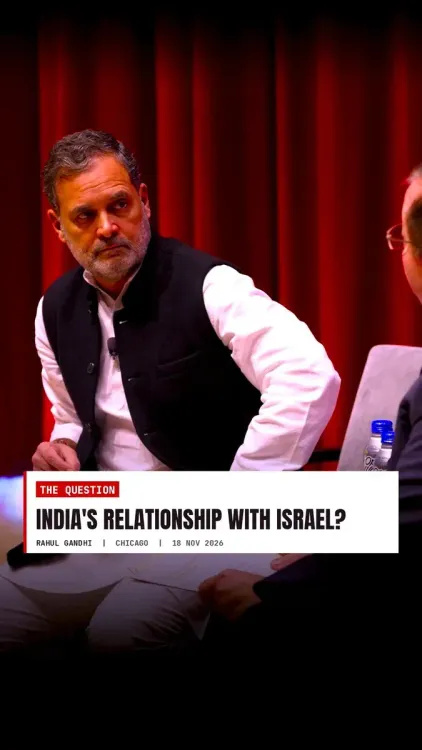
Rahul Gandhi: India must speak on Gaza, not stay silent
Synopsis
Congress leader Rahul Gandhi posted a foreign-policy statement on 19 November 2026 backing India-Israel defence ties while condemning both the October 7 attacks and Israeli military action in Gaza, arguing that a nation of 1.5 billion must assert an independent moral voice on the global stage.
Key Takeaways
Rahul Gandhi condemned both the October 7, 2023 Hamas attacks on Israel and Israeli military operations in Gaza , calling them two separate wrongs neither of which justifies the other.
He explicitly supported India's strategic relationship with Israel , including defence procurement, while insisting this cannot require silence on civilian casualties.
Gandhi invoked India's population of 1.5 billion to argue for a more assertive, independent foreign-policy voice unconstrained by any single power — listing Israel, USA, Russia, and China by name.
India and Israel have maintained full diplomatic relations since 1992 , with deep defence-technology cooperation built over subsequent decades.
The statement signals Congress's intent to press the government on its Gaza posture ahead of the parliamentary winter session and future UN votes.
India cannot afford the luxury of silence when innocent people are dying — that is the blunt message Congress leader Rahul Gandhi sent on Thursday, 19 November 2026, posting a pointed foreign-policy statement that simultaneously backed India's strategic ties with Israel and condemned Israeli military action in Gaza.
A double condemnation, with no room for ambiguity
Gandhi's post draws a sharp moral line in both directions. 'I condemn the October 7th attacks and the killing of innocent people,' he wrote. 'I also condemn what Israel has done in Gaza. One wrong cannot justify another.' The phrasing is deliberate — refusing to give either Hamas or the Israeli government a moral pass, and refusing to let strategic interests excuse political silence.
He is equally direct on defence. 'I support a strong relationship with Israel,' Gandhi says, explicitly naming weapons procurement as a legitimate strategic interest. India and Israel established full diplomatic relations in 1992, and bilateral defence cooperation has deepened significantly since — Israeli-made drones, missiles, and surveillance systems are integral to Indian armed-forces inventory. Gandhi is not asking India to walk away from that.
Where India's balancing act gets complicated
What Gandhi is challenging is the government's near-silence on Palestinian civilian casualties — a posture that has drawn quiet discomfort from India's traditional foreign-policy establishment. For decades, the Indian National Congress anchored its foreign policy in Non-Aligned Movement principles and consistent UN votes backing Palestinian self-determination. Post-2014, successive NDA governments recalibrated that balance, deepening ties with Israel while carefully managing optics with Gulf Arab states.
India has pursued what analysts call multi-alignment — buying Israeli weapons, maintaining energy ties with Gulf nations, and hedging every public statement on the conflict. That diplomatic juggle has worked economically. What Gandhi argues is that it costs India something larger: credibility as a civilisational power willing to say what it believes.
'1.5 billion people' — the scale argument
The rhetorical centrepiece of the post is a sovereignty claim, not a sympathy appeal. 'We are a nation of 1.5 billion people,' Gandhi writes. 'No country — Israel, USA, Russia or China — should hold us back from playing our rightful role on the global stage.' By listing all four major powers in a single breath, the post reframes the Gaza position not as a regional grievance but as a test of whether India can exercise independent strategic will. It is a pitch for a more assertive, values-driven foreign policy — one that Gandhi argues India's size and history demand.
The statement lands ahead of what is expected to be a combative winter session of Parliament, where the government's foreign-policy record is likely to face scrutiny from the opposition benches. India's voting behaviour on future UN General Assembly or Security Council resolutions on Gaza will be the clearest test of whether this debate shifts official posture.
India has long prided itself on speaking truth to power across the global order. The question Gandhi is asking — loudly — is whether that tradition still has a pulse.
Point of View
He repackages a traditional left-leaning position as great-power realism, making it harder to dismiss as naive idealism. The dual condemnation structure also insulates him from charges of being pro-Hamas, a standard counter in domestic political debate. How the ruling NDA responds — and how India votes at the UN — will determine whether this pressure finds traction beyond the opposition benches.
NationPress
19 Nov 2026
Frequently Asked Questions
What did Rahul Gandhi say about Gaza?
Rahul Gandhi condemned Israeli military action in Gaza in a post on 19 November 2026, calling it a wrong that cannot be justified by the October 7 Hamas attacks. He also condemned the October 7 attacks themselves, stating both sides had caused the deaths of innocent people.
Does Rahul Gandhi support India's ties with Israel?
Yes. Gandhi explicitly said he supports a strong relationship with Israel and acknowledged that India has strategic interests including buying weapons from Israel for its armed forces. His criticism is specifically about remaining silent on civilian casualties in Gaza.
What is India's current foreign policy on the Israel-Gaza conflict?
India has pursued multi-alignment — deepening defence ties with Israel while maintaining energy and trade relationships with Gulf Arab states. The government has generally expressed concern for civilian lives without directly condemning Israeli military operations, a posture Gandhi is challenging.
When did India establish diplomatic relations with Israel?
India and Israel established full diplomatic relations in 1992 . Before that, ties were limited, partly due to India's traditional support for Palestinian self-determination through the Non-Aligned Movement.
What does Rahul Gandhi mean by India's 'rightful role on the global stage'?
Gandhi argues that as a nation of 1.5 billion people, India should assert an independent moral and diplomatic voice on global conflicts rather than staying silent out of deference to any major power — specifically naming Israel, the USA, Russia, and China as potential constraints on that freedom.