CM Rajasthan lauds Modi as India weathers global energy crisis
Synopsis
The Rajasthan Chief Minister's Office has praised PM Narendra Modi for steering India through the 21st century's gravest energy crisis, contrasting India's resilience with fuel shortages afflicting major nations, and linking the achievement to national renewable and energy security policies.
Key Takeaways
The Rajasthan CMO posted on 4 July 2026 crediting PM Narendra Modi with navigating India through the 21st century's biggest energy crisis.
The post contrasts India's position with large nations currently grappling with acute fuel scarcity .
India's energy resilience is rooted in schemes including the Jawaharlal Nehru National Solar Mission (2010) , the International Solar Alliance (2015) , and Pradhan Mantri Ujjwala Yojana (2016) .
Rajasthan is among India's leading states for solar and wind resources, directly contributing to national renewable capacity targets.
The post was hashtagged #PMModi4ViksitRajasthan , signalling alignment between state and central development agendas.
Upcoming 2026-27 Union Budget announcements and state-level project commissioning data will be the next key indicators of India's energy trajectory.
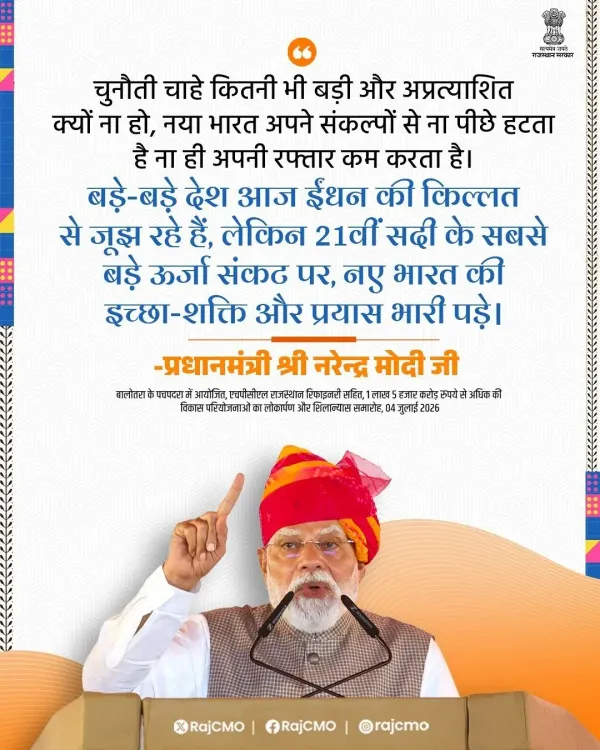
The Chief Minister's Office of Rajasthan on Saturday, 4 July 2026 credited Prime Minister Narendra Modi with steering India through what it called the 21st century's gravest energy crisis, even as large nations continue to struggle with acute fuel shortages.
Posting on X, the official Rajasthan CMO account wrote: 'बड़े-बड़े देश आज ईंधन की किल्लत से जूझ रहे हैं, लेकिन 21वीं सदी के सबसे बड़े ऊर्जा संकट पर, नए भारत की इच्छा-शक्ति और प्रयास भारी पड़े।' ('Big nations today are grappling with fuel scarcity, but on the biggest energy crisis of the 21st century, the will-power and efforts of new India have prevailed.') The post was tagged with the hashtags #PMModi4ViksitRajasthan and #आपणो_अग्रणी_राजस्थान, signalling the state government's alignment with the national development narrative.
Context
Global energy markets have remained volatile since the disruptions of 2022, when supply chain fractures and geopolitical conflict pushed fuel prices to multi-year highs across Europe, South Asia, and parts of Africa. Several economies faced rolling power cuts and import crises. India, by contrast, accelerated its domestic energy diversification programme, drawing on its vast solar and wind potential to reduce exposure to international oil and gas price swings. Rajasthan, with some of the country's largest solar irradiation zones and wind corridors, has been a frontline state in this push. The CMO's post frames the state's trajectory as part of a broader national success story driven by the Modi government's energy policy.Policy Backdrop
India's current energy resilience rests on a policy architecture built over more than a decade. The Jawaharlal Nehru National Solar Mission, launched in 2010, set the foundation for utility-scale solar deployment. India then co-founded the International Solar Alliance in 2015 to mobilise global capital for solar projects across sun-rich nations. The Pradhan Mantri Ujjwala Yojana, introduced in 2016, extended clean cooking fuel access to millions of households, reducing dependence on traditional biomass. Beyond these flagship schemes, the central government has pursued strategic petroleum reserves, biofuel blending mandates, and an aggressive renewable capacity addition calendar. These layered interventions are widely credited with insulating Indian consumers from the worst of the post-2022 global fuel price spiral.Stakeholders and Impact
The beneficiaries of India's energy diversification are broad: household consumers who have seen greater LPG and electricity access, industrial users who draw on cheaper renewable power, and renewable energy developers who have found a growing domestic market. For Rajasthan specifically, large-scale solar parks have created local employment and added to state revenues, while also contributing to national grid stability. The CMO's framing — contrasting India's position with fuel-scarce nations — is also a political signal ahead of continued central-state cooperation on the Viksit Rajasthan development agenda, the state government's roadmap for accelerated growth aligned with the Centre's Viksit Bharat vision.What's Next
Attention will now turn to state-level renewable project commissioning figures and any new energy security measures expected in the 2026-27 Union Budget session. Rajasthan's ability to translate its natural resource advantage into sustained capacity addition will be a key metric. If India's energy self-sufficiency narrative is to hold, consistent policy execution at the state level — including grid integration and storage investment — will be as important as the central government's headline targets.Point of View
Reinforcing the BJP's 'new India' brand at a moment when global energy insecurity offers a ready contrast. By invoking 'will-power' rather than specific policy metrics, the post keeps the narrative broad and aspirational — useful for electoral positioning under the Viksit Rajasthan umbrella. It also reflects a wider pattern of BJP-governed states amplifying central government achievements on social media to build a unified development story ahead of budget and election cycles. The absence of concrete state-specific data, however, means the claim rests on national-level policy lineage rather than Rajasthan's own measurable outcomes.
NationPress
4 Jul 2026
Frequently Asked Questions
Why is Rajasthan CMO praising PM Modi for the energy crisis?
The Rajasthan CMO posted on 4 July 2026 to credit PM Modi's policies for shielding India from the global fuel shortage that has affected many large nations, framing it as a success of the 'new India' vision.
What has India done to avoid the global energy crisis?
India has pursued energy diversification through the Jawaharlal Nehru National Solar Mission, the International Solar Alliance, the Pradhan Mantri Ujjwala Yojana, strategic petroleum reserves, and aggressive renewable capacity addition since the mid-2010s.
What is Viksit Rajasthan?
Viksit Rajasthan is the Rajasthan state government's development roadmap, aligned with the Centre's Viksit Bharat vision, aimed at accelerated economic and infrastructure growth in the state.
How has Rajasthan contributed to India's energy security?
Rajasthan hosts some of India's largest solar irradiation zones and wind corridors, making it a key contributor to national renewable capacity and grid stability.
What comes next for India's energy policy in 2026?
Analysts are watching for new energy security measures in the 2026-27 Union Budget session and state-level renewable project commissioning data that will test whether India's energy self-sufficiency narrative is backed by execution on the ground.