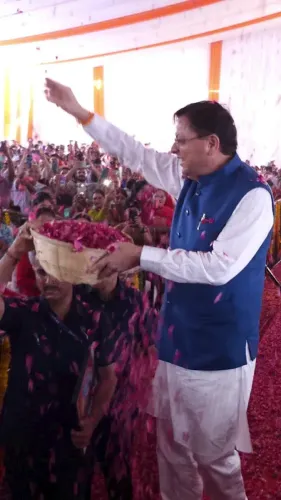
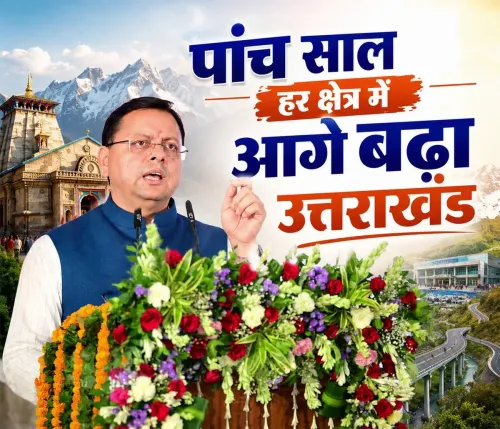
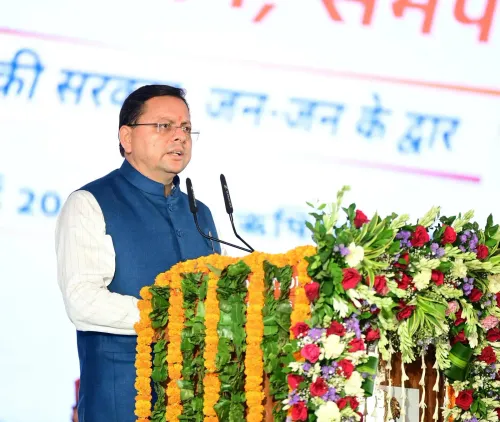
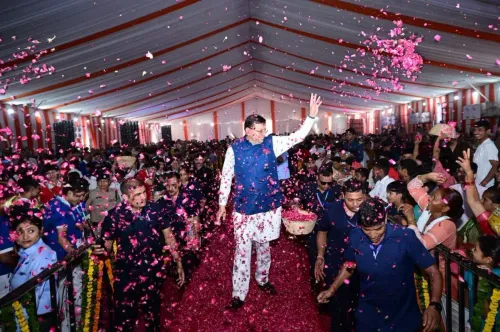
CM Dhami Marks 5 Years of Governance in Uttarakhand
Synopsis
Uttarakhand Chief Minister Pushkar Singh Dhami on 4 July 2026 marked five years of governance, saying the positive results of his administration's work are now reaching every citizen, and reaffirmed his government's resolve to build a developed and excellent Uttarakhand ahead of the 2027 state elections.
Key Takeaways
CM Pushkar Singh Dhami publicly marked five years of governance in Uttarakhand on 4 July 2026 .
He described his role using the term 'mukhya sevak' (chief servant), a people-centric framing consistent with BJP governance messaging.
The post reaffirmed the administration's resolve under the slogan 'Jan-Jan Ki Sarkar, Jan-Jan Ke Dwaar' — government for every person, at every doorstep.
Dhami became the first BJP chief minister of Uttarakhand to complete a full term and return to power after the 2022 assembly elections .
The five-year milestone messaging is seen as setting the stage for the BJP 's re-election campaign ahead of the 2027 Uttarakhand assembly elections .
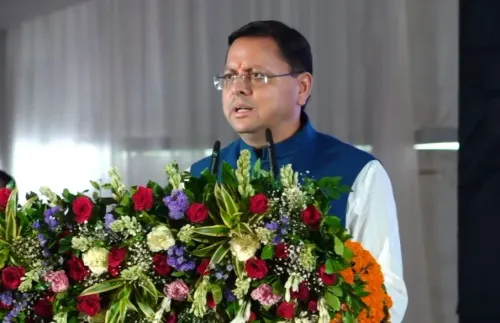
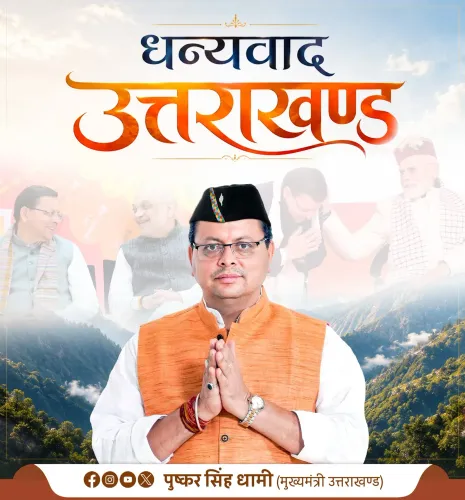
Uttarakhand Chief Minister Pushkar Singh Dhami on Saturday, 4 July 2026, reflected on five years of governance, saying the positive results of work done as 'mukhya sevak' (chief servant) are now reaching every citizen, and reaffirming his administration's commitment to building a developed and excellent Uttarakhand.
Context
In a post on X, CM Dhami wrote in Hindi: 'Mukhya sevak ke roop mein beete paanch varshon mein kiye gaye kaaryon ke sakaratmak parinaam aaj jan-jan tak pahunchte dekh nayi urja milti hai' — translating to: 'Seeing the positive results of work done over the past five years as chief servant now reaching every citizen gives new energy.' He added that his government remains continuously dedicated to building a 'developed and excellent Uttarakhand' under the resolve of 'Jan-Jan Ki Sarkar, Jan-Jan Ke Dwaar' — meaning 'Government for every person, at the doorstep of every person.'
Dhami first assumed the Chief Minister's office in 2021 and was returned to power following the 2022 Uttarakhand assembly elections, making him the state's first BJP chief minister to complete a full term and be re-elected. The five-year milestone he references spans his tenure from 2021 to 2026.
Policy Backdrop
Uttarakhand, a Himalayan state in northern India, has seen a policy focus under the Dhami administration on tourism infrastructure, pilgrimage corridor development, administrative reforms, and welfare delivery to remote hill districts. The BJP's 'double-engine government' model — aligned state and central governments — has been a central plank of its governance messaging in the state.
The slogan 'Jan-Jan Ki Sarkar, Jan-Jan Ke Dwaar' encapsulates the administration's stated emphasis on last-mile delivery of government services and schemes. This framing is consistent with a broader pattern among BJP-ruled states of publicly marking multi-year governance milestones to highlight welfare and infrastructure progress to constituents.
Stakeholders and Impact
The primary stakeholders are Uttarakhand's approximately 1.1 crore residents, particularly those in rural and hill areas who are the stated target of the 'doorstep governance' model. Beneficiaries of state welfare schemes, pilgrims visiting religious sites such as the Char Dham circuit, and local communities dependent on tourism infrastructure are directly affected by the administration's policy choices.
The post's tone — drawing personal energy from visible public impact — signals that CM Dhami is positioning his governance record as a continuing mandate rather than a closed chapter, with the 2027 Uttarakhand assembly elections on the horizon.
What's Next
With the 2027 Uttarakhand assembly elections approaching, the coming months are likely to see the Dhami administration accelerate scheme rollouts and public outreach to consolidate its governance narrative. The framing of five years of 'positive results reaching every citizen' sets the rhetorical groundwork for the BJP's re-election pitch in the state.
Observers will watch whether new state schemes are announced and how public feedback on service delivery shapes the political landscape ahead of the next electoral cycle in Uttarakhand.
Point of View
Dhami leaves room to build a broader electoral narrative without committing to verifiable claims. The post fits a well-established BJP pattern of using social media milestones to shape the dominant political narrative in the run-up to state polls.
NationPress
4 Jul 2026
Frequently Asked Questions
How long has Pushkar Singh Dhami been Chief Minister of Uttarakhand?
Pushkar Singh Dhami has been Chief Minister of Uttarakhand since 2021, first appointed in July 2021 and re-elected after the 2022 assembly elections, making his tenure span five years as of 2026.
What does 'Jan-Jan Ki Sarkar, Jan-Jan Ke Dwaar' mean?
'Jan-Jan Ki Sarkar, Jan-Jan Ke Dwaar' translates to 'Government for every person, at the doorstep of every person' — a slogan used by the Dhami administration to emphasise last-mile delivery of government services to all citizens.
What is the 'mukhya sevak' term used by CM Dhami?
'Mukhya sevak' means 'chief servant' in Hindi. CM Dhami uses the term to describe his role as Chief Minister, framing governance as service to the public rather than exercise of authority.
When are the next Uttarakhand assembly elections?
The next Uttarakhand assembly elections are expected in 2027 . CM Dhami's five-year governance milestone messaging is widely seen as early groundwork for the BJP's re-election campaign.
What are the key development priorities of the Dhami government in Uttarakhand?
The Dhami government has focused on tourism infrastructure, pilgrimage corridor development including the Char Dham circuit, administrative reforms, and welfare delivery to remote hill districts across Uttarakhand.