CM Rekha Gupta Expresses Solidarity Amid Cyclone Arnab Relief Ops

Synopsis
Delhi Chief Minister Rekha Gupta offered solidarity to Cyclone Arnab victims on October 30, 2026, confirming NDRF and SDRF teams are conducting rescue operations under PM Modi's direction, reflecting India's federal disaster-response framework under the Disaster Management Act, 2005.
Key Takeaways
Delhi CM Rekha Gupta posted a message of solidarity with families affected by Cyclone Arnab on October 30, 2026 .
She confirmed that NDRF and SDRF teams are actively conducting rescue and relief operations.
Central assistance is being extended under the leadership of Prime Minister Narendra Modi .
The Disaster Management Act, 2005 underpins the coordinated central-state disaster response framework in India.
The NDRF was constituted in 2006 as India's specialised national force for disaster rescue and relief.
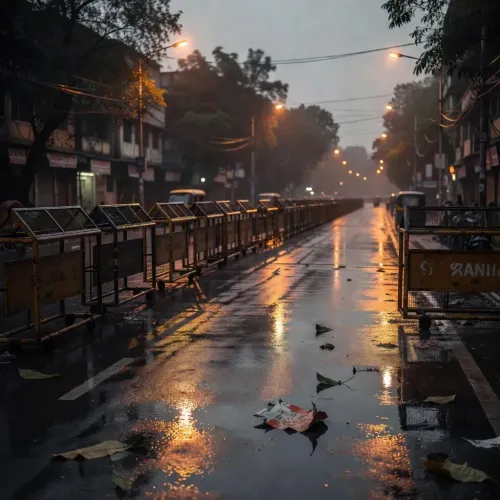
As Cyclone Arnab batters affected communities, Delhi Chief Minister Rekha Gupta reached out on Friday, October 30, 2026, offering solidarity and prayers to every family caught in the storm's path — and signalling that the full machinery of central disaster response is already in motion.
'Our thoughts and prayers are with all those affected by Cyclone Arnab,' CM Gupta wrote, adding that Delhi 'stands in solidarity with our fellow citizens.' She credited Prime Minister Narendra Modi for directing central assistance and confirmed that both NDRF (National Disaster Response Force) and SDRF (State Disaster Response Force) teams are conducting round-the-clock rescue and relief operations.
NDRF and SDRF: the two-tier shield India deploys in every major disaster
The National Disaster Response Force, constituted in 2006 under the framework of the Disaster Management Act, 2005, is India's specialised frontline unit for exactly these moments — swift deployment, search-and-rescue, medical first response. The SDRF, operating at the state level, works in parallel, providing the local manpower and ground knowledge that a centrally-deployed force alone cannot replicate. Together, the two tiers represent the federal compact India codified after the lessons of earlier catastrophes.
When a cyclone hits, the sequence is well-rehearsed: the National Disaster Management Authority (NDMA) coordinates with the Ministry of Home Affairs, NDRF battalions are pre-positioned or airlifted in, and state governments activate their own SDRF while channelling relief through district administrations. CM Gupta's statement fits squarely inside that framework — a state leader signalling both public empathy and federal co-operation.
Why Delhi speaks when a distant cyclone strikes
Delhi is not a coastal state; cyclones do not make landfall here. But India's federal political culture means that chief ministers across the country routinely voice solidarity during major natural calamities, reinforcing the idea that a disaster affecting one corner of India concerns every corner of India. It is also a moment that underlines the central government's coordination role — and in this case, CM Gupta explicitly frames PM Modi's leadership as the anchor of the relief architecture.
For the affected families, the message carries an implicit assurance: the resources of the state are not waiting for a crisis to deepen before moving. Whether that assurance translates into adequate, timely relief on the ground is the question that damage assessments and distribution reports in the coming days will answer.
Point of View
Reinforcing the BJP's governance-delivery narrative. The explicit mention of both NDRF and SDRF signals awareness of the two-tier disaster architecture, suggesting a calculated, not merely ceremonial, communication. For a landlocked capital chief minister, the outreach also serves to project a pan-India governing sensibility ahead of any political cycle. The real test, as with all such solidarity statements, is whether relief logistics match the political messaging on the ground.
NationPress
30 Oct 2026
Frequently Asked Questions
What is Cyclone Arnab?
Cyclone Arnab is a natural calamity that struck in or around late October 2026, prompting the Indian central government to deploy NDRF and SDRF teams for rescue and relief. Specific details about its landfall location and intensity have not been officially confirmed in public reports at the time of this article.
What has the Delhi government done in response to Cyclone Arnab?
Delhi Chief Minister Rekha Gupta issued a public statement of solidarity on October 30, 2026, and confirmed that central teams — NDRF and SDRF — are conducting rescue and relief operations under PM Modi's direction. Delhi itself is not in the cyclone-affected zone but expressed federal solidarity.
What is the NDRF and what does it do during cyclones?
The National Disaster Response Force (NDRF) is India's specialised disaster response unit, constituted in 2006 under the Disaster Management Act, 2005. During cyclones it conducts search-and-rescue operations, provides medical assistance, and supports evacuation of affected populations.
What is the difference between NDRF and SDRF?
NDRF is a central government force deployed nationally for major disasters, while SDRF (State Disaster Response Force) is maintained by individual state governments for local-level disaster response. Both work in coordination under the Disaster Management Act framework.
Why does Delhi's CM comment on a cyclone that doesn't affect Delhi?
Indian political culture and the federal governance framework encourage state leaders to express solidarity during national calamities. It signals unity and reinforces the principle — embedded in the Disaster Management Act, 2005 — that disaster response is a shared national responsibility.