CM Rekha Gupta Pays Tribute to C.V. Raman on His Birth Anniversary
Synopsis
Delhi Chief Minister Rekha Gupta honoured Nobel Prize-winning physicist Dr. C.V. Raman on his birth anniversary, calling his discovery of the Raman Effect a turning point that placed India's scientific genius on the world stage.
Key Takeaways
Delhi CM Rekha Gupta posted a tribute to Dr.
Raman on his birth anniversary, 7 November .
Raman won the Nobel Prize in Physics in 1930 for the discovery of the Raman Effect — the inelastic scattering of light.
He was the first Asian scientist to win a Nobel Prize in a science category and the first Indian to receive the Bharat Ratna in 1954 .
The discovery was made on 28 February 1928 , a date now observed as National Science Day across India.
CM Gupta described the Raman Effect as a discovery that gave 'science a new direction' and established India's scientific prestige globally.
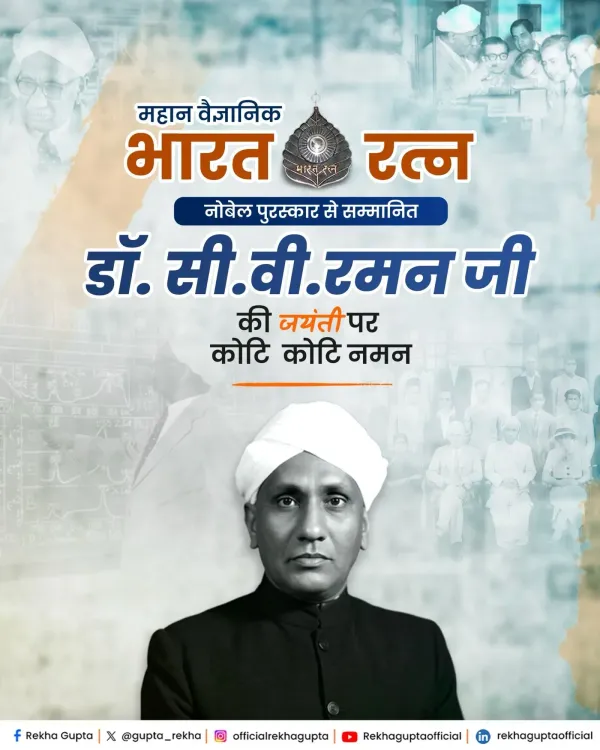
A Nobel laureate whose single discovery rewrote the laws of light — Dr. Chandrashekhara Venkata Raman turns a year older in memory on 7 November 2026, and Delhi Chief Minister Rekha Gupta has marked the occasion with a heartfelt tribute on X, saluting the scientist who put India on the global physics map.
In her post, CM Gupta wrote: 'Nobel Puraskar vijeta evam Bharat Ratna se sammanit mahan vaigyanik Dr. C. V. Raman ji ki jayanti par unhe shat-shat naman.' — offering 'a hundredfold salute' to the great scientist on his birth anniversary. She specifically invoked the Raman Effect, calling it a historic discovery that 'gave science a new direction and established the glory of India's scientific genius on the world stage.'
The discovery that changed physics — and India's place in it
Dr. C. V. Raman was born on 7 November 1888 in Tiruchirapalli, Tamil Nadu. On 28 February 1928, working at the Indian Association for the Cultivation of Science in Calcutta, he observed that when light passes through a transparent material, a small fraction of it scatters at a different wavelength — a phenomenon that would bear his name forever. The Raman Effect opened an entirely new field of spectroscopy, transforming how scientists study molecular composition across chemistry, biology, and materials science.
Two years later, in 1930, Raman became the first Asian scientist to win the Nobel Prize in Physics — a milestone that reverberated far beyond the laboratory. In 1954, independent India honoured him with its highest civilian distinction, the Bharat Ratna, making him the first scientist to receive it. The date of his great discovery, February 28, is observed annually as National Science Day across India.
A tradition of remembrance — and what it signals
India's political leaders across the spectrum routinely mark Raman's birth anniversary, a tradition that reflects how deeply the scientist is woven into the national identity of a country that aspires to be a global science power. For CM Gupta, the tribute arrives against the backdrop of Delhi's own ambitions in education and research infrastructure — the capital hosts some of the country's leading scientific institutions.
Raman's legacy is not merely ceremonial. His work remains foundational: Raman spectroscopy today drives advances in pharmaceuticals, semiconductor research, and even space science. The man who proved that an Indian laboratory could produce world-first physics still inspires the researchers doing so a century on.
Point of View
Honouring a figure who predates post-independence politics also signals a broad, consensus-building form of cultural pride. The annual repetition of such tributes reflects a deliberate effort to anchor India's contemporary innovation narrative to its 20th-century scientific heroes. Whether these gestures translate into stronger policy commitments to basic-science funding remains the more consequential question.
NationPress
7 Nov 2026
Frequently Asked Questions
Why is 7 November significant for C.V. Raman?
7 November 1888 is the birth anniversary of Dr. C.V. Raman , the Indian physicist who won the Nobel Prize in Physics in 1930. Indian leaders and institutions mark the day each year to honour his contributions to science.
What is the Raman Effect?
The Raman Effect is the phenomenon by which light changes wavelength when it scatters through a transparent material. Discovered by Dr. C.V. Raman on 28 February 1928 , it became the foundation of Raman spectroscopy, now used widely in chemistry, medicine, and materials science.
What awards did C.V. Raman receive?
Dr. C.V. Raman received the Nobel Prize in Physics in 1930 — the first Asian to do so — and was awarded the Bharat Ratna in 1954 , making him the first scientist to receive independent India's highest civilian honour.
What is National Science Day and why is it celebrated on February 28?
National Science Day is observed every year on 28 February to commemorate the date in 1928 when Dr. C.V. Raman announced the discovery of the Raman Effect. It is marked across Indian schools, colleges, and research institutions.
What did Delhi CM Rekha Gupta say about C.V. Raman?
Delhi Chief Minister Rekha Gupta saluted Dr. Raman on his birth anniversary on 7 November 2026 , saying his discovery of the Raman Effect 'gave science a new direction' and 'established the glory of India's scientific genius on the world stage.'