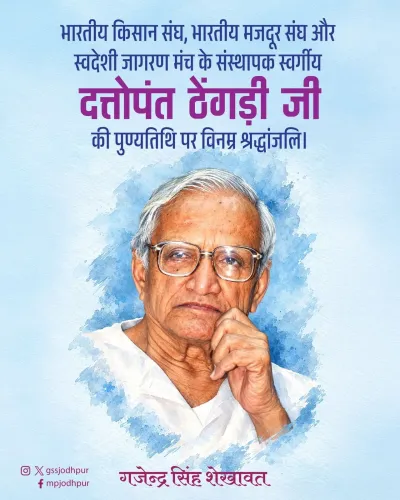
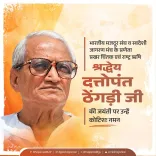
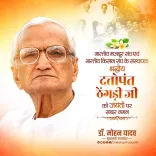
CM Rekha Gupta pays tribute to Dattopant Thengdi on his birth anniversary
Synopsis
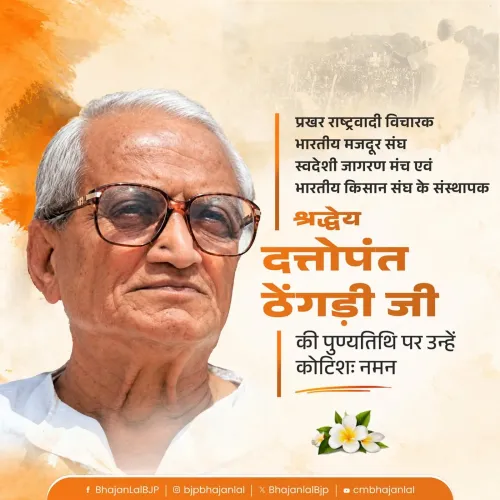
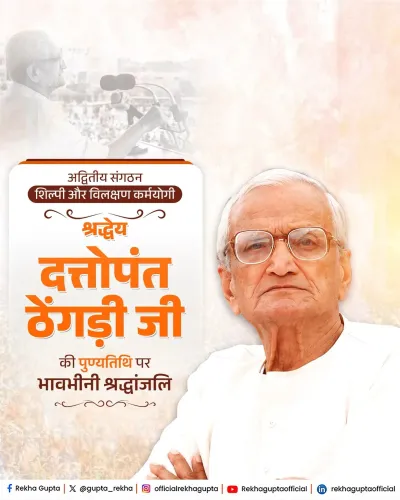
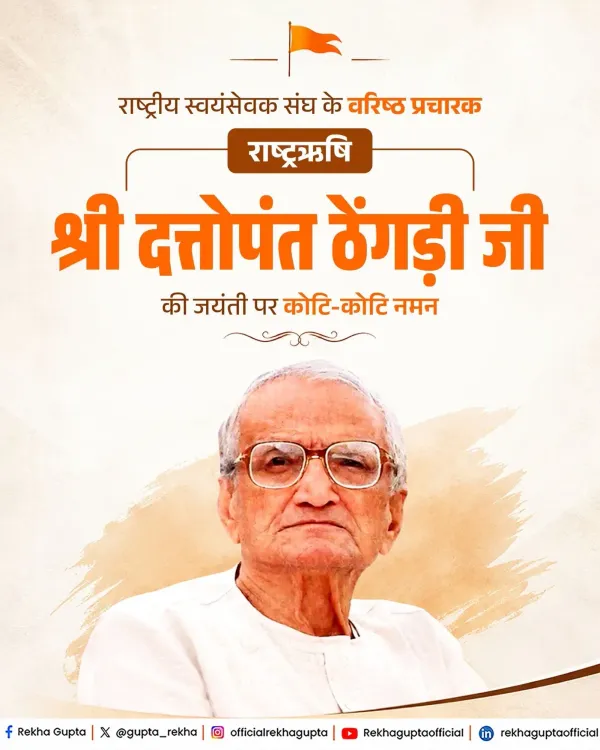
Delhi Chief Minister Rekha Gupta paid tribute to Dattopant Thengdi on his birth anniversary, honouring the BMS founder's nationalist labour, agrarian and swadeshi vision as an enduring ideal for a self-reliant India.
Key Takeaways
Delhi CM Rekha Gupta posted a tribute to Dattopant Thengdi on his birth anniversary on 10 November 2026 .
Thengdi founded the Bharatiya Mazdoor Sangh in 1955 , one of India's largest central trade unions, on nationalist rather than class-conflict principles.
He also shaped the Bharatiya Kisan Sangh and co-founded the Swadeshi Jagran Manch , forming a labour-agriculture-swadeshi ideological framework.
CM Gupta linked Thengdi's legacy of antyodaya and rashtranishtha to the goal of a self-reliant and harmonious India.
The tribute reflects the BJP's consistent practice of invoking RSS-linked ideological forebears to reinforce its nation-building narrative.
On the birth anniversary of Dattopant Thengdi, Delhi Chief Minister Rekha Gupta offered a deeply respectful salute to the man who turned the toil of workers and farmers into the bedrock of a nationalist economic vision — a vision that continues to echo in India's policy corridors today.
Posting on Tuesday, 10 November 2026, CM Gupta wrote in Hindi: 'Koti-koti naman' — 'a million salutations' — to the 'revered thinker of the nation' and founder of the Bharatiya Mazdoor Sangh, and architect of the Bharatiya Kisan Sangh and the Swadeshi Jagran Manch. She credited Thengdi with transforming the labour of workers, the enterprise of farmers, and the pride of indigenous self-reliance into instruments of nation-building.
Who was Dattopant Thengdi and why does his legacy endure?
Thengdi founded the Bharatiya Mazdoor Sangh (BMS) in 1955 as a trade union rooted not in class conflict but in nationalist solidarity — a deliberate counter to left-leaning labour movements of the era. The BMS grew to become one of India's largest central trade unions, organising workers under the banner of swadesh and social harmony rather than adversarial strikes.
He subsequently shaped the Bharatiya Kisan Sangh, channelling the same nationalist framework toward agrarian communities, and co-founded the Swadeshi Jagran Manch, which became the loudest institutional voice against unchecked foreign capital and economic globalisation. Together, the three organisations form a coherent ideological triangle — labour, agriculture, and indigenous enterprise — that Thengdi envisioned as the spine of a self-reliant India.
From Thengdi's swadeshi ideal to Atmanirbhar Bharat
CM Gupta's tribute draws a direct line between Thengdi's life's work and the present. His emphasis on 'antyodaya' — upliftment of the last person in the social order — and on 'rashtranishtha' (national commitment) resonates with the vocabulary of the Atmanirbhar Bharat initiative launched in 2020, which explicitly frames economic self-reliance as a national mission.
BJP leaders across the ideological ecosystem regularly mark Thengdi Jayanti, reinforcing the party's claim to an unbroken organisational lineage stretching from the RSS-affiliated trade union movement of the 1950s to contemporary governance. These tributes are not merely ceremonial — they signal which intellectual traditions the party considers foundational to its policy identity.
Rekha Gupta's post closes with a pointed aspiration: that Thengdi's life — dedicated to national loyalty, organisational discipline, and the welfare of the marginalised — remains 'an inspiring ideal for building a self-reliant and harmonious India.' Seven decades after the BMS was founded, that phrase still carries freight.
Point of View
Agriculture, and swadeshi, the post implicitly frames the Atmanirbhar Bharat initiative as the fulfilment of a decades-old ideological project rather than a novel policy pivot. For the Delhi CM, it also signals alignment with Sangh Parivar intellectual traditions at a moment when the party's urban voter base is being consolidated. The ritual regularity of such tributes across BJP ranks speaks less to spontaneity and more to a coordinated effort to maintain ideological coherence.
NationPress
10 Nov 2026
Frequently Asked Questions
Who was Dattopant Thengdi?
Dattopant Thengdi was a prominent RSS-affiliated nationalist thinker who founded the Bharatiya Mazdoor Sangh in 1955 and later shaped the Bharatiya Kisan Sangh and co-founded the Swadeshi Jagran Manch, organisations focused on workers, farmers and indigenous economic self-reliance.
What is the Bharatiya Mazdoor Sangh?
The Bharatiya Mazdoor Sangh (BMS) is an RSS-affiliated central trade union established in 1955 by Dattopant Thengdi. It organises workers on nationalist principles, emphasising social harmony over class conflict, and is one of India's largest trade union federations.
What is the Swadeshi Jagran Manch?
The Swadeshi Jagran Manch is an organisation co-founded by Dattopant Thengdi that advocates for indigenous economic policies and raises concerns about the unrestricted entry of foreign capital. It operates within the broader RSS ecosystem.
Why do BJP leaders pay tribute to Dattopant Thengdi?
BJP leaders regularly mark Thengdi's birth anniversary to affirm ideological continuity with RSS-linked nationalist traditions in labour and economic policy. The tributes connect current governance priorities such as Atmanirbhar Bharat to Thengdi's earlier vision of swadeshi self-reliance.
What is Antyodaya and how did Thengdi use the concept?
Antyodaya, meaning 'upliftment of the last person,' is a social-welfare ideal drawn from Indian tradition. Thengdi embedded it in his organisational work to ensure that the most marginalised workers and farmers were the primary focus of his nationalist labour and agrarian movements.