CM Revanth Reddy flags off 553 MMS buses for women entrepreneurs
Synopsis
Telangana CM Revanth Reddy flagged off 553 buses managed by Mandal Mahila Samakhyas at Parade Grounds on June 9, 2026, advancing the Mahalakshmi Scheme's goal of making one crore women financially independent entrepreneurs.
Key Takeaways
553 buses were flagged off by CM A.
Revanth Reddy at Parade Grounds, Hyderabad on June 9, 2026 .
The buses will be operated by Mandal Mahila Samakhyas (MMS) , federated self-help group bodies at the mandal level.
The initiative is part of the Mahalakshmi Scheme , the Telangana Congress government's flagship women's welfare programme.
The government's stated goal is to make one crore women financially independent entrepreneurs and industrialists.
Ministers Seethakka, Ponnam Prabhakar and MP Anil Kumar Yadav were among the dignitaries present at the event.
The programme has been described by the CM as a 'yagna' pursued for two-and-a-half years under the Praja Palana governance model.
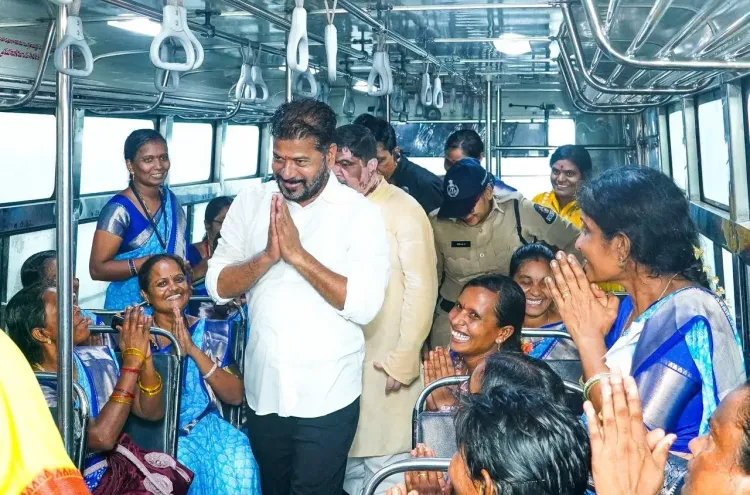
Telangana Chief Minister A. Revanth Reddy on Tuesday, June 9, 2026, flagged off 553 buses to be operated under Mandal Mahila Samakhyas (MMS) at a public event held at Parade Grounds, Hyderabad, as part of the state government's drive to turn one crore women into entrepreneurs and wealth creators.
Context
Addressing the gathering, Chief Minister Revanth Reddy described the initiative as a 'yagna' — a sustained, mission-mode effort — that his government has been pursuing for two-and-a-half years with the goal of making women financially independent. The event saw participation from Minister Seethakka, Minister Ponnam Prabhakar, MP Anil Kumar Yadav, and other elected representatives.
In his post, the Chief Minister stated: 'As part of the resolve to make one crore daughters into crorepatis, the people's government has been conducting this great programme like a yagna for two-and-a-half years, shaping them into industrialists and entrepreneurs.' The 553 buses will be managed and operated by MMS federations, providing both a livelihood asset and a mobility resource to women's collectives at the mandal level.
Policy Backdrop
The bus flagoff is rooted in the Mahalakshmi Scheme, the Telangana Congress government's flagship women's welfare programme, which was a central promise in the party's 2023 Telangana assembly election manifesto. The scheme commits to financial support and entrepreneurship training for women organised through self-help groups (SHGs).
Mandal Mahila Samakhyas are federated bodies of SHGs operating at the sub-district level. Entrusting them with the operation of 553 buses is consistent with the government's broader strategy of channelling economic assets directly to grassroots women's institutions rather than through conventional government departments. This model builds on Telangana's long-standing investment in SHG federations, which were substantially strengthened under earlier state administrations and align with national rural livelihood frameworks.
Stakeholders and Impact
The primary beneficiaries are women belonging to SHG federations across Telangana's mandals, particularly those in rural and semi-urban areas who gain both a commercial transport asset and an organisational leadership opportunity. Revenue generated from bus operations is intended to flow back to the MMS collectives, reinforcing their financial autonomy.
For the broader Praja Palana governance framework — the Congress government's stated model of people-centric administration — the event represents a visible, measurable delivery milestone. Ministers and elected representatives attending the event signals the political weight the ruling party attaches to women's welfare as a mobilisation plank ahead of future electoral cycles.
What's Next
The government is expected to continue phased expansion of vehicles and supporting infrastructure under the Mahalakshmi Scheme and MMS activities through the 2026-27 state budget cycle. Analysts and women's rights groups will watch whether the operational model — MMS-run bus services — translates into sustained income for SHG members or faces logistical challenges in route allocation and maintenance. The scale of the ambition, reaching one crore women, means execution at the last mile will be the definitive test of the programme's impact.
Point of View
Photographable asset transfer, reinforcing its welfare credentials at the grassroots. Entrusting bus operations to SHG federations rather than a state transport corporation is politically shrewd: it embeds the ruling party's delivery narrative directly within women's collectives that double as mobilisation networks. The 'one crore women into crorepatis' framing is aspirational by design, setting a benchmark that will be scrutinised as the 2028 assembly election cycle draws closer. Whether the MMS-run model generates durable income or becomes a maintenance liability will determine whether this becomes a replicable welfare template or a cautionary tale.
NationPress
24 Oct 2026
Frequently Asked Questions
What is the Mandal Mahila Samakhya bus scheme in Telangana?
The Mandal Mahila Samakhya (MMS) bus scheme is a Telangana government initiative under which 553 buses are being handed over to women's SHG federations at the mandal level to operate commercially, generating income for member women and supporting their entrepreneurship goals under the Mahalakshmi Scheme.
What is the Mahalakshmi Scheme in Telangana?
The Mahalakshmi Scheme is the Telangana Congress government's flagship women's welfare programme, announced in the party's 2023 election manifesto, aimed at providing financial support and entrepreneurship training to one crore women through self-help groups.
Where was the MMS bus flagoff event held?
The event was held at Parade Grounds in Hyderabad on June 9, 2026, and was presided over by Chief Minister A. Revanth Reddy.
Who attended the Telangana women entrepreneur bus event on June 9?
Apart from CM Revanth Reddy, Ministers Seethakka and Ponnam Prabhakar, MP Anil Kumar Yadav, and other elected representatives attended the Parade Grounds event.
What is Praja Palana in Telangana?
Praja Palana, meaning 'people's governance,' is the governance framework adopted by the Telangana Congress government after winning the 2023 state assembly elections, emphasising direct welfare delivery and public accountability.