CM Revanth Reddy Pitches Telangana as Top Industrial Hub at Global Business Summit 2026
Synopsis
Chief Minister Revanth Reddy addressed the Global Business Summit 2026 in Hyderabad, detailing Telangana's three-zone economic blueprint — CURE, PURE and RARE — and calling on young and women entrepreneurs to drive the state's $3 trillion GDP ambition by 2047.
Key Takeaways
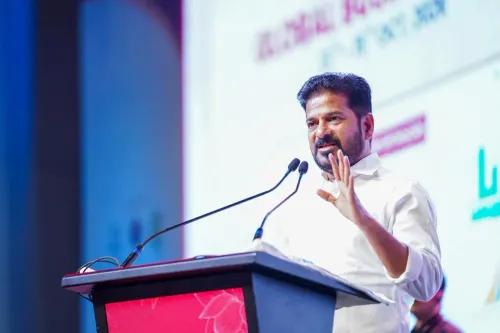
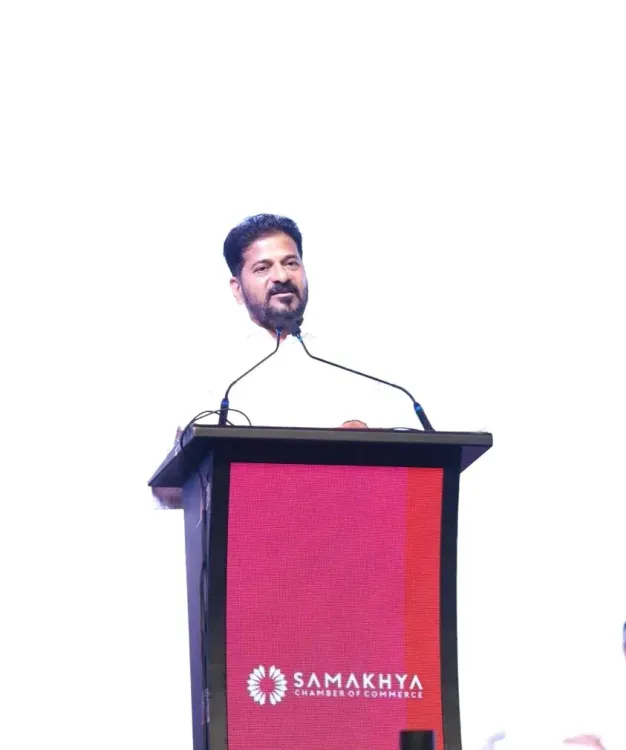
CM Revanth Reddy addressed the Global Business Summit 2026 at Hyderabad HITEX , organised by Samakhya Global Chamber of Commerce .
Telangana's economic map is divided into three zones: CURE (core urban, ~2,100 sq km), PURE (peri-urban manufacturing belt, ~10,500 sq km), and RARE (rural agriculture, ~1 lakh sq km).
Polluting industries inside the Outer Ring Road will be relocated outward under the new HILT Policy , with government incentives and clearance support.
The Regional Ring Road — roughly 360 km long at ~50 km outside the ORR — is being developed to replicate the ORR's connectivity-led growth effect.
The state has set a target of becoming a $3 trillion economy by 2047 , aligned with the national Viksit Bharat 2047 framework targeting a $30 trillion India.
The CM stressed that youth and women's equal participation in industry is central to Telangana's growth strategy, not a peripheral goal.
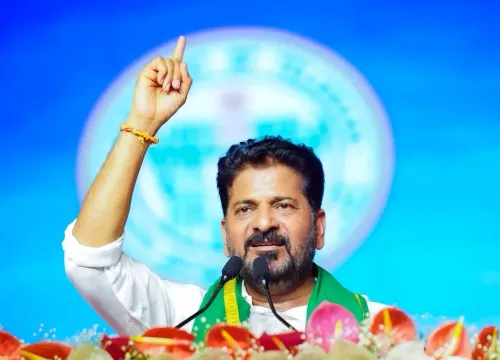
With a $3 trillion GDP target for Telangana by 2047 on the table, Chief Minister Revanth Reddy used the stage of the Global Business Summit 2026 in Hyderabad on Wednesday, October 14 to lay out the most detailed public articulation yet of the state's regional economic blueprint — and to call on young and women entrepreneurs to seize the moment.
The summit, organised by Samakhya Global Chamber of Commerce at Hyderabad HITEX, brought together legislators, parliamentarians, industrialists and policymakers for a two-day dialogue. CM Revanth Reddy opened the event with a speech that ranged from ground-level zoning policy to India's place in the global economy — all anchored on one proposition: 'Telangana Rising 2047' is not a vision document, it is a construction plan.
Three Zones, One Blueprint — How Telangana Is Carving Up Its Economic Map
The centrepiece of the CM's address was the state's three-zone economic architecture. The innermost layer — the Core Urban Region Economy (CURE) — covers roughly 2,100 sq km within the Outer Ring Road (ORR) corridor, serving a population of approximately 1.34 crore. The plan here is deliberate: push polluting industries out, double down on the service sector, and protect Hyderabad's identity as a knowledge hub.
The middle layer is where the growth action is. The Peri-Urban Region Economy (PURE) — the roughly 10,500 sq km belt between the ORR and the under-construction Regional Ring Road (RRR) — is designated as the state's primary manufacturing zone. This is the belt the CM explicitly called out as the opportunity zone for young entrepreneurs and startups. The outermost layer, stretching from the RRR to the state's borders — nearly 1 lakh sq km — will be developed as the Rural Agriculture Region Economy (RARE), anchoring agrarian livelihoods while feeding inputs into the industrial chain.
Underpinning the outward shift of industries is what the government calls the HILT Policy — a package of incentives, clearances and logistical support designed specifically to help polluting units currently inside Hyderabad relocate to zones beyond the ORR.
The Regional Ring Road — Telangana's Next Connectivity Bet
If the Outer Ring Road built Hyderabad's IT-pharma corridor over two decades, the Regional Ring Road is intended to replicate that effect at the next radius. The RRR will stretch approximately 360 km in a ring roughly 50 km outside the ORR. The CM drew the parallel directly: better connectivity unlocked the last generation of industrial growth; this road is meant to unlock the next one.
Youth, Women and the $30 Trillion National Frame
Revanth Reddy framed Telangana's ambitions explicitly within the national Viksit Bharat 2047 goal of transforming India into a $30 trillion economy. Achieving that target, he argued, requires the central government to move with 'clear and decisive action' — strong language that implicitly pressed the Union government on the pace of implementation.
The CM's sharpest passages were reserved for inclusion. 'Countries where women's participation has grown are the ones advancing economically,' he said, calling on the state's own schemes for women entrepreneurs to be treated as industrial policy, not welfare. He also pointed to the Kapu community's achievers across industry, law and cinema as a resource for inspiring the next generation — urging that their stories be documented and shared. The core argument was direct: equal opportunity for youth and women is not a social goal layered on top of growth — it is the growth strategy.
The summit also saw the participation of Andhra Pradesh Legislative Assembly Deputy Speaker K. Raghu Raju, MPs Dr. Laxman and Vem Narender Reddy, government advisor V. Hanumantha Rao, and government whip Aadi Srinivas.
Whether the startups and factories follow the zoning maps is a question the PURE belt will answer over the next decade — but the blueprint, at least, is now on the table.
Point of View
Which is ambitious but implementation-dependent. The explicit call on the central government to accelerate its Viksit Bharat action plan introduces a subtle federal tension: the CM is benchmarking state progress against a national target while flagging that Union inaction could be a constraint. Foregrounding women's entrepreneurship as industrial policy rather than social welfare also repositions a common political talking point into an economic argument — one that carries more weight with investors than with voters alone.
NationPress
14 Oct 2026
Frequently Asked Questions
What is the Global Business Summit 2026 in Hyderabad?
The Global Business Summit 2026 is a two-day conference organised by Samakhya Global Chamber of Commerce at Hyderabad HITEX, focused on industrial growth, startup ecosystems and investment in Telangana.
What is the PURE zone in Telangana's economic plan?
The Peri-Urban Region Economy (PURE) is a roughly 10,500 sq km belt between Hyderabad's Outer Ring Road and the Regional Ring Road, designated as a manufacturing zone with opportunities for startups and new industries.
What is the HILT Policy announced by CM Revanth Reddy?
The HILT Policy is a Telangana government initiative that provides incentives, clearances and logistical support to help polluting industries currently inside Hyderabad's Outer Ring Road relocate to areas beyond it.
What is Telangana's GDP target for 2047?
Chief Minister Revanth Reddy stated that Telangana aims to become a $3 trillion economy by 2047, aligned with India's national Viksit Bharat 2047 goal of a $30 trillion economy.
What is the Regional Ring Road project around Hyderabad?
The Regional Ring Road (RRR) is a planned approximately 360 km road corridor being developed roughly 50 km outside Hyderabad's existing Outer Ring Road, intended to drive industrial and economic growth in the peri-urban zone.