CM Revanth Reddy Pays Tribute on Valmiki Jayanti
Synopsis
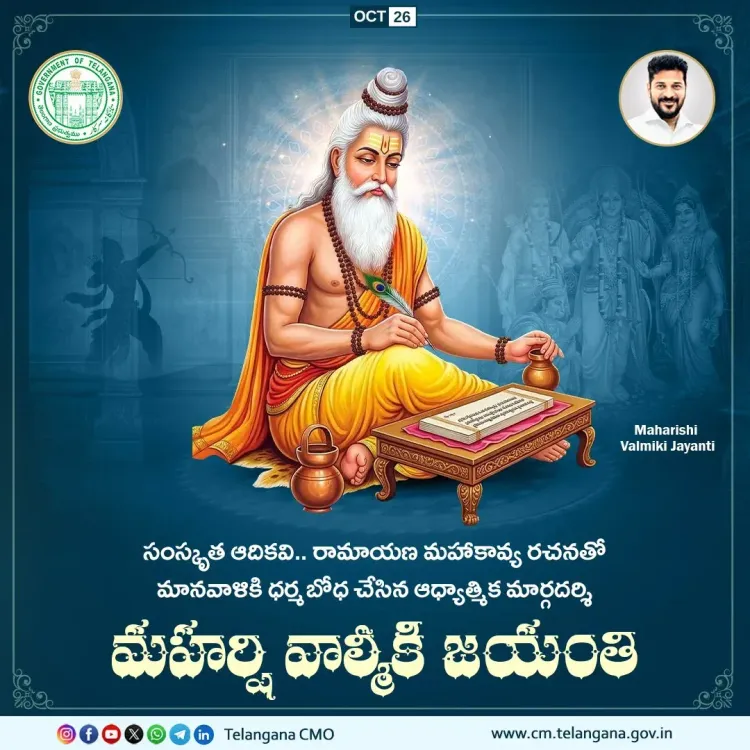
On Valmiki Jayanti, Telangana Chief Minister A. Revanth Reddy honoured Maharishi Valmiki as Indian literature's first poet and the Ramayana's author, calling his journey from ignorance to wisdom an eternal inspiration for all of humanity.
Key Takeaways
Revanth Reddy paid formal tribute to Maharishi Valmiki on the occasion of Valmiki Jayanti, 26 October 2026 .
Revanth Reddy described Valmiki as the aadikavi (first poet) of Indian literature, a spiritual guide, and a symbol of humanistic values.
He called the Ramayana a supreme epic that has preached dharma, truth, sacrifice, and compassion across generations.
The CM highlighted Valmiki's personal transformation — from ignorance to wisdom, from darkness to light — as an ideal for every individual.
The tribute was posted by the official Chief Minister's Office of Telangana account on X .
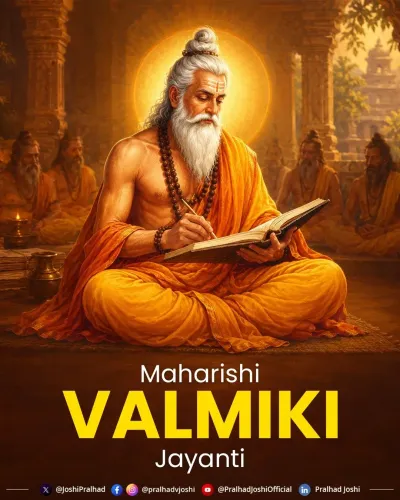
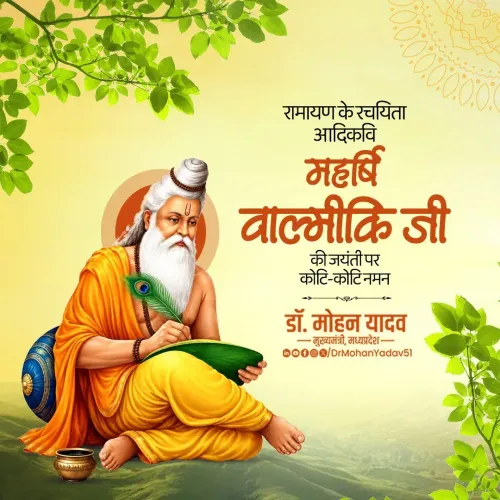
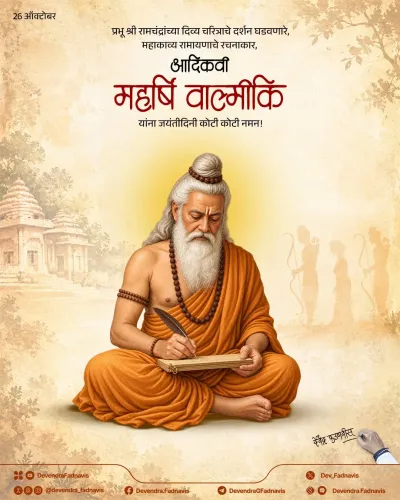
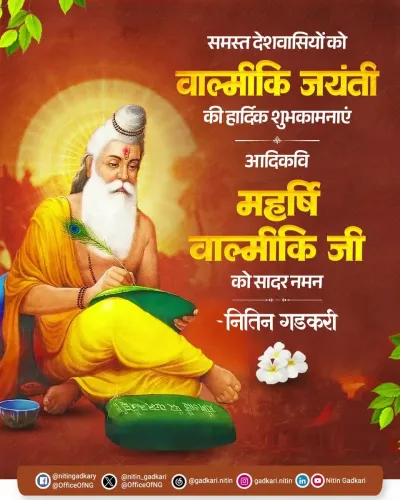
From darkness to light — that is the arc Maharishi Valmiki lived, and the arc Telangana Chief Minister A. Revanth Reddy invoked on Monday, 26 October 2026, as he offered a formal tribute to the ancient sage on the occasion of Valmiki Jayanti.
In a statement shared by the Chief Minister's Office of Telangana, Revanth Reddy described Valmiki as the aadikavi (the first poet) of Indian literature — a spiritual guide and a living symbol of humanistic values whose life story remains an inspiration to all of humanity. He praised the sage as the author of the Ramayana, calling it a towering epic that has, across generations, preached the values of dharma (righteousness), truth, sacrifice, compassion, and an ideal way of life.
A Journey from Ignorance to Wisdom
The CM's tribute centred on Valmiki's own transformation — a life that travelled from ignorance toward knowledge, from darkness toward light. Revanth Reddy said this journey 'stands as an ideal for every individual,' drawing a universal moral from a deeply ancient story. The post carried the hashtags #MaharishiValmiki and #ValmikiJayanti, marking the official nature of the tribute.
Valmiki Jayanti and the Ramayana's Enduring Reach
Maharishi Valmiki is traditionally credited with composing the Sanskrit epic Ramayana — one of the foundational texts of Indian civilisation, shaping art, ethics, and governance philosophy across the subcontinent for millennia. Valmiki Jayanti, observed on the full moon day of the Ashwin month in the Hindu calendar, is a national occasion marked by state governments, cultural organisations, and communities — particularly those from the Valmiki community — across India.
Indian leaders across party lines routinely issue formal tributes on this day, acknowledging the Ramayana's cultural and moral weight. Congress-led Telangana, under Chief Minister Revanth Reddy since December 2023, follows that tradition here — but the statement's emphasis on Valmiki's personal transformation from a life of wrongdoing to sainthood gives it a distinctly humanistic, inclusive tone.
A sage remembered not just for the epic he authored, but for the person he became. That, Revanth Reddy suggests, is the lesson worth carrying forward.
Point of View
Humanistic framing that broadens the tribute's appeal beyond any single community. For a Congress government in Telangana still consolidating its voter coalition, inclusive cultural tributes carry quiet but real political meaning. The consistency of such statements across party lines also signals the Ramayana's unique status as a cross-partisan touchstone in Indian public life.
NationPress
26 Oct 2026
Frequently Asked Questions
What did Telangana CM Revanth Reddy say on Valmiki Jayanti 2026?
CM Revanth Reddy described Maharishi Valmiki as the aadikavi (first poet) of Indian literature and a symbol of humanistic values. He paid tribute to Valmiki's life journey from ignorance to wisdom and praised the Ramayana as a great epic teaching dharma, truth, sacrifice, and compassion.
What is Valmiki Jayanti and why is it celebrated?
Valmiki Jayanti is an annual observance marking the birth anniversary of Maharishi Valmiki, the ancient sage traditionally credited with composing the Sanskrit epic Ramayana. It is observed on the full moon day of the Ashwin month in the Hindu calendar and is widely celebrated across India.
Who is Maharishi Valmiki?
Maharishi Valmiki is the ancient sage traditionally regarded as the author of the Ramayana, one of India's foundational Sanskrit epics. He is known as the aadikavi, or the first poet, in Indian literary tradition. His life story is also celebrated as a journey of personal transformation and redemption.
Who is Telangana Chief Minister A. Revanth Reddy?
A. Revanth Reddy is the Chief Minister of Telangana, representing the Indian National Congress party. He assumed office in December 2023 after the Congress party won the Telangana state assembly elections.
What is the significance of the Ramayana according to Revanth Reddy's tribute?
According to the tribute, Revanth Reddy described the Ramayana as a supreme epic that has, across generations, preached values of dharma (righteousness), truth, sacrifice, compassion, and an ideal way of life to humanity.