CM Rio Marks Biodiversity Day, Highlights Nagaland's Hotspot Status
Synopsis
On International Day for Biological Diversity, Nagaland Chief Minister Neiphiu Rio called for stronger conservation of the state's ecosystems, noting its position within the Indo-Burma global biodiversity hotspot. His remarks underscore northeastern India's central role in the country's multilateral environmental commitments.
Key Takeaways
Nagaland CM Neiphiu Rio posted on 22 May 2026 — International Day for Biological Diversity — urging stronger protection of the state's natural heritage.
Nagaland is part of the Indo-Burma Biodiversity Hotspot , one of 36 such hotspots recognised globally for endemic species concentration.
The United Nations designated 22 May as Biodiversity Day in 2000 , marking the adoption of the Convention on Biological Diversity text.
India ratified the Convention in 1994 and enacted the Biological Diversity Act, 2002 to implement conservation and benefit-sharing obligations.
Much of Nagaland's forest cover is under customary tenure of indigenous tribal communities, making them central stakeholders in conservation outcomes.
Progress on Nagaland's State Biodiversity Strategy and Action Plan revisions remains a key indicator of how the state translates this commitment into policy.
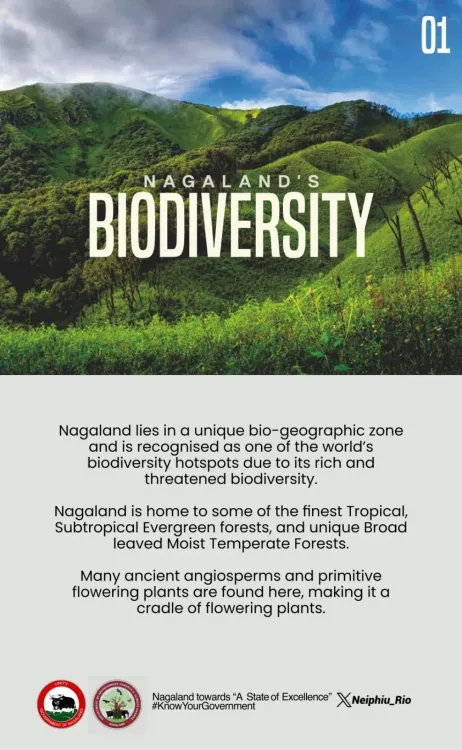
Nagaland Chief Minister Neiphiu Rio on Friday, 22 May 2026 marked the International Day for Biological Diversity by calling on citizens to strengthen efforts to protect the state's natural heritage, describing Nagaland as part of one of the world's biodiversity hotspots.
Context
In his post, Chief Minister Rio stated: 'We celebrate Nagaland's rich biodiversity and ecosystems that sustain our people, culture, and way of life.' He emphasised that as part of a global biodiversity hotspot, the state must deepen its conservation commitments. The remarks came on the United Nations observance held every 22 May, a date chosen to commemorate the adoption of the text of the Convention on Biological Diversity.
The International Day for Biological Diversity was designated by the United Nations in 2000 to raise global awareness of biodiversity loss and promote action at every level of governance, from multilateral bodies down to individual states and communities.
Policy Backdrop
Nagaland sits within the Indo-Burma Biodiversity Hotspot, one of 36 such hotspots globally, recognised for high concentrations of endemic flora and fauna. The state's extensive forest cover, much of it under customary tenure controlled by indigenous tribal communities, forms a critical component of this ecological corridor.
India ratified the Convention on Biological Diversity in 1994 and subsequently enacted the Biological Diversity Act, 2002 to operationalise commitments around conservation, sustainable use, and equitable benefit-sharing. The Act provides a framework under which state-level biodiversity boards and local biodiversity management committees are mandated to document and protect biological resources.
Northeastern states including Nagaland occupy a distinctive position in India's federal conservation architecture: community-controlled forests under customary tenure mean that tribal institutions hold significant de facto authority over biodiversity management, linking traditional ecological knowledge with national and international obligations.
Stakeholders and Impact
The ecosystems Chief Minister Rio referenced directly sustain indigenous communities and forest-dependent households across Nagaland, for whom biodiversity is not merely an environmental concern but the foundation of livelihood, food security, and cultural identity. Shifting cultivation practices, infrastructure expansion, and climate variability continue to exert pressure on these ecosystems.
The Chief Minister's messaging reinforces a pattern visible across northeastern India, where state governments periodically signal alignment with global biodiversity targets — a signal directed at both domestic audiences and multilateral forums tracking India's progress under the Convention on Biological Diversity.
What's Next
Attention will turn to whether Nagaland advances revisions to its State Biodiversity Strategy and Action Plan, the primary instrument through which states translate national commitments into on-ground programmes. Any state-level inputs to India's reporting ahead of future meetings of the Conference of the Parties to the Convention on Biological Diversity will be closely watched by conservation stakeholders. Chief Minister Rio's public emphasis on the state's hotspot status may also inform budget and policy discussions in the coming legislative sessions.
Point of View
Signalling Nagaland's alignment with global conservation frameworks at a moment when India's biodiversity commitments face scrutiny in multilateral settings. The emphasis on ecosystems sustaining 'people, culture, and way of life' is a deliberate framing that centres indigenous communities rather than abstract environmental metrics — a politically astute move in a state where tribal institutions wield real authority over forest governance. The post also reflects the broader northeastern pattern of leveraging biodiversity credentials in federal negotiations over development versus conservation trade-offs. Whether the rhetoric translates into updated state action plans or legislative action will determine its lasting policy weight.
NationPress
20 Sept 2026
Frequently Asked Questions
Why did Nagaland CM Neiphiu Rio post about biodiversity on 22 May 2026?
22 May is the International Day for Biological Diversity , a United Nations observance held annually since 2000 . Chief Minister Rio used the occasion to highlight Nagaland's status as part of the Indo-Burma Biodiversity Hotspot and call for stronger conservation efforts.
Is Nagaland really a biodiversity hotspot?
Yes. Nagaland falls within the Indo-Burma Biodiversity Hotspot , one of 36 globally recognised hotspots defined by high levels of endemic species and significant habitat loss. The state's forest cover and tribal community-managed lands are key components of this designation.
What is India's law on biodiversity protection?
India enacted the Biological Diversity Act in 2002 to implement the Convention on Biological Diversity , which the country ratified in 1994 . The law establishes the National Biodiversity Authority , state biodiversity boards, and local biodiversity management committees to oversee conservation and benefit-sharing.
What role do tribal communities play in Nagaland's biodiversity?
Indigenous tribal communities in Nagaland control large tracts of forest under customary tenure, making them the primary stewards of the state's biodiversity. Their traditional ecological knowledge and land-management practices are integral to conservation outcomes under both state and national frameworks.
What is the Nagaland State Biodiversity Strategy and Action Plan?
The State Biodiversity Strategy and Action Plan is the instrument through which Nagaland translates national biodiversity commitments into on-ground conservation programmes. Periodic revisions to the plan are expected to align with updated targets under the Convention on Biological Diversity .