CM Rio Calls for Forest Conservation on World Environment Day
Synopsis
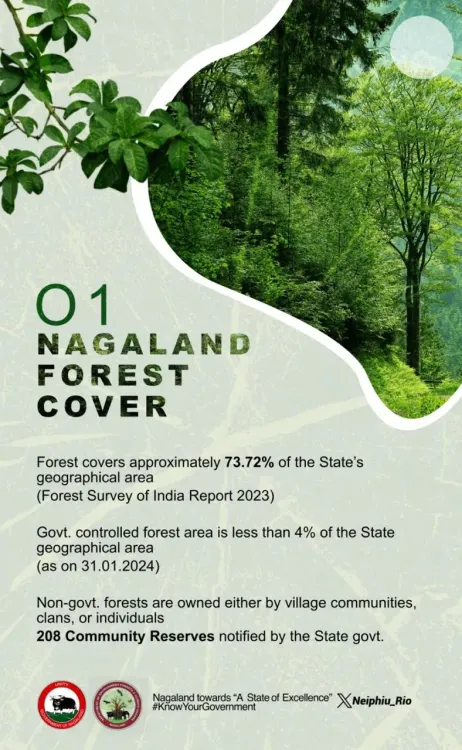
On World Environment Day 2026, Nagaland Chief Minister Neiphiu Rio highlighted that forests cover approximately 73.72 per cent of the state's geographical area, calling them a vital ecological asset and urging their conservation for sustainable development and biodiversity protection.
Key Takeaways
Nagaland's forests cover approximately 73.72 per cent of the state's geographical area, according to CM Neiphiu Rio 's post on June 5, 2026 .
Chief Minister Rio described forests as a 'vital ecological asset' sustaining biodiversity, livelihoods, and environmental balance.
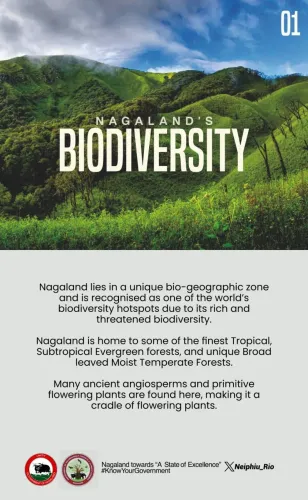
Nagaland forms part of the Indo-Burma biodiversity hotspot , one of the world's most ecologically significant zones.
The state's forests are protected under Article 371A of the Constitution, which recognises Naga customary law and community land rights.
India's National Forest Policy, 1988 , targets 33 per cent forest cover nationally — Nagaland far exceeds this benchmark.
Observers await concrete state-level policy announcements on afforestation and community forestry to follow the World Environment Day message.
Nagaland Chief Minister Neiphiu Rio on Friday, June 5, 2026, marked World Environment Day by highlighting that forests cover approximately 73.72 per cent of Nagaland's geographical area, calling on citizens to conserve and protect them as a cornerstone of the state's sustainable development journey.
Context
Chief Minister Rio posted on X, stating: 'Forests cover approx. 73.72% of Nagaland's geographical area. They're a vital ecological asset, sustaining biodiversity, livelihoods and environmental balance. Let us conserve and protect them as they remain crucial for Nagaland's sustainable development journey.' The post was accompanied by two images and tagged #WorldEnvironmentDay.
World Environment Day is observed annually on June 5 under the United Nations framework, a tradition that dates to the 1972 Stockholm Conference on the Human Environment and has been marked globally since 1973.
Policy Backdrop
Nagaland is one of India's most densely forested states and forms part of the Indo-Burma biodiversity hotspot, a globally significant ecological zone. The state's forests are governed under a framework that includes constitutional protections afforded by Article 371A, which recognises Naga customary law and land rights, making community-managed forests a defining feature of the state's conservation landscape.
India's National Forest Policy, 1988, set the benchmark of maintaining at least 33 per cent forest cover nationally for ecological security. Nagaland's figure, as cited by CM Rio, far exceeds that national target, underlining the state's outsized contribution to the country's green cover and climate resilience commitments.
Northeastern states collectively account for a disproportionately large share of India's total forest cover. Regional leaders routinely use World Environment Day to align local ecological priorities with national climate commitments, including India's targets under the Paris Agreement and its Nationally Determined Contributions.
Stakeholders and Impact
The forests of Nagaland are not merely an environmental statistic — they sustain the livelihoods of a significant share of the state's predominantly rural and indigenous population. Community forestry systems, embedded in Naga tribal traditions, govern large tracts of land and represent a model of decentralised conservation that national policymakers have increasingly sought to replicate.
However, these forests face mounting pressure from infrastructure expansion, shifting cultivation practices known locally as jhum (slash-and-burn agriculture), and developmental demands. CM Rio's statement, while ceremonial in occasion, reflects an ongoing tension between growth imperatives and ecological preservation that state leadership must navigate.
Forest-dependent communities — including farmers, artisans, and those reliant on non-timber forest produce — stand to be most directly affected by any shifts in conservation policy or forest cover. Their participation in stewardship is widely regarded as essential to any durable conservation outcome in the region.
What's Next
Observers will watch for concrete follow-through from the Nagaland government in the form of afforestation schemes, community forestry partnerships, or state-level policy announcements that translate the World Environment Day message into actionable programmes. The periodic release of India State of Forest Reports by the Forest Survey of India will provide the next quantitative benchmark against which Nagaland's forest cover trajectory can be assessed.
As climate pressures intensify across the subcontinent, Nagaland's ability to protect its exceptional forest endowment will carry significance well beyond its borders — both as a biodiversity reservoir and as a test case for community-led conservation in federal India.
Point of View
He implicitly makes a case for recognising the Northeast's disproportionate contribution to India's climate commitments. The statement also signals awareness of the delicate balance between Nagaland's infrastructure ambitions and its constitutionally protected community forest systems. Whether it translates into measurable policy action will determine its lasting significance beyond the annual observance cycle.
NationPress
19 Sept 2026
Frequently Asked Questions
What percentage of Nagaland is covered by forests?
According to Chief Minister Neiphiu Rio , forests cover approximately 73.72 per cent of Nagaland 's geographical area, making it one of India's most densely forested states.
What did Nagaland CM Neiphiu Rio say on World Environment Day 2026?
CM Rio posted on June 5, 2026 that Nagaland's forests are a vital ecological asset sustaining biodiversity and livelihoods, and called on citizens to conserve and protect them for the state's sustainable development.
Why are Nagaland's forests important for India?
Nagaland lies within the Indo-Burma biodiversity hotspot and contributes significantly to India's national forest cover, far exceeding the 33 per cent target set by the National Forest Policy, 1988 , while also supporting indigenous livelihoods.
What is Article 371A and how does it relate to Nagaland's forests?
Article 371A of the Indian Constitution grants special protections to Nagaland , recognising Naga customary law and land rights. This underpins the community-managed forest systems that govern large tracts of the state's forest land.
When is World Environment Day observed and why?
World Environment Day is observed every year on June 5 under the United Nations framework, a tradition established following the 1972 Stockholm Conference on the Human Environment and observed globally since 1973 .