CM Rio Launches Fellowship Prog & Development Study for Nagaland

Synopsis
Nagaland CM Neiphiu Rio launched the CM's Fellowship Programme and released a NEDFi-backed research report on 'Strategic Interventions for Endogenous Development' on September 24, signalling a push for locally rooted, evidence-driven governance in the Northeast state.
Key Takeaways
CM Neiphiu Rio launched two initiatives on September 24, 2026 focused on Nagaland's long-term development.
The CM's Fellowship Programme Nagaland aims to bring talent into the state's policy and governance processes.
A research study titled 'Strategic Interventions for Endogenous Development' was released in collaboration with NEDFi .
NEDFi (North Eastern Development Finance Corporation Ltd.) is a public-sector body with a track record of economic research and financing across the Northeast.
Both initiatives reflect a push for internally driven development, aligned with Nagaland's Article 371A constitutional identity.
Cohort size, eligibility criteria for the fellowship, and full findings of the research report are yet to be publicly detailed.
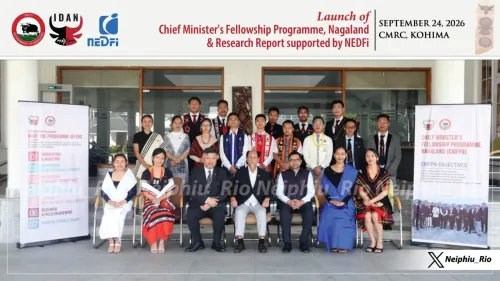
Nagaland Chief Minister Neiphiu Rio on Thursday, September 24 launched two initiatives he described as 'closely connected to the future of Nagaland' — the CM's Fellowship Programme Nagaland and a research study report titled 'Strategic Interventions for Endogenous Development', the latter produced in collaboration with the North Eastern Development Finance Corporation Ltd. (NEDFi).
A fellowship for Nagaland's next chapter
The CM's Fellowship Programme Nagaland is a state-level initiative designed to draw talent into the work of governing and developing the state. Fellowship programmes of this kind are a growing instrument in Indian governance — structured pipelines that place motivated young professionals inside policy machinery, accelerating both delivery and institutional knowledge. The specifics of cohort size, eligibility, and placement are yet to be publicly detailed, and the administration is expected to release those parameters in the coming weeks.
For a state that has long navigated the tensions between central-scheme frameworks and locally rooted aspirations, a home-grown fellowship carries particular resonance. Nagaland's Article 371A constitutional protections reinforce the principle that its development path must reflect its own communities — and a state fellowship, by design, keeps that process internal.
What 'endogenous development' means for the Northeast
The research report — 'Strategic Interventions for Endogenous Development' — represents the second strand of Thursday's launch. Commissioned in collaboration with NEDFi, a public-sector financial institution with a long track record of supporting economic planning across the Northeast, the study examines development strategies that grow from within rather than being imposed from outside.
The concept of endogenous development is not rhetorical. It directly pushes back against the critique — persistent across India's Northeast — that large central programmes arrive pre-designed for different geographies and leave communities as passive recipients rather than active architects. NEDFi has previously partnered on research and infrastructure financing across the region, lending the report an institutional credibility that solo state-commissioned studies sometimes lack.
The specific findings, recommendations, and pilot proposals contained in the report have not yet been made public in full, but their release signals that the state government intends to anchor upcoming policy decisions in documented, local evidence.
Why both moves together matter
Launching both on the same day is deliberate. A fellowship builds human capital; a research report builds the intellectual infrastructure to deploy that capital wisely. Together, they sketch a governance strategy that is less reliant on external templates. Whether that sketch translates into measurable action — pilot projects, budget allocations, new hiring — will define how significant this moment actually is.
For CM Rio, the twin launch also underlines a long-standing emphasis on participatory, evidence-led planning, one that his administration has pursued across multiple terms even as the state's political and peace-process landscape has shifted around it. The question now is what the report's recommendations demand — and whether the fellowship's first cohort will be the ones tasked with delivering them.
Point of View
Rather than relying on centrally designed templates. For Nagaland, a state with strong constitutional protections under Article 371A and a complex peace process history, this framing of development as locally owned carries political as well as policy weight. The NEDFi partnership lends institutional credibility and signals that the findings are intended to drive real financing decisions, not just sit in a government archive. The real test will come when the fellowship's first cohort is deployed and when the report's recommendations face the friction of budgets and political priorities.
NationPress
24 Sept 2026
Frequently Asked Questions
What is the CM's Fellowship Programme Nagaland?
It is a newly launched state fellowship initiative by Nagaland Chief Minister Neiphiu Rio aimed at engaging talented professionals in the governance and development of Nagaland. Specific details on eligibility, cohort size and placement are yet to be officially announced.
What is the 'Strategic Interventions for Endogenous Development' report about?
It is a research study released by the Nagaland government in collaboration with NEDFi that examines development strategies rooted in Nagaland's own communities and resources, rather than externally imposed models. The full findings and recommendations have not yet been made fully public.
What is NEDFi and why is it involved?
NEDFi, the North Eastern Development Finance Corporation Ltd., is a public-sector financial institution that supports economic research, infrastructure financing, and development initiatives across India's Northeast. Its collaboration lends institutional weight to the research report.
What is endogenous development and why does it matter for Nagaland?
Endogenous development refers to growth strategies driven from within a community, using local knowledge, resources and leadership, rather than externally designed programmes. For Nagaland, with its unique constitutional protections under Article 371A, this approach aligns development with local identity and aspirations.
Who is Neiphiu Rio and how long has he been Nagaland's Chief Minister?
Neiphiu Rio is the Chief Minister of Nagaland and the leader of the Nationalist Democratic Progressive Party (NDPP). He has held the chief ministership across multiple terms, making him one of the Northeast's most experienced state leaders.