CM Rio Meets Amit Shah on Nagaland Peace, Welfare
Synopsis
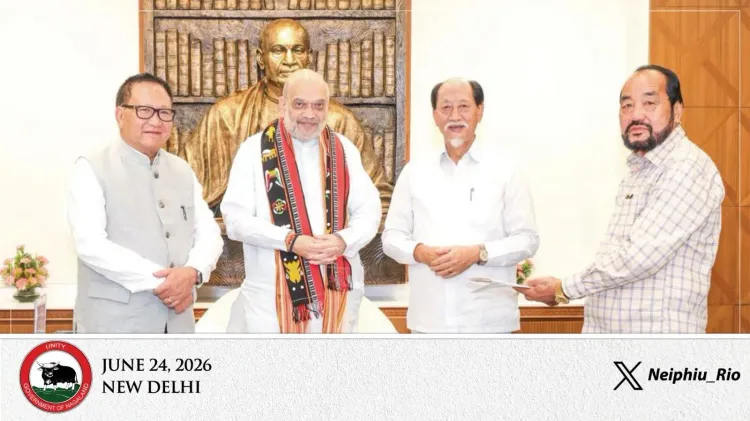
Nagaland Chief Minister Neiphiu Rio, flanked by Deputy CMs T. R. Zeliang and Yanthungo Patton, met Union Home Minister Amit Shah in New Delhi on June 24, 2026, to discuss peace and state welfare — a high-level engagement reflecting India's sustained dialogue strategy for the Northeast.
Key Takeaways
CM Neiphiu Rio met Union Home Minister Amit Shah in New Delhi on June 24, 2026 .
Zeliang and Yanthungo Patton were part of the delegation.
Discussions covered 'peace and the welfare of the State,' per Rio's own account on X.
The meeting is part of India's long-running centre-state engagement strategy for Nagaland and the Northeast.
The 2015 Framework Agreement with NSCN-IM remains the political backdrop for all such high-level dialogues.
No specific decisions or outcomes have been officially disclosed from the meeting.
Nagaland Chief Minister Neiphiu Rio called on Union Home Minister and Minister for Cooperation Amit Shah in New Delhi on Wednesday, June 24, 2026, accompanied by Deputy Chief Ministers T. R. Zeliang and Yanthungo Patton, to discuss peace and state welfare matters.
Context
Rio posted on X that the delegation 'discussed matters related to peace and the welfare of the State,' expressing gratitude for Shah's 'continued support, guidance, and commitment towards our State.' The meeting marks a fresh round of high-level centre-state engagement on Nagaland's long-standing political and security concerns.
The presence of both Deputy CMs — Zeliang, a former Chief Minister with deep experience in Naga political dialogue, and Patton, who oversees welfare and central-scheme coordination — signals that the delegation carried a broad governance agenda, spanning security, development, and political negotiation.
Policy Backdrop
Nagaland has been at the centre of India's most protracted peace process in the Northeast. A Framework Agreement signed in 2015 between the Government of India and the NSCN-IM laid out a political roadmap to address Naga aspirations while preserving India's territorial integrity, but a final settlement has remained elusive over the decade since.
Under Article 371A of the Constitution, Nagaland holds special protections for Naga customary law and land rights — a provision that frames every negotiation between Kohima and New Delhi. Successive central governments have paired security measures with political dialogue and infrastructure investment as twin levers for stabilising the region.
Amit Shah, as Union Home Minister, is the nodal minister for Northeast peace processes and also holds the Cooperation portfolio, which governs cooperative-sector development — an avenue increasingly used to channel rural economic support to conflict-affected states.
Stakeholders and Impact
The primary stakeholders in any outcome from this meeting are Naga communities across the state, whose daily lives are shaped by the pace of the peace process, the delivery of central welfare schemes, and the security environment. Armed groups that have operated under ceasefire arrangements will also watch for any signals emerging from the engagement.
State government officials and civil society in Nagaland have consistently pressed for clarity on the political solution promised under the 2015 Framework Agreement. Parallel to the political track, the state depends heavily on central transfers and scheme funding — making the Home Minister's 'commitment' to welfare, as Rio described it, a matter of practical fiscal significance.
What's Next
No specific outcomes or decisions from the meeting have been made public, and details of the agenda remain unverified. Observers will track whether the visit accelerates any movement on the Naga peace talks or triggers announcements of new central allocations or infrastructure projects for the state.
The meeting reinforces a pattern of sustained centre-state dialogue that Indian governments have maintained on the Northeast — a pattern where regular, visible engagement at the ministerial level is itself a signal of political attention, even when concrete outcomes take time to materialise.
Point of View
Likely pressing on multiple tracks simultaneously: the stalled Naga peace process, central development funding, and law-and-order concerns. For Amit Shah, receiving the full Nagaland executive is consistent with his approach of maintaining visible, high-frequency engagement with Northeast state governments as a stabilisation tool. The absence of any disclosed outcome is itself telling: in Northeast diplomacy, the meeting is often the message, reassuring stakeholders that the centre has not lost interest in the political solution. Analysts will watch whether this visit precedes any formal announcement on the Naga peace talks, which have been in a holding pattern since the 2015 Framework Agreement.
NationPress
23 Sept 2026
Frequently Asked Questions
Why did Nagaland CM Neiphiu Rio meet Amit Shah?
Rio met Amit Shah to discuss matters related to peace and the welfare of Nagaland, as stated in Rio's own post on X on June 24, 2026.
Who accompanied CM Rio to meet Amit Shah?
Deputy Chief Ministers T. R. Zeliang and Yanthungo Patton accompanied Chief Minister Neiphiu Rio during the meeting with Amit Shah.
What is the Naga peace process and where does it stand?
The Naga peace process is a long-running negotiation between the Government of India and armed Naga groups; a Framework Agreement was signed with NSCN-IM in 2015, but a final settlement has not been reached as of 2026.
What is Article 371A and why does it matter for Nagaland?
Article 371A of the Indian Constitution grants Nagaland special protections for Naga customary law, land rights, and social practices, making it a central element in any political settlement with the state.
What role does Amit Shah play in Northeast peace talks?
As Union Home Minister, Amit Shah is the nodal minister overseeing internal security and peace negotiations in the Northeast, including the ongoing Naga political dialogue.