CM Sai Backs Modi's Resolve on Exam Paper Leak Crackdown
Synopsis
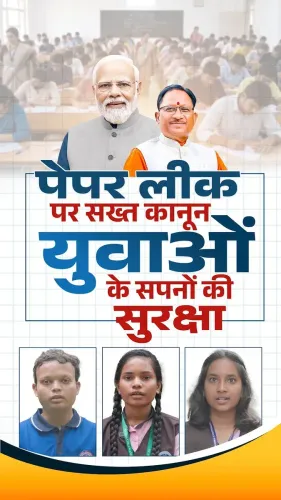
Chhattisgarh Chief Minister Vishnu Deo Sai on 24 July 2026 praised Prime Minister Narendra Modi's resolve to act strictly against exam paper leaks, calling it unprecedented. The endorsement aligns with the Centre's Public Examinations (Prevention of Unfair Means) Act, 2024, which prescribes up to 10 years' imprisonment for organised paper leak offences.
Key Takeaways
CM Vishnu Deo Sai called PM Modi's anti-paper-leak resolve 'unprecedented' in a post on X on 24 July 2026 .
The Union government enacted the Public Examinations (Prevention of Unfair Means) Act, 2024 , prescribing up to 10 years' imprisonment and fines of up to Rs 1 crore for paper leak offences.
High-profile leaks in NEET-UG and central recruitment tests sparked the legislative push and nationwide student protests.
Technological safeguards including multi-layer encryption of question papers are being deployed for the 2025–26 recruitment cycle.
State-level adoption of the 2024 Act by governments such as Chhattisgarh is the next critical implementation step.
Millions of exam aspirants stand to benefit if coordinated central-state action restores credibility to competitive examinations.
Chhattisgarh Chief Minister Vishnu Deo Sai on Friday, 24 July 2026, publicly lauded Prime Minister Narendra Modi's commitment to taking strict action against paper leaks in public examinations, calling the resolve 'unprecedented' in a post on X.
In his post, Chief Minister Sai wrote: 'Mananiya Pradhanmantri Shri Narendra Modi ji ka paper leak ke viruddh sakht karvai ka sankalp abhutpurva hai' — translated as, 'Honourable Prime Minister Shri Narendra Modi ji's resolve to take strict action against paper leaks is unprecedented.' The post was addressed directly to @narendramodi and @BJP4India, signalling coordinated messaging between the BJP's central leadership and state governments.
Context
The statement comes against the backdrop of a sustained national conversation around examination integrity. Over the past two years, high-profile paper leaks — most notably in the NEET-UG undergraduate medical entrance examination and several central recruitment tests — triggered widespread protests by students and prompted demands for systemic reform. The incidents exposed vulnerabilities in the management and distribution of question papers across multiple agencies.
Chief Minister Sai's endorsement reflects the alignment of the Bharatiya Janata Party (BJP)-led state government in Chhattisgarh with the Centre's stance on treating examination malpractice as a serious governance failure rather than an administrative lapse.
Policy Backdrop
The Union government enacted the Public Examinations (Prevention of Unfair Means) Act, 2024, a landmark piece of central legislation that prescribes up to 10 years' imprisonment and fines of up to Rs 1 crore for those found guilty of organising or facilitating paper leaks. The law was framed as a deterrent targeting the organised criminal networks that profit from selling question papers to aspirants.
Beyond legislative action, successive BJP-led administrations have pushed for technological safeguards, including multi-layer encryption of question papers and centralised digital examination infrastructure, to reduce human intervention at vulnerable points in the distribution chain. These measures are expected to be more widely deployed during the 2025–26 recruitment cycles.
Stakeholders and Impact
The stakes are high for millions of exam aspirants across India who depend on competitive examinations for access to higher education and government employment. Paper leaks not only compromise the fairness of these tests but also erode public trust in state and central recruitment agencies, forcing costly re-examinations that delay career prospects for lakhs of candidates.
State education departments and recruitment bodies such as staff selection commissions are the primary implementing arms. Chhattisgarh, like other states, is expected to align its own examination administration with the standards set by the 2024 Act, bringing local recruitment tests under the same legal deterrent framework.
What's Next
Attention will now turn to state-level adoption of the Public Examinations (Prevention of Unfair Means) Act, 2024 and the pace at which digital examination infrastructure is rolled out across recruitment cycles. Chief Minister Sai's public endorsement signals that Chhattisgarh is likely to position itself as an active partner in the Centre's anti-paper-leak drive. If state governments move in concert with the Centre's legislative and technological push, it could mark a significant shift in how India conducts large-scale competitive examinations — with credibility and fairness restored as a policy priority.
Point of View
Sai is also drawing a contrast with opposition-governed states where implementation of the Act may be slower. The move suggests the party intends to make examination reform a visible, trackable governance deliverable ahead of future electoral cycles.
NationPress
22 Oct 2026
Frequently Asked Questions
What did Chhattisgarh CM Vishnu Deo Sai say about paper leaks?
CM Vishnu Deo Sai praised Prime Minister Narendra Modi's resolve to take strict action against paper leaks, calling it 'unprecedented' in a post on X on 24 July 2026.
What is the Public Examinations (Prevention of Unfair Means) Act, 2024?
It is a central law enacted in 2024 that prescribes up to 10 years' imprisonment and fines of up to Rs 1 crore for individuals found guilty of organising or facilitating paper leaks in public examinations.
Which exams were affected by paper leaks in India?
The NEET-UG undergraduate medical entrance examination and several central government recruitment tests were among the most high-profile examinations affected by paper leak incidents that prompted the 2024 legislation.
How is the government preventing paper leaks in India?
The government has enacted strict legislation under the 2024 Act and is also deploying technological measures such as multi-layer encryption of question papers and centralised digital examination infrastructure to reduce malpractice.
What is Chhattisgarh's role in the anti-paper-leak drive?
As a BJP-governed state, Chhattisgarh is expected to align its examination administration with the 2024 Act. CM Sai's public endorsement of PM Modi's stance signals the state's intent to actively participate in the Centre's anti-paper-leak framework.