CM Vishnu Deo Sai attends BJP Mahila Morcha state committee meet
Synopsis
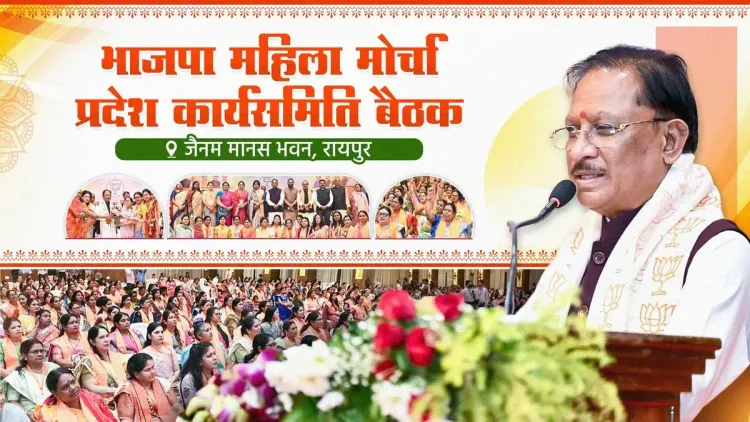
Chhattisgarh Chief Minister Vishnu Deo Sai attended the BJP Mahila Morcha's state executive committee meeting on November 17, hailing women party workers as essential to booth-level organisation and door-to-door delivery of government welfare schemes.
Key Takeaways
CM Vishnu Deo Sai attended the BJP Mahila Morcha Pradesh Karyasamiti meeting on November 17, 2026 .
He credited Mahila Morcha workers with strengthening the party down to the booth level across Chhattisgarh.
Women workers are described as key to connecting women citizens to the organisation and delivering government welfare schemes door to door .
The BJP has governed Chhattisgarh since December 2023 , with women's wing outreach integrated into its welfare-delivery strategy.
This model — coupling party organisation with scheme promotion via the Mahila Morcha — is replicated across multiple BJP-ruled states .
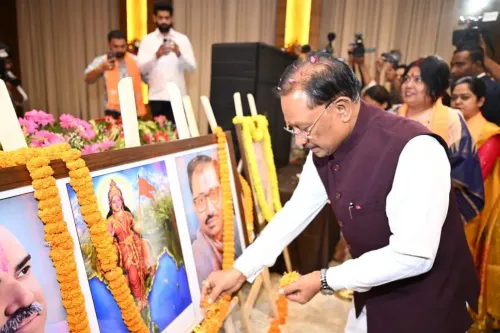
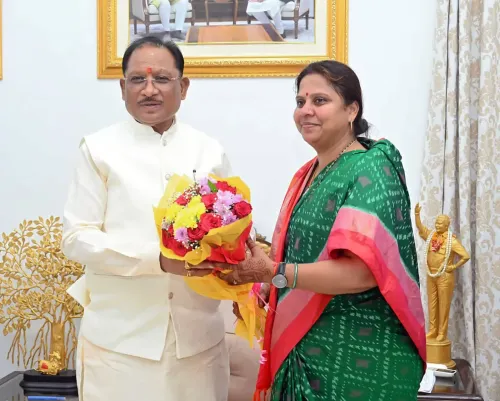
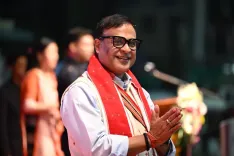
Chhattisgarh Chief Minister Vishnu Deo Sai joined the BJP Mahila Morcha's Pradesh Karyasamiti (state executive committee) meeting on Tuesday, November 17, saluting women party workers as the living spine of booth-level organisation and welfare outreach across the state.
Posting on X in Hindi, CM Sai wrote: 'Nari Shakti ka sashakt netritva aur sakriya bhagidari sangathan evam samaj ko nayi urja deti hai' — 'The empowered leadership and active participation of women's power gives fresh energy to the organisation and society.' He specifically acknowledged Mahila Morcha members for their role in strengthening the party down to the booth level, connecting women to the organisation, and carrying government welfare schemes 'door to door.'
Booth-to-household: what the Mahila Morcha actually does
The BJP Mahila Morcha is the party's dedicated women's wing, tasked with grassroots mobilisation across Chhattisgarh's blocks, mandals, and individual booths. In a state where large swathes of the population live in rural and tribal belts, the booth is the last democratic unit — and the Morcha's reach there determines how effectively government schemes translate from notification to kitchen table.
Since the BJP returned to power in Chhattisgarh in December 2023, the state unit has emphasised linking party organisation-building directly with welfare delivery. Women workers effectively become informal extension agents for schemes targeting female beneficiaries — health, nutrition, housing, and self-help group programmes — amplifying government communication in areas where formal outreach is thin.
A pattern repeated across BJP-ruled states
This is not an isolated exercise. BJP state units across the country have replicated the Mahila Morcha model of coupling organisational meetings with welfare-scheme promotion, treating female voter outreach and grassroots party-building as a single, integrated task. Pradesh Karyasamiti sessions serve as calibration points — where senior leadership listens, recalibrates messaging, and re-energises ground-level cadres before the next electoral or programmatic cycle.
CM Sai's public acknowledgement — using the phrase 'sankalp, samarthya aur sevabhav' (resolve, capability, and spirit of service) — signals that the Chhattisgarh government views Mahila Morcha not merely as a political auxiliary but as an active delivery mechanism for public welfare.
The women who carry welfare schemes door to door today are also the booth managers who shape electoral outcomes tomorrow — in Chhattisgarh, that dual role has never been more visible.
Point of View
Using women cadres as the last-mile link between government schemes and beneficiaries. In Chhattisgarh — a state with significant rural and tribal constituencies — this dual-role model for women workers carries both electoral logic and genuine administrative utility. The public salute to 'resolve, capability, and spirit of service' also reinforces a broader BJP narrative of Nari Shakti (women's power) that has become central to the party's identity in state-level politics since 2014. How well the Morcha's booth-level networks actually translate into scheme coverage and voter trust will be the real test heading into the next electoral cycle.
NationPress
17 Nov 2026
Frequently Asked Questions
What is the BJP Mahila Morcha and what does it do in Chhattisgarh?
The BJP Mahila Morcha is the women's wing of the Bharatiya Janata Party. In Chhattisgarh, it mobilises women at the booth level, connects them to the party organisation, and helps communicate government welfare schemes directly to households across the state.
What was the BJP Mahila Morcha Pradesh Karyasamiti meeting on November 17, 2026?
It was a state executive committee meeting of the BJP Mahila Morcha in Chhattisgarh, attended by Chief Minister Vishnu Deo Sai, focused on strengthening booth-level organisation and promoting women-centric government welfare programmes.
Who is Vishnu Deo Sai and when did he become Chhattisgarh CM?
Vishnu Deo Sai is a senior BJP leader and Chief Minister of Chhattisgarh. He assumed office in December 2023 after the BJP won the state assembly elections.
How does the BJP use Mahila Morcha for welfare delivery in states?
BJP state units use Mahila Morcha workers as grassroots mobilisers who simultaneously build party organisation and act as informal outreach agents for government welfare schemes, particularly in rural areas where formal delivery mechanisms are limited.
What did CM Vishnu Deo Sai say at the Mahila Morcha meeting?
CM Sai said that the empowered leadership and active participation of women gives fresh energy to the organisation and society, and saluted Mahila Morcha members for their resolve, capability, and spirit of service in strengthening the party and delivering welfare schemes door to door.