CM Sai Cabinet Clears Two Rural Jobs, Livelihood Schemes
Synopsis
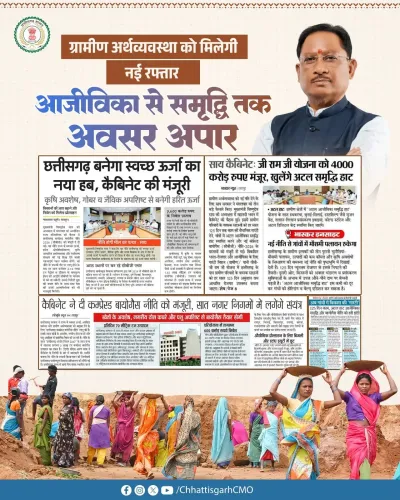
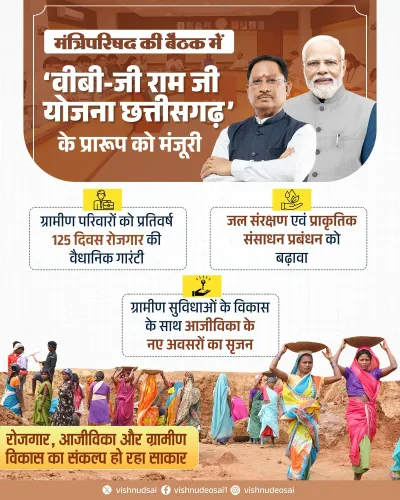
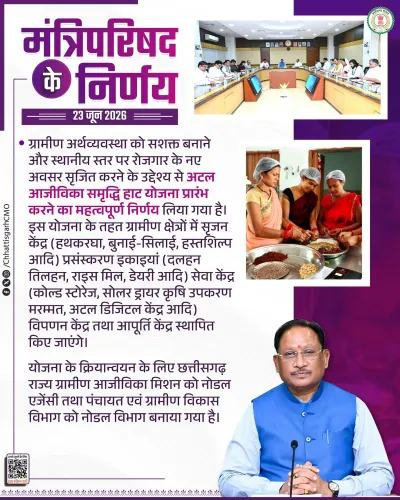
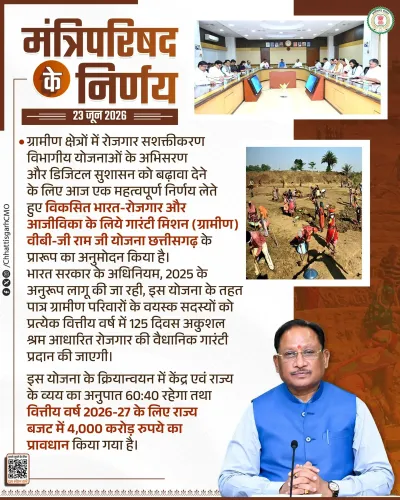
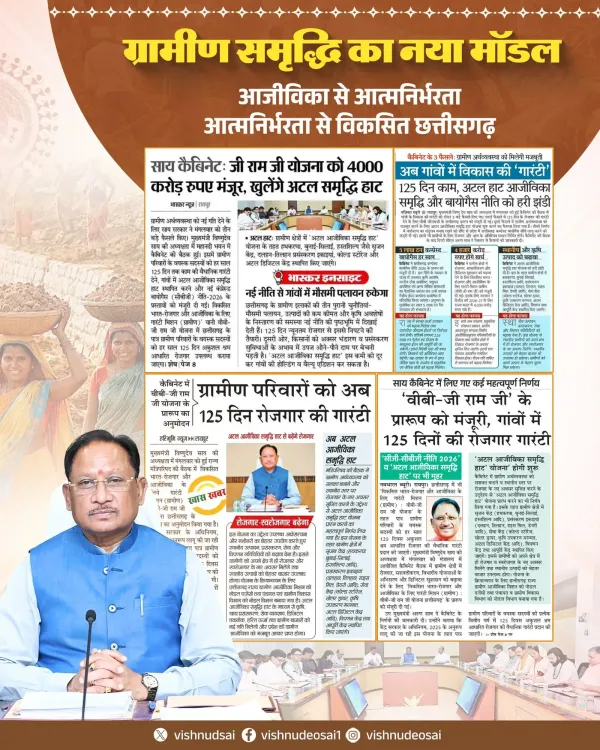
Chhattisgarh CM Vishnu Deo Sai announced cabinet approval for two rural schemes on 24 June 2026: the VB-G Ram Ji Yojana, promising 125 days of employment to rural households, and the Atal Ajeevika Samridhi Haat, designed to boost village-level production and self-employment.
Key Takeaways
The Chhattisgarh Council of Ministers approved two rural development schemes on 24 June 2026 .
The VB-G Ram Ji Yojana aims to guarantee 125 days of wage employment to rural households, extending the central MGNREGA entitlement of 100 days by 25 days.
The Atal Ajeevika Samridhi Haat scheme targets local production, employment, and self-employment in villages through organised market platforms.
CM Vishnu Deo Sai framed the decisions as part of a larger goal of building a 'developed Chhattisgarh' through livelihood and self-reliance.
Detailed implementation guidelines, budgetary allocations, and district-level rollout plans are yet to be announced.
Chhattisgarh Chief Minister Vishnu Deo Sai announced on Wednesday, 24 June 2026 that the state Council of Ministers has approved two major rural development schemes aimed at guaranteeing employment and boosting self-reliance in villages across the state.
Context
Posting on X, CM Sai said the cabinet had cleared the framework for the 'VB-G Ram Ji Yojana' (VB-G Ram Ji Yojana), describing it as a step toward guaranteeing 125 days of wage employment to rural households. A second scheme, 'Atal Ajeevika Samridhi Haat' (Atal Ajeevika Samridhi Haat), was also approved to accelerate local production, employment, and self-employment in villages. In his words, the decisions mark 'an important step toward realising the resolve of moving from livelihood to self-reliance, and from self-reliance to a developed Chhattisgarh.'
Policy Backdrop
The announcements build on the architecture of the Mahatma Gandhi National Rural Employment Guarantee Act (MGNREGA), the central legislation enacted in 2005 that guarantees up to 100 days of wage employment per year to rural households across India. The proposed VB-G Ram Ji Yojana would, if implemented, extend that floor by 25 additional days, placing Chhattisgarh among states that have supplemented the central framework with state-funded top-ups to address seasonal unemployment gaps.
The Atal Ajeevika Samridhi Haat scheme follows a broader national pattern of establishing rural market platforms to give village producers direct access to buyers, reduce dependence on intermediaries, and promote value addition of locally made goods — a model aligned with the Atmanirbhar Bharat framework launched at the central level in 2020. Chhattisgarh, with its large tribal and agrarian population, has historically been a significant beneficiary of rural employment programmes.
Stakeholders and Impact
The primary beneficiaries of both schemes are rural households in Chhattisgarh, particularly those dependent on agricultural wages and seasonal labour. The VB-G Ram Ji Yojana targets income security during lean agricultural seasons, while the Atal Ajeevika Samridhi Haat is designed to create sustained market linkages for village-level producers and artisans.
Self-help group members, small farmers, and cottage-industry workers stand to benefit from the haat network, which is intended to provide organised platforms for trade and entrepreneurship at the gram panchayat or block level. The Chhattisgarh Council of Ministers, chaired by CM Sai, approved the draft frameworks; detailed operational guidelines, budgetary allocations, and rollout timelines are yet to be formally notified.
What's Next
The state government is expected to release implementation guidelines, district-wise rollout plans, and budgetary allocations for both schemes in the coming months. The success of the VB-G Ram Ji Yojana will depend on the state's capacity to fund the additional 25 days beyond the central MGNREGA entitlement and on convergence with existing district administration machinery. The Atal Ajeevika Samridhi Haat network will require site selection, infrastructure development, and vendor registration processes before it becomes operational on the ground.
Point of View
CM Sai is echoing a pattern seen in other BJP-ruled states of layering state-funded schemes atop central programmes to claim visible welfare delivery. The 'Haat' model also reflects a wider ideological preference for market-based livelihood platforms over direct cash transfers. Whether these frameworks translate into measurable on-ground outcomes will hinge on the pace and quality of implementation, which remains to be seen.
NationPress
24 Jun 2026
Frequently Asked Questions
What is the VB-G Ram Ji Yojana in Chhattisgarh?
The VB-G Ram Ji Yojana is a state scheme approved by the Chhattisgarh Council of Ministers on 24 June 2026 that aims to guarantee 125 days of wage employment to rural households, going beyond the 100-day entitlement under the central MGNREGA.
What is the Atal Ajeevika Samridhi Haat scheme?
The Atal Ajeevika Samridhi Haat is a Chhattisgarh government scheme approved in June 2026 to establish village-level market platforms that promote local production, employment, and self-employment among rural communities.
How many days of employment does the new Chhattisgarh scheme guarantee?
The VB-G Ram Ji Yojana proposes to guarantee 125 days of employment to rural households, which is 25 days more than the 100-day annual guarantee under the central Mahatma Gandhi National Rural Employment Guarantee Act.
Who approved the rural schemes announced by CM Vishnu Deo Sai?
The Chhattisgarh Council of Ministers, chaired by Chief Minister Vishnu Deo Sai, approved the draft frameworks for both schemes on 24 June 2026.
When will the Chhattisgarh rural employment and haat schemes be implemented?
Detailed implementation guidelines, budgetary allocations, and district-wise rollout timelines for both schemes have not yet been formally notified and are expected to be released in the coming months.