CM Sai Declares Naxalism Eradicated in Chhattisgarh

Synopsis
Chhattisgarh Chief Minister Vishnu Deo Sai declared on 13 October 2026 that Naxalism has been eliminated in the state, crediting PM Modi's guidance, Home Minister Amit Shah's resolve, and the courage of security forces, as the state charts a path toward peace and prosperity.
Key Takeaways
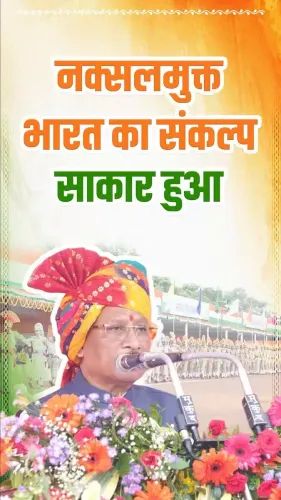
CM Vishnu Deo Sai declared on 13 October 2026 that Naxalism has been eradicated in Chhattisgarh .
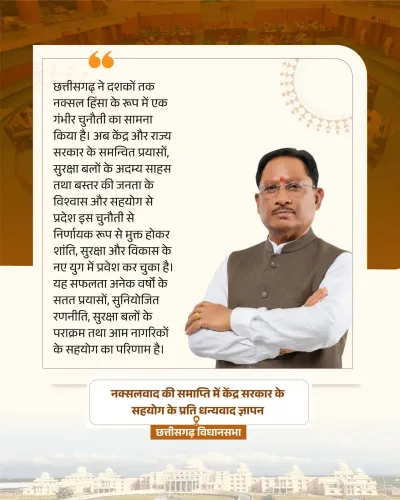
He credited PM Narendra Modi , Home Minister Amit Shah , and the state's security forces for the outcome.
Chhattisgarh has historically been the most affected state in India's Red Corridor of Left-Wing Extremism.
The BJP government, since taking office in December 2023 , intensified clearance operations in Bastar and Sarguja divisions.
A 2015 MHA National Policy established the dual-track framework of security operations and development that underpins the campaign.
The MHA annual LWE report and rollout of development packages in newly peaceful districts will be the key markers to watch.
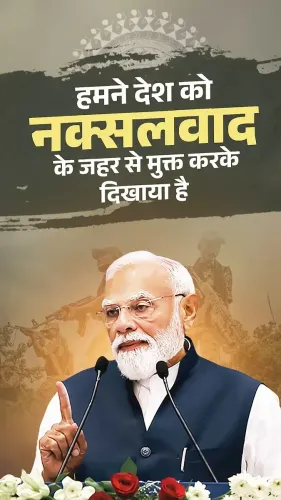
For decades, the dense forests of Chhattisgarh were the beating heart of India's deadliest internal insurgency — a shadow conflict that swallowed lives, blocked roads, and froze development across entire tribal districts. On Tuesday, 13 October 2026, Chhattisgarh Chief Minister Vishnu Deo Sai made a sweeping declaration on X: Naxalism, he said, has been finished, and the state is now moving toward a new era of peace, security, and prosperity.
Writing in Hindi, CM Sai credited three pillars for what he described as the insurgency's end: the guidance of Prime Minister Narendra Modi, the 'firm resolve' (dridh ichchhashakti) of Union Home Minister Amit Shah, and the 'indomitable courage' (adamya sahas) of security forces deployed in the state's most volatile districts. 'Naxalism has been eliminated,' he posted. 'Chhattisgarh is now moving towards a new era of peace, security and prosperity.'
From the Red Corridor to the Road Out
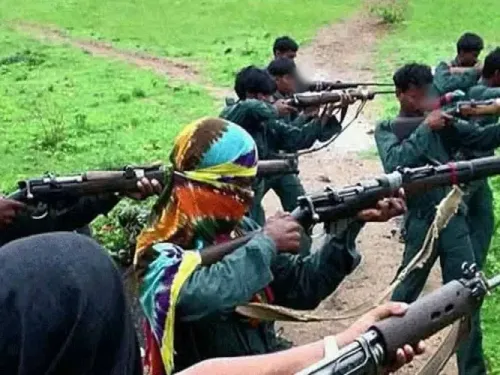
Chhattisgarh has long been the most resistant pocket of India's so-called Red Corridor — the belt of forested, mineral-rich districts stretching across central and eastern India where Maoist cadres once ran parallel administrations, collected levies, and targeted security personnel with devastating regularity. The state accounted for a disproportionate share of Left-Wing Extremism (LWE) fatalities recorded in Ministry of Home Affairs annual reports over the past two decades.
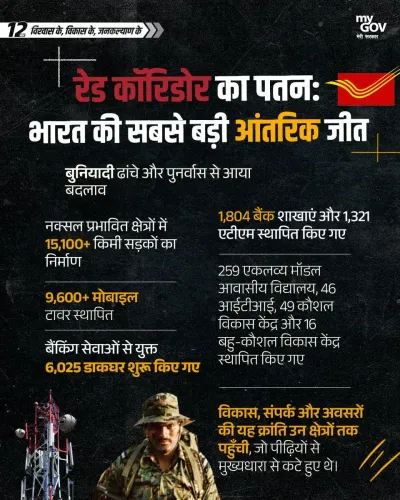
The policy architecture behind the push dates to 2015, when the MHA formalised a dual-track National Policy and Action Plan — combining sustained security operations with an accelerated development drive in LWE-affected districts. Roads, schools, mobile connectivity, and banking access were pushed into areas that had been effectively no-go zones. Official data over the subsequent decade tracked a measurable, if uneven, decline in violence.
Bastar Operations and the BJP Government's Intensified Push
When the BJP returned to power in Chhattisgarh after the 2023 assembly elections, the new government under CM Sai — who took office in December 2023 — moved to intensify clearance operations specifically in the Bastar and Sarguja divisions, the two regions historically most entrenched with Naxal presence. Central paramilitary forces coordinated with state police in a sequence of operations through 2024 and 2025 that security officials described as the most sustained offensive in the insurgency's history.
The human cost on the insurgent side, and the policy gains on the ground, fed a political narrative in New Delhi that the Modi government had finally turned a definitive corner on the LWE problem — one that had plagued governments of multiple political stripes since the late 1960s.
What the Declaration Means — and What Comes Next
CM Sai's post is a political milestone, marking the state government's formal position that organised Naxal resistance has collapsed. The next concrete test will be the release of the MHA's annual LWE report, which independently tracks incident counts, fatalities, and district-level threat classifications — and will serve as the authoritative public record against which this claim is measured.
Equally important is the speed with which special development packages reach districts newly classified as peaceful. Tribal communities in Bastar have lived through multiple cycles of promised reconstruction; delivery of roads, healthcare, and livelihood schemes now carries both an economic and a political weight.
A state once defined by the sound of improvised explosives in forested corridors is now, its chief minister insists, ready to be defined by something else entirely. Whether the infrastructure follows the declaration will determine whether this moment becomes a turning point or a talking point.
Point of View
But Chhattisgarh consistently remained the outlier. The post signals that the government is now confident enough to move from 'containment' language to 'victory' language, raising the stakes for the development delivery that must follow. If infrastructure and welfare reach Bastar's tribal communities at scale, the declaration becomes a governance legacy; if it stalls, it becomes a political liability.
NationPress
13 Oct 2026
Frequently Asked Questions
Has Naxalism really ended in Chhattisgarh?
Chief Minister Vishnu Deo Sai declared on 13 October 2026 that Naxalism has been eliminated in Chhattisgarh. Official MHA data over the past decade shows a substantial reduction in LWE violence, though the MHA's next annual report will provide an independent incident-based assessment of the current situation.
What operations did the Chhattisgarh government conduct against Naxals?
After the BJP government took office in December 2023, it intensified security operations in the Bastar and Sarguja divisions — historically the most Naxal-affected areas — coordinating central paramilitary forces with state police through 2024 and 2025 in what officials described as the most sustained offensive in the insurgency's history.
What is the Red Corridor?
The Red Corridor refers to the belt of forested, mineral-rich districts across central and eastern India where Maoist (Naxalite) insurgents maintained a strong presence for decades. Chhattisgarh, particularly its Bastar region, was considered the most entrenched part of this corridor.
What is India's national policy on Left-Wing Extremism?
In 2015, the Ministry of Home Affairs formalised a National Policy and Action Plan on LWE, combining sustained security operations with accelerated development — roads, banking, mobile connectivity, and schools — in affected districts. This dual-track framework has guided both central and state government responses since.
Who is Vishnu Deo Sai?
Vishnu Deo Sai is a BJP leader who became Chief Minister of Chhattisgarh in December 2023 after the party's victory in the state assembly elections. He is a tribal leader from Jashpur and has been a member of parliament previously.