CM Sai: Chhattisgarh Sheds Naxal Shadow, Eyes Investment Era
Synopsis
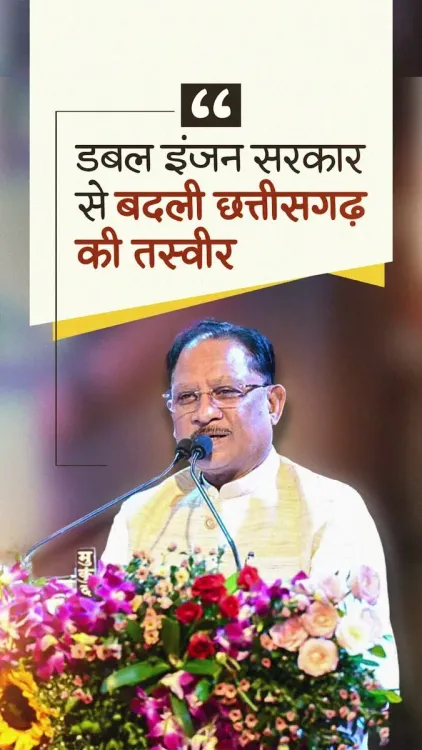
Chief Minister Vishnu Deo Sai declared on 1 August 2026 that Chhattisgarh has transformed from a Naxalism-defined state into one of peace and development, crediting the Double Engine Government, security forces, and Bastar's people for a decisive shift.
Key Takeaways
CM Vishnu Deo Sai declared on 1 August 2026 that Chhattisgarh has built a new identity of peace, trust, and development, replacing its long association with Naxalism.
He credited the Double Engine Government — aligned BJP administrations at state and centre — alongside security forces and the people of Bastar .
Bastar , the southern Chhattisgarh division, was the epicentre of Left-Wing Extremism for over two decades since the state's formation in 2000 .
The central government's SAMADHAN strategy (late 2010s) formalised a twin-track approach of security operations and development delivery in affected districts.
Sai took office in December 2023 and has consistently linked anti-Naxal operations with efforts to attract investment into the mineral-rich state.
Hashtags #NaxalFreeChhattisgarh and #ViksitChhattisgarh signal the government's intent to rebrand the state as an investment destination.
For decades, the name Chhattisgarh carried an unwanted association — a state where Naxalite violence defined the headlines and stunted development. On Saturday, 1 August 2026, Chief Minister Vishnu Deo Sai, through the Chief Minister's Office of Chhattisgarh, declared that chapter decisively closed.
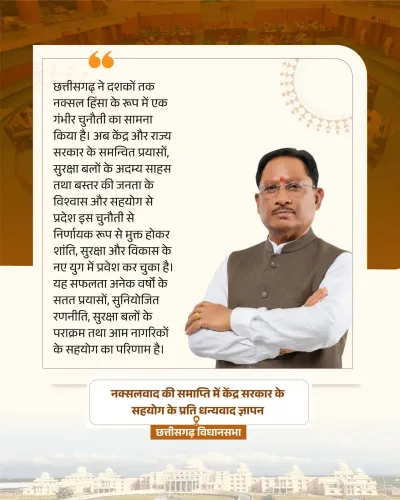
In a message posted on X, CM Sai wrote: 'Chhattisgarh ab pehle wala Chhattisgarh nahin raha' — 'Chhattisgarh is no longer the Chhattisgarh it once was.' The state that was long defined by Naxalism, he said, has now built a new identity rooted in peace, trust, and development. He credited the 'Double Engine Government' — the alignment of the BJP-led state and central administrations — alongside the courage of security forces and the cooperation of the people of Bastar.
Bastar's Long Shadow — and What Changed
Bastar, the sprawling southern division of Chhattisgarh, became the geographic heart of India's Left-Wing Extremism crisis after the state was carved out of Madhya Pradesh on 1 November 2000. Its dense forests and tribal hinterland provided cover for Maoist networks for more than two decades. Successive governments — state and central — combined paramilitary operations with surrender-rehabilitation schemes and infrastructure pushes, but the violence proved stubborn. The central government's SAMADHAN strategy, introduced in the late 2010s, formalised this twin-track approach: security pressure paired with accelerated welfare delivery in affected districts. The framework set the stage for the intensified operations that followed.Sai Government's Security-Development Pitch
CM Sai took office in December 2023 after the Bharatiya Janata Party won the Chhattisgarh assembly elections, ending a five-year Congress tenure. His government has consistently framed anti-Naxal operations and investment attraction as two sides of the same coin — the argument being that lasting peace is the precondition for capital inflow into a mineral-rich state that has long underperformed its economic potential. Saturday's post sharpens that narrative, signalling to potential investors that the security environment in previously volatile districts has shifted. The hashtags #NaxalFreeChhattisgarh and #ViksitChhattisgarh ('Developed Chhattisgarh') make the political branding explicit. The tribal communities of Bastar — the people most directly caught between insurgent pressure and security operations for generations — stand as the clearest measure of whether this transition holds. Their livelihoods, land rights, and access to services will determine whether the 'new identity' the Chief Minister describes translates into lived reality. If the peace holds and investment follows, Chhattisgarh's transformation from India's most troubled insurgency zone to a development frontier would be one of the decade's most consequential governance stories. That verdict is still being written.Point of View
Useful ahead of any future electoral cycle. The emphasis on investment and development suggests the administration is now trying to convert reduced violence into tangible economic dividends, a transition that has historically proven harder than the security gains themselves. Whether official Left-Wing Extremism incident data corroborates the scale of the claimed transformation will be the key test of this narrative's durability.
NationPress
16 Sept 2026
Frequently Asked Questions
Is Chhattisgarh Naxal free in 2026?
The Chhattisgarh government has claimed a decisive blow against Naxalism, with CM Vishnu Deo Sai stating the state has built a new identity of peace and development. However, independent verification of a complete end to Left-Wing Extremism in the state requires official Ministry of Home Affairs incident data.
Who is Vishnu Deo Sai?
Vishnu Deo Sai is the Chief Minister of Chhattisgarh, a Bharatiya Janata Party leader who assumed office in December 2023 after the BJP won the state assembly elections.
What is the Double Engine Government in Chhattisgarh?
'Double Engine Government' is the BJP's term for having aligned party governments at both the state and central levels, arguing that policy coordination accelerates development and security outcomes.
Why was Bastar so affected by Naxalism?
Bastar 's dense forests, remote tribal hinterland, and historical underdevelopment made it a stronghold for Maoist-Naxalite networks for over two decades after Chhattisgarh's formation in 2000 .
What is the SAMADHAN strategy for Naxalism?
SAMADHAN is a central government framework introduced in the late 2010s that combines sustained security operations with accelerated development and welfare delivery in Left-Wing Extremism-affected districts.