CM Sai Backs Modi's Claim on Defeating Naxalism at NDA Meet
Synopsis
At the NDA convention in New Delhi, Chhattisgarh CM Vishnu Deo Sai quoted PM Modi declaring that India has been freed from the 'poison' of Naxalism-Maoism — a claim the BJP is positioning as a landmark governance achievement of the Modi era.
Key Takeaways
Chhattisgarh CM Vishnu Deo Sai shared a quote from PM Narendra Modi at the NDA convention, Bharat Mandapam, New Delhi on June 11, 2026 .
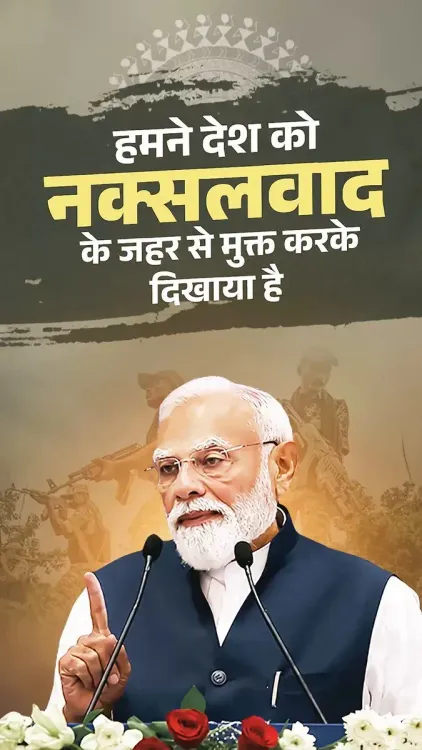
Modi declared that India had been freed from the 'poison' of Naxalism-Maoism, calling it a feat once considered impossible.
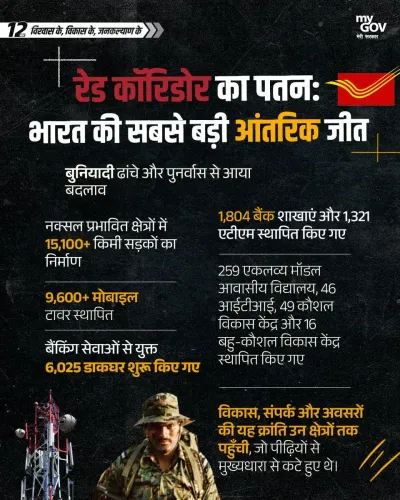
The central government's SAMADHAN doctrine (2017) has guided an integrated security-plus-development approach to Left Wing Extremism.
Official data cited a reduction in Naxal-affected districts from 126 to under 90 between 2019 and 2023 .
Chhattisgarh remains the most frequently cited state in government accounts of declining Maoist violence.
The BJP is expected to highlight the anti-Naxal record as a key governance achievement ahead of future elections.
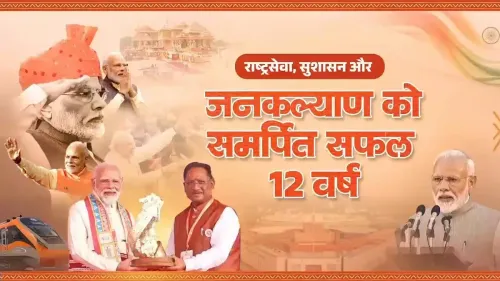
Chhattisgarh Chief Minister Vishnu Deo Sai on Thursday, June 11, 2026, shared a statement by Prime Minister Narendra Modi delivered at the National Democratic Alliance convention at Bharat Mandapam, New Delhi, amplifying the assertion that India has freed itself from the 'poison' of Naxalism and Maoism.
Quoting the Prime Minister directly, Sai posted: 'Pehle yeh maan liya gaya tha ki Naxalwad-Maoism ab kabhi nahi khatam hone wale.' ['It was earlier assumed that Naxalism-Maoism would never end.'] Modi was quoted adding: 'We have shown the country that it can be freed from this poison of Naxalism-Maoism.'
Context
The remarks were made at the NDA convention held at Bharat Mandapam, New Delhi, a gathering of the BJP-led ruling coalition. Chief Minister Sai, who leads Chhattisgarh — the state most associated with Left Wing Extremism (LWE) in India — shared the quote under the hashtag #LongestServingElectedPMModi, framing it as a governance milestone of the Modi administration.
Chhattisgarh has for decades been the epicentre of Maoist violence, with its forested Bastar region witnessing sustained conflict between security forces and armed cadres of the Communist Party of India (Maoist). The state's tribal communities and security personnel have borne the heaviest costs of this insurgency.
Policy Backdrop
The BJP-led central government has pursued an integrated approach to Left Wing Extremism since 2014, expanding paramilitary deployments while simultaneously pushing road, telecom, and financial-inclusion infrastructure into previously inaccessible forest belts. In 2017, the Ministry of Home Affairs formalised this as the SAMADHAN doctrine — an acronym covering smart leadership, aggressive strategy, motivation, actionable intelligence, dashboard-based monitoring, harnessing technology, and no access to financing.
Official Home Ministry data has cited a reduction in the number of Naxal-affected districts from 126 to under 90 over the 2019–2023 period. The government's narrative has consistently contrasted its security-led approach with earlier administrations, which it characterises as having treated Naxalism primarily as a socio-economic problem requiring restraint rather than resolution.
The UPA government had launched Operation Green Hunt in late 2009 as a multi-state offensive, but critics and successive governments argued the effort lacked sustained follow-through in development and governance delivery.
Stakeholders and Impact
The communities most directly affected by any decline in LWE violence are the tribal populations of central India — particularly in Chhattisgarh, Jharkhand, Odisha, and Telangana — who have lived under the dual pressure of Maoist coercion and security-force operations for decades. Improved access to roads, schools, and banking in these areas is frequently cited by the government as evidence of territorial recovery.
Security forces, including the Central Reserve Police Force and state police, have recorded significant casualties over the years; official accounts point to a declining trend in Maoist-initiated incidents in recent years. Surrender-and-rehabilitation programmes have also been expanded under both the central and state governments.
What's Next
The Home Ministry is expected to release updated district-level LWE data ahead of the monsoon session of Parliament, where internal security allocations are likely to face scrutiny. Any formal declaration of a 'Naxal-free India' — implied but not explicitly stated in Modi's quoted remark — would require sustained verification across the remaining affected districts. Chief Minister Sai's amplification of the Prime Minister's words signals that the BJP intends to make the anti-Naxal record a central political theme heading into future electoral cycles, with Chhattisgarh positioned as the flagship proof point.
Point of View
Moving from 'reducing Naxalism' to 'eliminating' it. The choice of Bharat Mandapam and an NDA-wide convention as the venue signals that the party intends to nationalise what has largely been a state-level security story. For Vishnu Deo Sai, sharing the quote is doubly strategic: it ties Chhattisgarh's ground-level security gains directly to central leadership, reinforcing both his own administration's credentials and the broader Modi governance narrative. The claim, however, will face rigorous scrutiny in Parliament and from affected communities, where the definition of 'free from Naxalism' will be contested.
NationPress
26 Oct 2026
Frequently Asked Questions
Has India completely eliminated Naxalism in 2026?
PM Modi, quoted by Chhattisgarh CM Vishnu Deo Sai at the NDA convention on June 11, 2026, claimed India has been freed from Naxalism-Maoism; however, official Home Ministry district-level data and parliamentary verification of this claim are still awaited.
What is the SAMADHAN doctrine on Naxalism?
The SAMADHAN doctrine, introduced by the Ministry of Home Affairs in 2017, is an integrated framework combining smart leadership, aggressive strategy, motivation, actionable intelligence, technology use, and cutting off Maoist financing to address Left Wing Extremism.
Which state is most affected by Naxalism in India?
Chhattisgarh, particularly its Bastar region, has historically been the most affected state, and the government most frequently cites it when reporting on declining Maoist violence.
What did PM Modi say about Naxalism at the NDA convention?
At the NDA convention at Bharat Mandapam, New Delhi, PM Modi stated that it was once assumed Naxalism-Maoism would never end, but that India had now been freed from this 'poison' — a quote shared on social media by Chhattisgarh CM Vishnu Deo Sai.
How many districts in India are still Naxal-affected?
According to official Home Ministry data cited in government records, the number of Naxal-affected districts declined from 126 to under 90 between 2019 and 2023; updated figures are expected ahead of the monsoon session of Parliament.