CM Sai Demands Unconditional Apology From Rahul Gandhi Over EVM Allegations
Synopsis
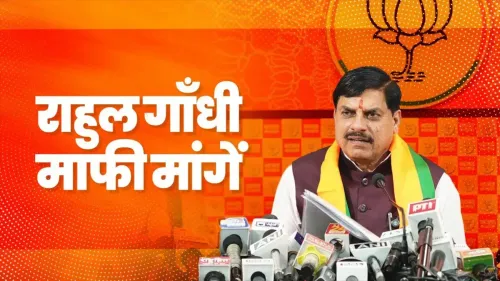
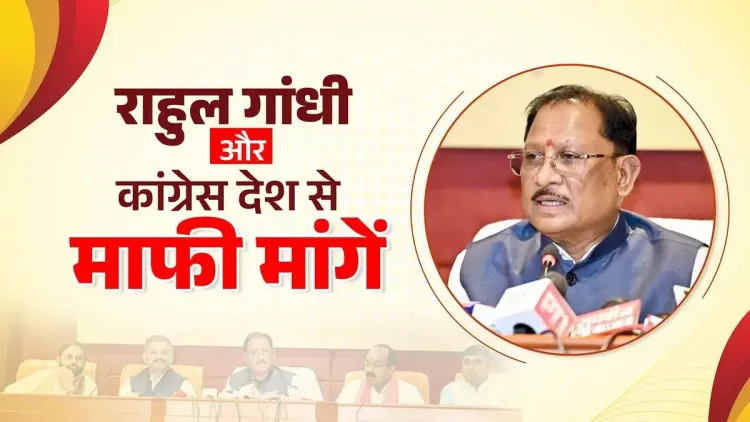
Chhattisgarh CM Vishnu Deo Sai, speaking in Raipur on September 27, demanded Rahul Gandhi and Congress offer an unconditional apology to India and its constitutional institutions for repeatedly alleging EVM tampering and maligning the Election Commission after electoral losses.
Key Takeaways
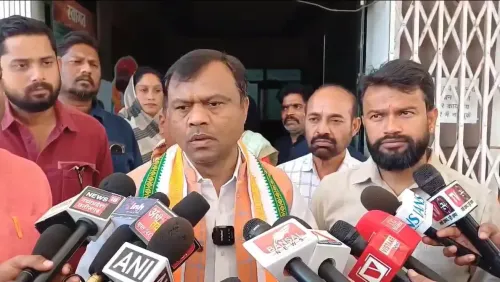
CM Vishnu Deo Sai held a press conference at Kushabhau Thakre Parisar, Raipur on September 27, 2026 .
He accused Congress and its allies of levelling false allegations against EVMs, constitutional institutions, and the Election Commission every time they lose elections.
Sai demanded that Rahul Gandhi and Congress offer an unconditional apology to the nation and its constitutional bodies.
He cited a 'complete and unanimous statement' by the Election Commission of India as the trigger for the apology demand.
The Election Commission has maintained since the nationwide EVM rollout in 2004 that the machines are standalone and tamper-proof, a position upheld by courts.
The BJP has consistently framed attacks on the ECI as an assault on the constitutional fabric of Indian democracy.
Every time the ballot boxes close and the results disappoint them, a familiar script plays out — and Chhattisgarh Chief Minister Vishnu Deo Sai has had enough of it. Speaking at a press conference at Kushabhau Thakre Parisar, Raipur, on Sunday, September 27, 2026, CM Sai directly called out Rahul Gandhi and the Indian National Congress, demanding they offer an unconditional apology to the nation and its constitutional institutions over repeated allegations against Electronic Voting Machines (EVMs) and the Election Commission of India.
In his post, CM Sai wrote in Hindi: 'Kaangres aur uske sahyogi dal jab chunaav haarte hain, to kabhi EVM par, kabhi samvaidhanik sansthaon par to kabhi chunaav aayog par jhuthe aarop lagaate hain.' — 'When Congress and its ally parties lose elections, they level false allegations — sometimes against EVMs, sometimes against constitutional institutions, and sometimes against the Election Commission.' He added that following a 'complete and unanimous statement' by the Election Commission, Rahul Gandhi and Congress owe the country and its constitutional bodies an unconditional apology.
The Long Paper Trail of EVM Distrust
This is not a new argument — it is a recurring flashpoint. In the aftermath of the 2019 Lok Sabha elections, senior Congress leaders including Rahul Gandhi publicly raised the spectre of EVM tampering and demanded a return to paper ballots. The Election Commission has consistently rejected these claims, maintaining that EVMs are standalone, tamper-proof machines, a position upheld repeatedly by the country's courts.
The ECI has conducted technical demonstrations and invited political parties to test the machines — a challenge that produced no verified evidence of manipulation. Yet the allegation has resurfaced after each major electoral reversal, cementing itself as a fixture of post-election political discourse.
BJP's Counter-Narrative: Defend the Umpire
The Bharatiya Janata Party's response to EVM criticism has consistently centred on one argument: that attacking the Election Commission is an attack on the constitutional framework of Indian democracy itself. CM Sai's statement from Raipur sharpens this line — framing Congress's allegations not merely as political grievances but as an affront to institutions that millions of voters trust.
What makes the demand for a public apology politically potent is its simplicity. It asks Congress to either stand by its allegations with evidence or retract them — and in the court of public opinion, silence on that binary is itself a statement.
For now, one question hangs over the opposition's response: if the institutions you question today delivered the democracy that put you in Parliament, what exactly are you asking voters to distrust?
Point of View
The BJP attempts to shift the burden of proof firmly onto Congress, forcing the opposition to either produce credible evidence of tampering or face the political cost of retreating from its own claims. The EVM debate has become a litmus test for how Indian parties handle electoral defeat, and each cycle it recurs, it erodes public confidence in institutions a little further — regardless of which side is correct. The apology demand is less about contrition and more about locking Congress into an uncomfortable public choice before the next electoral cycle.
NationPress
27 Sept 2026
Frequently Asked Questions
What did CM Vishnu Deo Sai say about Rahul Gandhi and EVMs?
CM Sai demanded that Rahul Gandhi and the Indian National Congress offer an unconditional public apology to the nation and its constitutional institutions for repeatedly alleging EVM tampering and maligning the Election Commission after electoral losses.
Why does Congress keep questioning EVMs?
Congress and several opposition parties have raised EVM reliability concerns after major electoral defeats, most prominently after the 2019 Lok Sabha elections, arguing machines could have been manipulated. The Election Commission has consistently denied these claims and courts have upheld EVM integrity.
What has the Election Commission said about EVM tampering allegations?
The Election Commission of India has maintained that EVMs are standalone, tamper-proof devices since their nationwide rollout in 2004. The Commission has conducted public technical demonstrations and invited parties to test machines, and courts have repeatedly upheld this position.
Where did Vishnu Deo Sai make this statement?
CM Vishnu Deo Sai made the statement at a press conference held at Kushabhau Thakre Parisar in Raipur, Chhattisgarh, on September 27, 2026.
What is the BJP's position on attacks against the Election Commission?
The BJP has consistently argued that allegations against the Election Commission constitute an attack on the constitutional framework of Indian democracy, and has defended the institution's independence in response to Congress-led criticism.