Anurag Thakur links education reform to India's $5-trillion goal
Synopsis
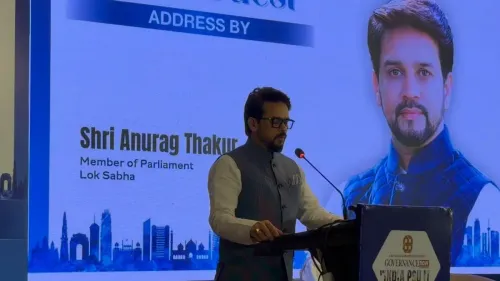
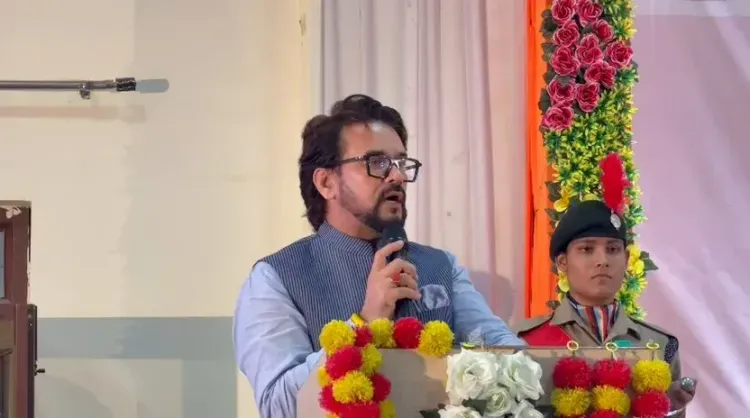
Speaking at Palampur, BJP MP Anurag Thakur called education a shared duty of both academia and the political class, tying a strong education system directly to India's $5-trillion economy ambition and technological self-reliance.
Key Takeaways
Anurag Thakur stated that education is the shared responsibility of both the academic community and elected politicians.
He directly linked the quality of India's education system to the national target of a $5-trillion economy , first set by PM Modi in 2019 .
Thakur argued that technological superiority and a knowledge-based economy depend on effective education reform.
The remarks were delivered at Palampur in Kangra district, Himachal Pradesh — within his own parliamentary constituency.
The National Education Policy 2020 provides the existing policy framework for the innovation-focused education overhaul Thakur referenced.
At Palampur in his home district of Kangra, Himachal Pradesh, BJP MP Anurag Thakur made a pointed case on Sunday, September 27, 2026: the ambition to build a knowledge economy and reach a $5-trillion GDP stands or falls on how seriously India upgrades its education system — and that responsibility belongs as much to elected representatives as to universities.
A shared responsibility beyond the classroom
Thakur's framing was deliberately inclusive. 'Education is our shared responsibility,' he said. 'It is not just the responsibility of academia, but of the political class as well.' The remark signals an acknowledgement that legislative attention — not just institutional reform — is required if India is to turn its demographic dividend into productive human capital.
He drew a direct line between classroom quality and macroeconomic ambition, arguing that India's 'plans and projections towards a $5-trillion economy' and its 'desire to achieve technological superiority' all hinge on how effectively the education system is strengthened. 'A nation having a very good education system,' he added, 'has more scope of ideas and innovations.'
The $5-trillion thread running through policy
Prime Minister Narendra Modi first articulated the $5-trillion economy target in 2019, framing it as a national milestone requiring structural reform across sectors. Education was built into that vision from the start: the National Education Policy 2020 was designed to shift India's school and higher-education architecture toward multidisciplinary learning, critical thinking, and innovation — the very ingredients Thakur invoked at Palampur.
Policy documents since 2014 have repeatedly tied human capital formation to goals of technological self-reliance and global competitiveness. Thakur's remarks, delivered in the constituency he represents in the Lok Sabha, reinforce that established linkage — while placing the onus squarely on the political class to follow through.
Why Palampur, and why it matters locally
Palampur sits in Kangra district, a largely agrarian and tourism-driven belt of Himachal Pradesh. For constituents here, the pivot to a knowledge economy is not abstract: it is about whether local youth find opportunities at home or migrate to cities for work. Connecting national macro-targets to the ground reality of a hill-state town gives Thakur's argument its sharpest edge.
With education outlays in successive Union Budgets and parliamentary debate on NEP 2020 implementation continuing to draw scrutiny, the political class's willingness to back rhetoric with resources will be the real test of the commitment Thakur is calling for.
Point of View
Not just institutions, he signals awareness that NEP 2020 risks stalling at the implementation stage without sustained political will. The framing also carries regional salience: in a state like Himachal Pradesh, where youth out-migration is a quiet crisis, connecting national economic ambition to local educational investment is a politically astute move. Watch whether this speech translates into parliamentary advocacy for higher education outlays when Budget season arrives.
NationPress
27 Sept 2026
Frequently Asked Questions
What did Anurag Thakur say about education at Palampur?
Thakur said education is a shared responsibility of both academia and the political class, and that India's $5-trillion economy target and technological ambitions depend on how effectively the education system is strengthened.
What is India's $5-trillion economy target?
India's $5-trillion GDP target was first set out by Prime Minister Narendra Modi in 2019 as a national economic growth milestone, requiring structural reforms including in education and human capital development.
What is the National Education Policy 2020?
The National Education Policy 2020 was approved by the Indian government to restructure school and higher education with a focus on multidisciplinary learning, innovation, and critical thinking — aligned with the knowledge-economy vision Thakur referenced.
Why did Anurag Thakur speak about education in Palampur?
Palampur is a town in Kangra district, Himachal Pradesh , which falls within Thakur's Hamirpur Lok Sabha constituency . Connecting national economic targets to local educational needs is relevant for constituencies where youth employment and out-migration are key concerns.
What is the connection between education and a knowledge-based economy in India?
Indian policy documents since 2014 have consistently linked human capital formation — through education reform — to goals of technological self-reliance and sustained high GDP growth, the foundation of a knowledge-based economy.