Anurag Thakur Calls for Parliament Debate on Student Justice
Synopsis
BJP MP Anurag Thakur on 23 July 2026 called for a structured parliamentary debate on education, urging the BJP under PM Modi to move beyond political blame and ensure no student faces injustice — directing his remarks publicly at party president JP Nadda.
Key Takeaways
BJP MP Anurag Thakur on 23 July 2026 called for a parliamentary debate on an education-related matter, moving beyond political accusations.
Thakur stated the Lok Sabha is the best forum for the discussion and that the BJP is ready for in-depth deliberation.
He asserted that PM Narendra Modi 's government is 'very serious' about education, framing children as the future of the nation.
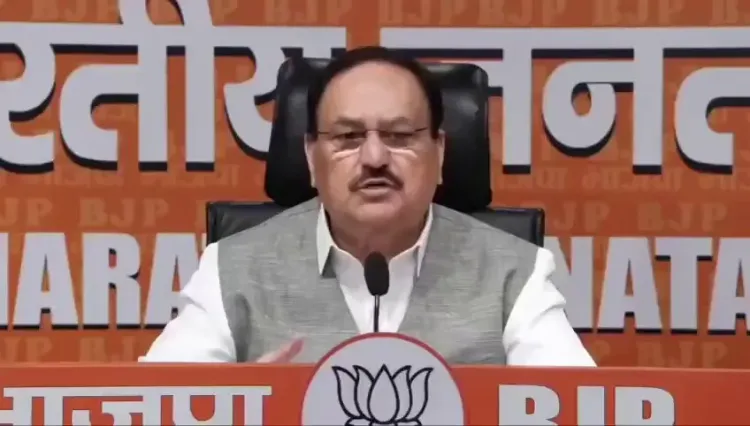
The post was directed at BJP National President JP Nadda , signalling coordinated party positioning on the issue.
The call echoes BJP's broader strategy of preferring structured House debates over street-level protests on youth and education issues.
Observers will watch for scheduling of education-related bills or discussions in the next parliamentary session.
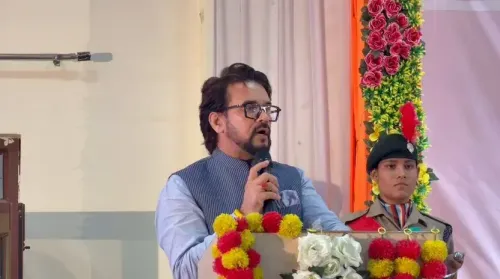
BJP Lok Sabha MP Anurag Thakur on Thursday, 23 July 2026, called for moving beyond political blame games and holding a substantive parliamentary debate on education, asserting that the BJP under PM Narendra Modi is deeply committed to ensuring no student faces injustice. Addressing his remarks to BJP National President JP Nadda, Thakur underscored that the House remains the most appropriate forum for such a discussion and that the party stands ready to engage.
Context
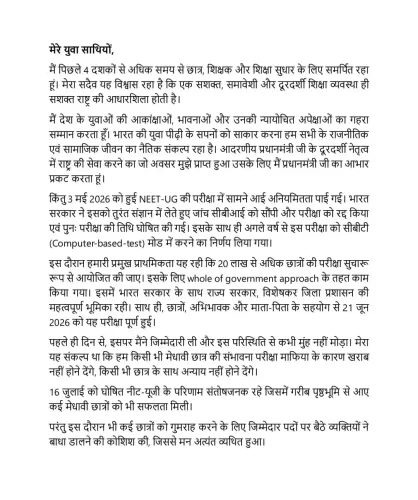
In his post, Thakur stated — 'arop-pratyarop se bahar nikalkar hamen is par charcha karni chahiye' (we must move beyond accusations and counter-accusations and discuss this) — framing the issue as one that demands serious, detail-oriented deliberation. He added that the goal is to examine the matter in its finer points 'taaki hamare chhatron ke saath anyay na ho' (so that no injustice is done to our students). The post was directed at JP Nadda, signalling an internal party communication made public, reinforcing BJP's collective stance on the matter.
Policy Backdrop
Education has been a recurring legislative priority for the BJP-led government since 2014. The landmark National Education Policy (NEP) 2020, approved by the Union Cabinet, sought to restructure both school and higher education with a focus on quality, access, and holistic development. Thakur's framing — that 'children are the future of the nation' — echoes the foundational rationale of the NEP and broader BJP messaging that positions demographic dividends as central to India's long-term growth story.
Parliamentary debates on education have historically allowed both treasury and opposition benches to place competing reform visions on record. The BJP has consistently preferred structured House discussions over street-level contestation, presenting this as evidence of institutional respect and policy seriousness.
Stakeholders and Impact
Students are the explicit focus of Thakur's appeal. By invoking the principle that no student should face injustice, he places youth welfare at the centre of the political argument, a framing that resonates with a large demographic of first-time voters and aspirational families across India. Opposition parties, who often use education controversies to mobilise campus sentiment, are implicitly challenged to shift the contest from protests to parliamentary debate — terrain where the ruling party holds procedural advantage.
The reference to JP Nadda suggests the statement also carries intra-party significance, possibly signalling alignment at the organisational level ahead of a formal legislative push or party position paper on the issue.
What's Next
Attention will now turn to whether an education-related discussion or bill is scheduled in the ongoing or upcoming parliamentary session. A formal debate, if convened, would give the Ministry of Education an opportunity to present implementation data on existing reforms, including the NEP 2020. Thakur's public call — directed at the party president — could also presage a coordinated BJP floor strategy when the House takes up the matter. The framing of children as the country's future is likely to remain a central rhetorical pillar as the party consolidates its education narrative ahead of future electoral cycles.
Point of View
The statement attempts to occupy the moral high ground on an issue that has historically energised opposition mobilisation on campuses. The tagging of Nadda suggests this is not a solo intervention but part of a coordinated organisational response, possibly ahead of a formal floor strategy. Framed against the NEP 2020 legacy, it reinforces BJP's long-running narrative that structural reform — not protest — is the credible path to educational equity.
NationPress
21 Oct 2026
Frequently Asked Questions
What did Anurag Thakur say about education on 23 July 2026?
Anurag Thakur called for a substantive parliamentary debate on education, saying the BJP is ready for in-depth discussion and that no student should face injustice under PM Modi's government.
Why did Anurag Thakur tag JP Nadda in his post?
Thakur tagged BJP National President JP Nadda to signal coordinated party positioning on the education issue, indicating the statement carries organisational weight beyond a personal opinion.
What is BJP's stance on parliamentary debate versus street protests on education?
BJP has consistently preferred structured parliamentary debates over street-level protests on education issues, presenting House discussions as the appropriate and more credible forum for policy disputes.
How does this relate to the National Education Policy 2020?
Thakur's framing of children as the nation's future and his call for detail-oriented debate align with the foundational goals of the NEP 2020, which the BJP-led Union Cabinet approved to reform school and higher education.
What should one watch for after Anurag Thakur's education debate call?
Key developments to watch include the scheduling of education-related discussions or bills in Parliament and any statements from the Ministry of Education on reform implementation.