Mandaviya Hails Pradhan's Student-First Decision, NEP Legacy
Synopsis
Union Labour and Sports Minister Mansukh Mandaviya commended Education Minister Dharmendra Pradhan for honouring student sentiments, crediting his tenure as pivotal to NEP 2020 rollout and expressing confidence in his continued national service.
Key Takeaways
Mansukh Mandaviya publicly praised Dharmendra Pradhan on 25 July 2026 for a decision aligned with students' sentiments and aspirations.
Mandaviya called Pradhan's tenure as Union Education Minister 'pivotal' in implementing the National Education Policy 2020 .
The NEP 2020 was approved by the Union Cabinet in July 2020 , replacing a policy dating to 1986 , with focus on multidisciplinary and mother-tongue-based education.
Pradhan has led the Education Ministry since 2021 , overseeing the policy's multi-year rollout across states and institutions.
Mandaviya expressed confidence that Pradhan will 'continue to serve the nation with the same conviction and dedication,' signalling continuity in education governance.
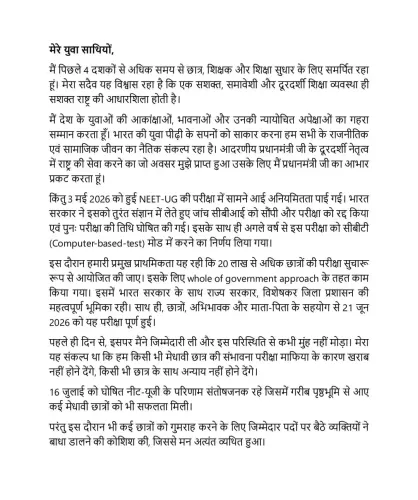
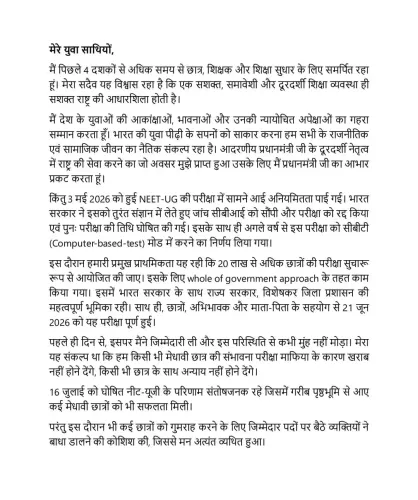
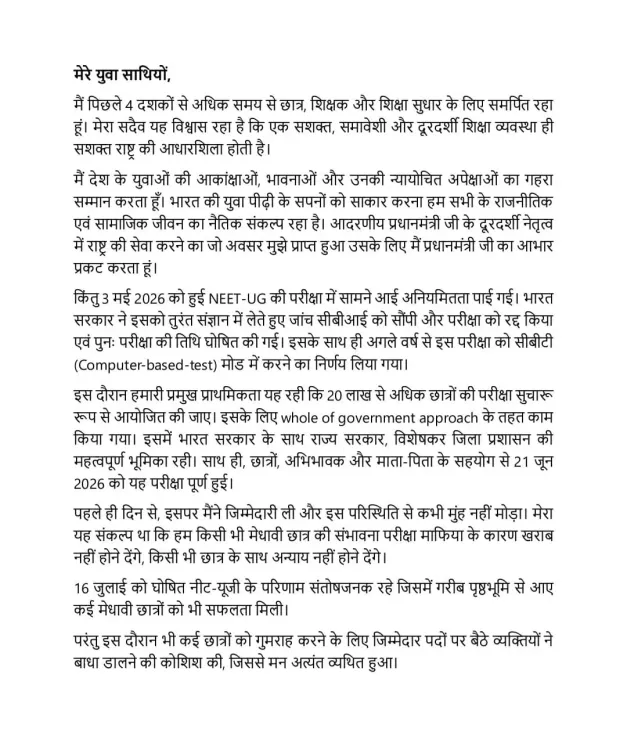
Union Labour and Sports Minister Mansukh Mandaviya on Saturday, 25 July 2026, praised Union Education Minister Dharmendra Pradhan for a decision described as respectful of students' sentiments and aspirations, calling it a reflection of Pradhan's ethical standards and commitment to public service.
Context
In his post, Mandaviya wrote that Pradhan's decision 'reflects his high ethical standards, deep sensitivity, and unwavering commitment to public service.' While the specific decision was not detailed in the post, Mandaviya framed it as student-centric and in keeping with Pradhan's broader ministerial character. Such public endorsements among senior cabinet colleagues are a common feature of BJP's internal communication, particularly around education and youth policy matters.
Mandaviya also credited Pradhan's tenure as Union Education Minister as 'pivotal in implementing the National Education Policy (NEP 2020) and modernizing our learning ecosystem,' signalling that the post carries weight beyond routine courtesy.
Policy Backdrop
The National Education Policy 2020 was approved by the Union Cabinet in July 2020, replacing the National Policy on Education 1986. The policy introduced sweeping changes to school and higher education, emphasising multidisciplinary learning, mother-tongue-based instruction in early years, and expanded vocational training pathways. Dharmendra Pradhan, who took charge of the Education Ministry in 2021, has been the primary face of NEP's rollout across states and institutions.
Prior to the Education portfolio, Pradhan held senior ministerial roles in petroleum and steel, making his education stint a significant pivot toward human-capital policy. The NEP's implementation has involved coordinating with state governments, universities, and school boards — a multi-year effort that is still ongoing.
Stakeholders and Impact
Students and educators across India remain the primary stakeholders in any decision tied to the Education Ministry. Mandaviya's explicit mention of 'sentiments and aspirations of our students' suggests the decision in question had a direct bearing on student welfare — a politically sensitive domain given recent debates over examinations, admissions, and curriculum changes at the national level.
Senior BJP leaders publicly affirming each other's student-friendly credentials also carries a messaging dimension for younger voters, a demographic both the Labour-Sports and Education portfolios actively engage with.
What's Next
Mandaviya expressed confidence that Pradhan 'will continue to serve the nation with the same conviction and dedication in the times ahead,' a phrasing that stops short of confirming any portfolio change but leaves open the possibility of transitions. Observers will watch upcoming parliamentary sessions and cabinet communications for any announcements on NEP implementation milestones or shifts in the education ministry's leadership structure.
The broader NEP rollout — spanning curriculum redesign, the National Credit Framework, and institutional accreditation reforms — is expected to remain a flagship governance narrative for the BJP-led government through the coming legislative calendar.
Point of View
Which is a standard political technique to amplify a colleague's student-friendly image without inviting scrutiny of the specifics. The explicit invocation of NEP 2020 as Pradhan's legacy asset suggests the BJP is keen to consolidate its education-reform narrative heading into the next legislative cycle. The phrase 'in the times ahead' is deliberately open-ended, a formulation senior ministers often use when cabinet reshuffles or role transitions are in the air. Taken together, the post reads less as a spontaneous endorsement and more as a coordinated signal about Pradhan's political standing within the party.
NationPress
25 Oct 2026
Frequently Asked Questions
What decision by Dharmendra Pradhan did Mansukh Mandaviya praise?
Mandaviya praised a decision by Education Minister Dharmendra Pradhan that he described as respectful of students' sentiments and aspirations, though the specific decision was not detailed in his post.
What is the National Education Policy 2020?
The National Education Policy 2020 is a comprehensive education reform framework approved by the Union Cabinet in July 2020 , replacing the 1986 policy. It emphasises multidisciplinary learning, mother-tongue instruction, and vocational training.
Who is Dharmendra Pradhan?
Dharmendra Pradhan is a senior BJP leader who has served as Union Education Minister since 2021 , overseeing the rollout of NEP 2020. He previously held portfolios in petroleum and steel.
Why did Mansukh Mandaviya post about Dharmendra Pradhan?
Mandaviya posted to publicly commend Pradhan's student-centric decision and acknowledge his contributions to modernising India's education ecosystem through NEP 2020.
Will Dharmendra Pradhan continue as Education Minister?
Mandaviya's post expressed confidence that Pradhan will 'continue to serve the nation with the same conviction,' but made no explicit statement about his portfolio. Any changes would be announced through official government channels.