Anurag Thakur at Noida Convocation: Real Education Starts Now
Synopsis
BJP MP Anurag Thakur addressed a convocation in Noida on 19 June 2026, telling graduates that their real education begins at commencement and urging them to sustain their sharpest contribution for the next twenty years to help realise the Viksit Bharat @ 2047 vision.
Key Takeaways
BJP MP Anurag Thakur spoke at a convocation ceremony in Noida, Uttar Pradesh on 19 June 2026 .
He reframed convocation as a commencement — a beginning, not an ending — and told graduates the 'real education starts today.' Thakur called on graduates to contribute their best 'every day for the next twenty years ' to achieve Viksit Bharat @ 2047 .
The Viksit Bharat @ 2047 vision, first outlined by PM Modi on Independence Day 2022 , aims to make India a fully developed nation by the centenary of independence.
The address aligns with the National Education Policy 2020 's emphasis on lifelong learning, skill development and research over rote memorisation.
As former Union Minister of Youth Affairs and Sports , Thakur has a track record of linking youth potential with national development goals.
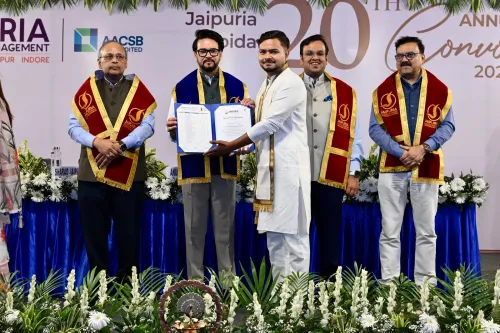
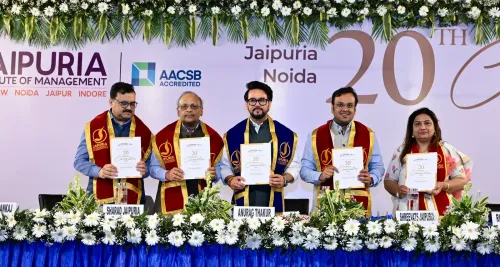
BJP MP Anurag Thakur addressed a convocation ceremony in Noida, Uttar Pradesh, on Friday, 19 June 2026, urging graduates to see the occasion not as a conclusion but as the launch of their true education and their contribution to national development.
Context
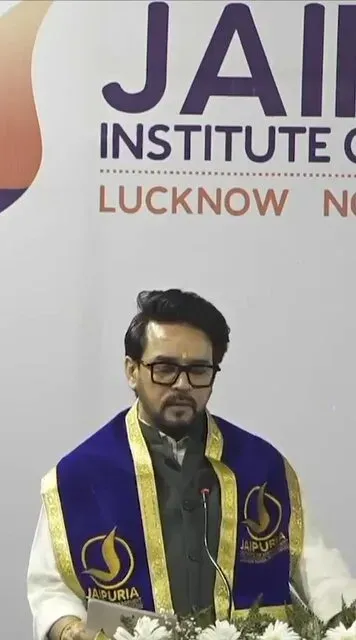
Speaking at the convocation, Thakur opened with a pointed reframe of the occasion itself: 'A convocation is called a commencement, because it marks not an ending, but a beginning.' He told graduates that whatever they had learned inside the institution was merely the foundation, and that the 'real education starts today.'
The message was aimed squarely at the graduating cohort, pushing them to remain in a state of continuous self-improvement. 'Stay sharp. Keep sharpening,' he said, adding that India needs their best 'not just today, but every day for the next twenty years.'
Policy Backdrop
The twenty-year horizon Thakur invoked maps directly onto the government's flagship developmental vision, Viksit Bharat @ 2047 — the goal of transforming India into a fully developed nation by the centenary of its independence. Prime Minister Narendra Modi first outlined this vision prominently in his 2022 Independence Day address and has reiterated it in subsequent Budget speeches and youth summits.
The framing also resonates with the National Education Policy 2020, which shifted the country's higher-education philosophy away from rote learning toward multidisciplinary study, skill development and research — precisely the kind of lifelong intellectual sharpening Thakur was advocating.
Central ministers and BJP MPs have routinely addressed university convocations since the NEP 2020 rollout, consistently linking academic milestones with national development targets. The emphasis on a sustained two-decade contribution mirrors the government's long-term planning tied to India's demographic dividend and economic self-reliance goals.
Stakeholders and Impact
Noida, a planned city in Gautam Buddh Nagar, Uttar Pradesh, hosts a dense cluster of private universities and technical institutes that hold annual convocations, making it a frequent platform for political and policy messaging directed at young graduates. The city's student population represents a cross-section of aspirants from across northern India.
For the graduating cohort, Thakur's address carried a dual message: personal accountability for continuous learning and a collective responsibility toward a national goal. As a former Union Minister of Youth Affairs and Sports and Information and Broadcasting, he brings institutional credibility to conversations about youth potential and national ambition.
What's Next
The immediate policy markers to watch include the rollout of NEP-mandated four-year undergraduate programmes across Indian universities and any fresh skilling allocations in the next Union Budget. Parliamentary debates on higher-education funding ahead of 2027-28 targets will test whether the rhetorical alignment between convocation addresses and policy delivery translates into concrete resource commitments.
As India moves deeper into the Viksit Bharat @ 2047 planning cycle, convocation addresses by senior BJP figures are likely to intensify in frequency and specificity, serving as both motivational outreach and a soft channel for communicating the government's long-term economic expectations from its youngest citizens.
Point of View
The messaging attempts to personalise a macro policy goal — making each graduate feel individually accountable to a national deadline. This approach leverages the NEP 2020 philosophy of lifelong learning to give policy continuity an emotional, aspirational register. The consistency of this messaging across senior party figures signals that youth mobilisation around 2047 will remain a central pillar of BJP's political communication well into the next electoral cycle.
NationPress
19 Sept 2026
Frequently Asked Questions
What did Anurag Thakur say at the Noida convocation?
Anurag Thakur told graduates that a convocation is called a commencement because it marks a beginning, not an ending, and urged them to stay sharp and contribute their best every day for the next twenty years to achieve Viksit Bharat @ 2047.
What is Viksit Bharat @ 2047?
Viksit Bharat @ 2047 is the Indian government's vision to transform India into a fully developed nation by 2047, the centenary of independence. Prime Minister Modi first outlined it in his Independence Day address in 2022.
Why is Anurag Thakur addressing convocations?
As a BJP MP and former Union Minister of Youth Affairs and Sports, Anurag Thakur regularly engages with young graduates to link academic achievements with national development goals, a practice that has intensified since the rollout of the National Education Policy 2020.
What is the National Education Policy 2020 and how does it relate to this speech?
The National Education Policy 2020 shifted India's higher-education focus from rote learning to multidisciplinary study and skill development. Thakur's call for continuous self-sharpening directly echoes NEP 2020's philosophy of lifelong learning.
Where is Noida and why is it significant for convocations?
Noida is a planned city in Gautam Buddh Nagar, Uttar Pradesh, that hosts a large number of private universities and technical institutes, making it one of northern India's key venues for annual convocation ceremonies and youth-focused political outreach.