Rajnath Singh hits Congress over EVM, EC blame after poll defeats
Synopsis
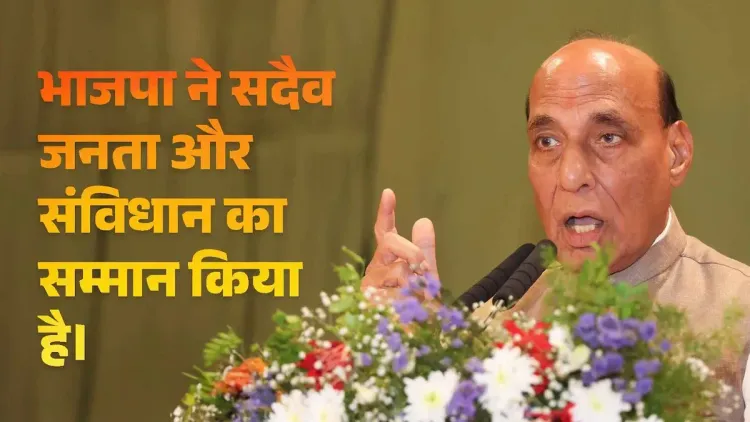
Union Defence Minister Rajnath Singh on June 12, 2026, accused Congress of repeatedly blaming EVMs and the Election Commission after electoral defeats, arguing the party has lost public trust due to its own falsehoods and flawed policies, while asserting that the BJP has always upheld the Constitution's dignity.
Key Takeaways
Rajnath Singh posted a sharp rebuke of Congress on June 12, 2026 , accusing the party of deflecting blame onto EVMs and the Election Commission after losses.
He argued Congress has lost public trust because of 'lies and wrong policies,' not because of institutional failures.
The Election Commission of India has previously held open EVM challenge demonstrations ( 2017–2019 ) that opposition parties did not successfully contest.
Courts, including the Supreme Court of India , have repeatedly upheld EVM integrity in multiple rulings.
BJP has framed its stance as one of institutional fidelity and respect for the Constitution, contrasting it with opposition conduct.
The exchange sets up institutional credibility as a key battleground ahead of upcoming state assembly elections.
Union Defence Minister Rajnath Singh on Friday, June 12, 2026, sharply criticised the Indian National Congress, accusing the party of deflecting responsibility for electoral losses by casting doubt on Electronic Voting Machines (EVMs), voter rolls, and the Election Commission of India instead of introspecting on its own failings.
Context
Posting in Hindi on X, Rajnath Singh wrote: 'चुनावों में हार-जीत लगी रहती है।' ('Wins and losses are part of elections.') He argued that every time Congress loses, it raises questions about EVMs, voter-roll processes, and the Election Commission — a pattern he described as misleading the public. 'Instead of misleading the people, they should see that they have lost the public's trust because of their lies and wrong policies,' he said. 'That is why they keep losing elections continuously.'
He contrasted this with the BJP's stated position, asserting: 'The BJP has always respected the sentiment of the people and the dignity of the Constitution.'
Policy backdrop
The dispute over EVMs is not new. After the 2019 Lok Sabha results, Congress leaders publicly demanded a return to paper ballots, citing alleged vulnerabilities. The Election Commission of India had, between 2017 and 2019, held open EVM challenge demonstrations inviting political parties to prove tampering claims — a challenge that went unmet.
Following multiple state assembly defeats between 2014 and 2023, opposition parties also petitioned courts on voter-roll irregularities and EVM audit demands. The Supreme Court of India has upheld EVM integrity in successive rulings, and the Election Commission has consistently defended the machines' technical design and administrative safeguards.
Stakeholders and impact
The statement lands at a sensitive intersection: public confidence in electoral institutions, the credibility of the Election Commission, and the BJP's broader political narrative ahead of upcoming state assembly elections. For ordinary voters, repeated institutional criticism by a major national party can erode trust in the democratic process itself.
Congress has not yet issued a formal response to this specific post. The party has, in the past, maintained that scrutiny of electoral machinery is a democratic right and not an attack on institutions. Opposition allies have at various points echoed similar concerns about EVMs, complicating the BJP's framing of the issue as a Congress-specific pattern.
What's next
With several state assembly elections on the horizon, the debate over EVM reliability and Election Commission autonomy is likely to intensify. Any fresh opposition petitions seeking EVM audits or rule changes will test the Election Commission of India's response and the judiciary's patience with repeat litigation on settled questions. Rajnath Singh's intervention signals that the BJP intends to keep institutional fidelity as a central campaign-trail argument, framing itself as the defender of constitutional bodies against what it calls politically motivated attacks.
Point of View
Aimed at discrediting any post-election institutional criticism before votes are even counted in upcoming contests. By linking Congress's EVM grievances to a pattern of repeated losses, the BJP is attempting to shift the public conversation from procedural questions to a referendum on the opposition's political credibility. The framing — 'respect for the Constitution' versus institutional blame-shifting — is a durable BJP rhetorical device that has worked electorally since 2014. The risk for Congress is that the more it questions EVMs without fresh, court-admissible evidence, the more the narrative hardens against it.
NationPress
29 Jul 2026
Frequently Asked Questions
Why does Congress keep raising EVM hacking claims after elections?
Congress and several other opposition parties have argued that EVMs are vulnerable to manipulation, particularly after unexpected defeats. The Election Commission has repeatedly denied these claims and held open challenge events, but the party maintains that independent audits are necessary for public confidence.
Has the Supreme Court ruled on EVM tampering allegations?
Yes. The Supreme Court of India has in multiple instances declined to order a return to paper ballots and has upheld the Election Commission's position on EVM integrity, though it has at times directed procedural improvements such as increased VVPAT slip verification.
What is Rajnath Singh's criticism of Congress about?
Rajnath Singh accused Congress of blaming EVMs, voter rolls, and the Election Commission every time it loses an election, saying the party should instead recognise that its own false statements and flawed policies have eroded public trust.
What is the BJP's position on the Election Commission of India?
The BJP has consistently defended the Election Commission's independence and the integrity of EVMs, framing any opposition criticism of these institutions as politically motivated and constitutionally irresponsible.
What are upcoming elections where this EVM debate matters?
Several state assembly elections are scheduled in the near term. The EVM and Election Commission credibility debate is expected to resurface in campaign rhetoric, legal petitions, and public discourse around each of these contests.