CM Sai Greets Dairy Farmers on World Milk Day
Synopsis
On World Milk Day 2026, Chhattisgarh Chief Minister Vishnu Deo Sai greeted India's dairy farmers and milk producers, calling milk the foundation of rural prosperity, healthy families, and national self-reliance, and urging citizens to spread awareness of its nutritional value.
Key Takeaways
Chhattisgarh CM Vishnu Deo Sai extended greetings to dairy farmers and milk producers on World Milk Day, 1 June 2026 .
India is the world's largest milk-producing country, with dairy contributing roughly 4–5 per cent of national GDP.
The sector employs over 80 million people, mostly smallholder farmers, making it a critical rural livelihood source.
Operation Flood (1970) and the Rashtriya Gokul Mission (2014) are the two landmark programmes underpinning India's dairy growth.
CM Sai called for greater public awareness of milk's nutritional role and linked dairy development to the Atmanirbhar Bharat vision.
Future focus will be on Chhattisgarh's budget allocations for dairy infrastructure under the National Programme for Dairy Development .
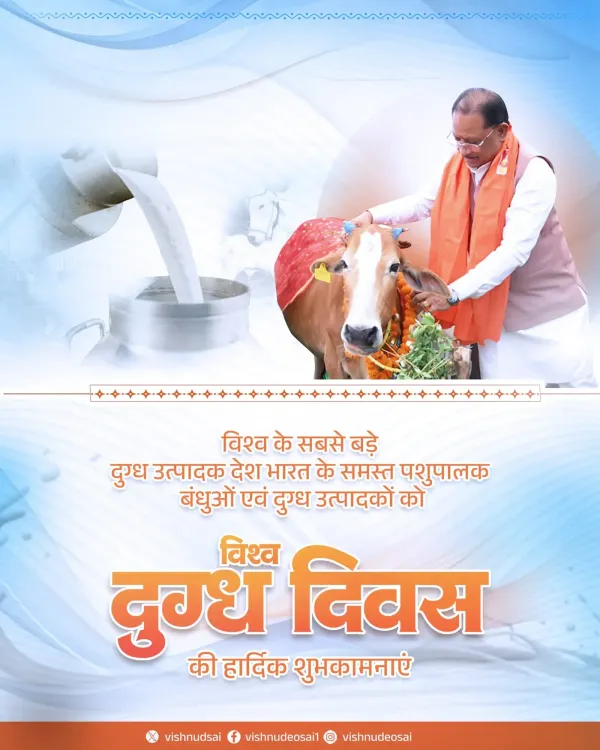
Chhattisgarh Chief Minister Vishnu Deo Sai extended greetings to livestock farmers, milk producers, and dairy-sector workers across India on World Milk Day, 1 June 2026, calling milk the foundation of a healthy society, empowered families, and a prosperous rural economy.
Context
World Milk Day is observed every year on 1 June as an initiative of the Food and Agriculture Organisation (FAO) to recognise the importance of milk in global nutrition and food security. Leaders across India mark the occasion by highlighting the country's dairy achievements and the livelihoods dependent on the sector.
In his post, CM Sai wrote — 'दूध केवल पोषण का स्रोत नहीं, बल्कि स्वस्थ समाज, सशक्त परिवार और समृद्ध ग्रामीण अर्थव्यवस्था की मजबूत आधारशिला है' ['Milk is not merely a source of nutrition, but the strong foundation of a healthy society, an empowered family, and a prosperous rural economy']. He also called on citizens to pledge wider awareness of milk's nutritional value and its role in a balanced diet.
Policy Backdrop
India is the world's largest milk-producing country, with the dairy sector contributing roughly 4–5 per cent of national GDP and employing over 80 million people, the majority of them smallholder farmers. This position was built largely on the cooperative infrastructure created by Operation Flood, launched in 1970 by the National Dairy Development Board (NDDB), which organised village-level cooperatives and scaled milk output dramatically over subsequent decades.
More recently, the Rashtriya Gokul Mission, announced in 2014, has focused on improving indigenous cattle breeds and enhancing per-animal productivity. Successive governments have framed dairy development within the broader Atmanirbhar Bharat self-reliance framework, positioning milk production as a pillar of rural income diversification and nutritional security.
Stakeholders and Impact
The message directly addresses the millions of dairy farmers and rural households in Chhattisgarh and across India whose livelihoods are tied to milk production. For smallholders in particular, dairy income provides a critical buffer against seasonal agricultural volatility.
CM Sai framed the sector as central to the vision of a 'healthy citizen, empowered farmer, and prosperous India' — 'स्वस्थ नागरिक, सशक्त किसान एवं समृद्ध भारत' — linking individual farm-level effort to national development goals. The message reinforces the BJP-led state government's alignment with central rural-welfare and self-reliance narratives.
What's Next
Attention will turn to Chhattisgarh's state budget allocations for dairy infrastructure and any fresh targets the state government may announce under the next phase of the National Programme for Dairy Development. Whether World Milk Day greetings translate into concrete policy announcements — expanded cold-chain facilities, cooperative credit, or breed-improvement camps — will be the measure of the state's commitment to the sector.
With India's dairy cooperative model increasingly cited as a template for emerging economies, state-level leadership in expanding farmer participation and milk-processing capacity will remain a key indicator of rural economic health in the months ahead.
Point of View
Reinforcing the party's rural-outreach credentials ahead of any electoral cycle. The framing of milk as both a nutritional and economic cornerstone is deliberate: it connects smallholder dairy farmers — a politically significant constituency in Chhattisgarh — to a larger national narrative of indigenous productivity and rural empowerment. What distinguishes substantive dairy policy from ceremonial messaging, however, is the follow-through in state budget allocations and on-ground cooperative expansion. Observers will watch whether this occasion is accompanied by specific scheme announcements or targets for Chhattisgarh's dairy infrastructure.
NationPress
19 Sept 2026
Frequently Asked Questions
When is World Milk Day celebrated and why?
World Milk Day is celebrated on 1 June every year, an initiative established by the FAO to recognise the importance of milk as a global food and highlight the livelihoods of dairy farmers worldwide.
Is India really the world's largest milk producer?
Yes, India is the world's largest milk-producing country, a position built over decades through cooperative models pioneered by Operation Flood in 1970 , with the dairy sector now contributing roughly 4–5 per cent of national GDP.
What is the Rashtriya Gokul Mission?
The Rashtriya Gokul Mission was announced in 2014 to conserve and develop indigenous cattle and buffalo breeds, improve per-animal milk productivity, and support the livelihoods of dairy farmers across India.
What did Chhattisgarh CM Vishnu Deo Sai say on World Milk Day 2026?
CM Vishnu Deo Sai greeted livestock farmers, milk producers, and dairy-sector workers, calling milk the foundation of a healthy society and prosperous rural economy, and urged citizens to pledge awareness of its nutritional value.
How many people does India's dairy sector employ?
India's dairy sector employs over 80 million people, the majority of them smallholder farmers for whom dairy income provides a critical supplement to seasonal agricultural earnings.