CM Sai Raises Tendu Leaf Rate to ₹5,500 Per Bag
Synopsis
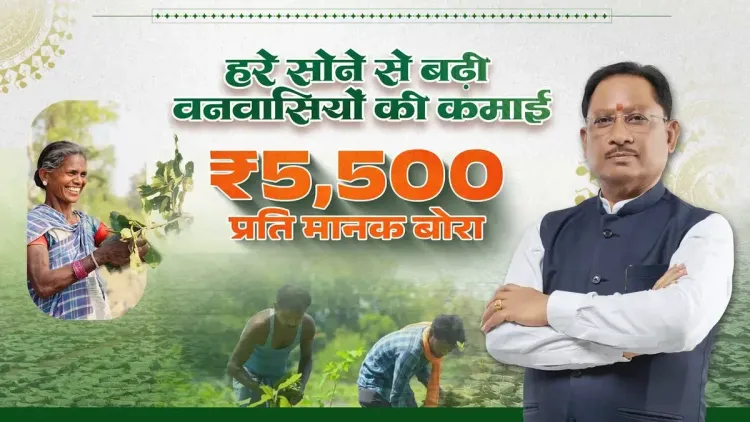
Chhattisgarh Chief Minister Vishnu Deo Sai announced a hike in the tendu leaf collection rate to ₹5,500 per standard bag on 23 July 2026, framing it as a recognition of forest-dependent families' labour and a step toward self-reliant livelihoods under the Antyodaya welfare framework.
Key Takeaways
Chhattisgarh CM Vishnu Deo Sai announced a tendu leaf collection rate of ₹5,500 per standard bag (manak bora) on 23 July 2026 .
The revision is framed under the Antyodaya principle, targeting the economic uplift of the poorest forest-dependent households.
Tendu leaves are a major minor forest produce in Chhattisgarh , with collection providing critical seasonal income to tribal and forest-dwelling communities .
Implementation will flow through state-designated collection and procurement agencies operating across the state's forest districts.
The move aligns with a broader pattern of MFP rate revisions by central Indian state governments to address rural and tribal income gaps.
Parallel revisions for other minor forest produce categories and neighbouring-state responses remain areas to watch.
Chhattisgarh Chief Minister Vishnu Deo Sai announced on Thursday, 23 July 2026 that his government has raised the collection rate for tendu leaves to ₹5,500 per standard bag (manak bora), framing the move as a direct recognition of the labour of forest-dependent families across the state.
Posting in Hindi on X, CM Sai wrote: 'श्रम का सम्मान ही सुशासन की पहचान है' ('Respect for labour is the hallmark of good governance'). He described the revision as rooted in the Antyodaya principle — the commitment to uplift the last person in the economic order — adding that it represents 'not merely a wage hike, but respect for the hard work of forest-dependent families, their economic strengthening, and a firm step toward self-reliant living.'
Context
Chhattisgarh is one of India's most forested states, with a substantial share of its population — particularly Scheduled Tribe (ST) communities — relying on the collection and sale of minor forest produce (MFP) for a significant portion of household income. Tendu leaves, used to wrap beedis (hand-rolled cigarettes), are among the most economically significant of these produce items and are collected seasonally across the state's forest belts.
The collection and procurement of tendu leaves in Chhattisgarh is managed through state-designated agencies, with collectors paid a per-bag rate set by the government. Periodic revisions to this rate have historically been a key lever for improving rural and tribal incomes in the state.
Policy Backdrop
The revision fits within the Antyodaya welfare framework that BJP-led governments at the Centre and in states have consistently invoked since 2014 to anchor social spending toward the poorest households. In Chhattisgarh, successive administrations have used MFP rate revisions as a tool to integrate forest communities into the formal welfare economy.
Broader policy efforts across central Indian states with large forest areas — including Madhya Pradesh, Jharkhand, and Odisha — have similarly focused on adjusting MFP collection rates to address rural income gaps. The ₹5,500 per standard bag rate announced by CM Sai represents the current benchmark set by his government for the tendu leaf season.
Stakeholders and Impact
The primary beneficiaries are tendu leaf collectors — predominantly tribal and forest-dwelling families spread across Chhattisgarh's forest districts. For many of these households, the seasonal income from tendu collection constitutes a critical supplement to agricultural earnings, particularly in lean months.
Collection agencies that procure and process the leaves will be required to implement the revised rate at the ground level. Any improvement in per-bag earnings directly translates into higher seasonal payouts for individual collector families, with downstream effects on local rural consumption and savings.
What's Next
Attention will now turn to the rollout of the ₹5,500 rate through procurement agencies and whether the government announces parallel revisions for other minor forest produce categories. Observers will also watch for similar moves in neighbouring states with comparable forest economies. For CM Sai's administration, effective on-ground implementation of the revised rate will be the measure of whether the stated commitment to forest-community welfare translates into tangible income gains this season.
Point of View
500 per standard bag is a textbook deployment of welfare optics ahead of what remains a politically sensitive constituency for the BJP in Chhattisgarh — forest-dwelling and tribal communities who constitute a significant voter base. By anchoring the announcement in the Antyodaya idiom, CM Sai connects a state-level administrative revision to a national ideological framework, reinforcing continuity with the Centre's tribal outreach narrative. The move also places competitive pressure on opposition-governed states in the region to match or exceed MFP rates, turning a welfare measure into a comparative governance benchmark. Whether the rate reaches collectors on the ground without leakage through procurement agencies will ultimately determine its political and economic dividend.
NationPress
21 Oct 2026
Frequently Asked Questions
What is the new tendu leaf collection rate in Chhattisgarh?
The Chhattisgarh government has set the tendu leaf collection rate at ₹5,500 per standard bag (manak bora) , as announced by Chief Minister Vishnu Deo Sai on 23 July 2026.
Who collects tendu leaves in Chhattisgarh?
Tendu leaves are collected primarily by tribal and forest-dwelling families across Chhattisgarh's forest districts. It is a major source of seasonal income for these communities and is procured through state-designated agencies.
What is Antyodaya and why is it mentioned in this context?
Antyodaya is a welfare philosophy meaning 'uplift of the last person,' promoted by BJP-led governments to prioritise the poorest households in welfare delivery. CM Sai invoked it to frame the tendu leaf rate hike as part of a broader commitment to the most economically vulnerable.
Why are tendu leaves economically important in Chhattisgarh?
Tendu leaves are used to wrap beedis (hand-rolled cigarettes) and are one of the most commercially significant minor forest produce items in Chhattisgarh . Seasonal collection provides critical supplementary income to tribal families, especially in lean agricultural months.
How will the revised tendu leaf rate be implemented?
The ₹5,500 per standard bag rate will be implemented through state-designated collection and procurement agencies , which are responsible for purchasing tendu leaves from individual collectors across the state's forest areas.