CM Sai Hits Back at Congress Over ECI Criticism
Synopsis
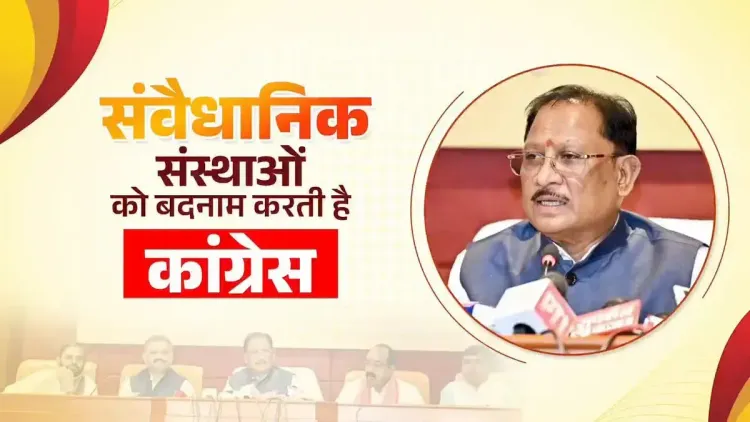
Chhattisgarh CM Vishnu Deo Sai, speaking at Kushabhau Thakre Parisar in Raipur, defended the Election Commission's unanimous SIR decisions and said Congress criticism of the electoral process reflects opposition frustration, not principled concern.
Key Takeaways
CM Vishnu Deo Sai held a press conference at Kushabhau Thakre Parisar, Raipur on September 27, 2026 .
He cited the Election Commission's joint statement confirming all decisions, including on SIR (Special Intensive Revision) , were taken unanimously by all three commissioners.
Sai called Congress's questioning of the ECI's impartiality a 'symbol of the opposition's frustration.' The Election Commission of India derives its authority from Article 324 of the Constitution and has operated as a three-member body since 1989–93 .
He directly called on Congress to 'stop such behaviour,' signalling BJP's intent to defend the Commission's institutional credibility ahead of future polls.
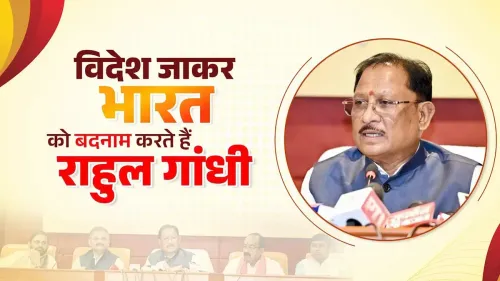
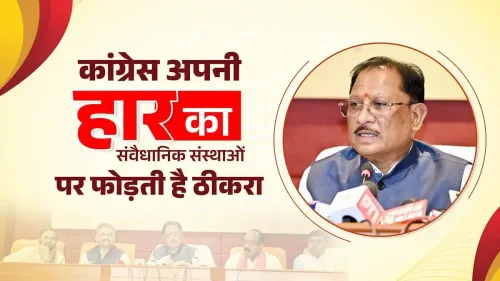
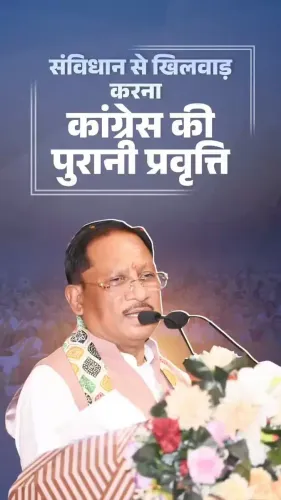
At a press conference in Raipur on Sunday, September 27, 2026, Chhattisgarh Chief Minister Vishnu Deo Sai launched a sharp defence of the Election Commission of India, calling out the Indian National Congress for questioning the body's impartiality — and framing that criticism as a sign of the opposition's desperation.
Speaking at Kushabhau Thakre Parisar in Raipur, CM Sai cited the Election Commission's own joint statement, which clarified that all decisions — including those related to the Special Intensive Revision (SIR) of electoral rolls — were taken with the unanimous consensus of all three Election Commissioners. 'Virodh ki haataasha ka prateek hai' (a symbol of the opposition's frustration), he said of the Congress's questioning of the electoral process.
What the Commission's joint statement actually said
The Election Commission of India is a constitutional body established under Article 324 of the Constitution (1950), charged with superintending all elections to Parliament, state legislatures, and the offices of President and Vice-President. Since 1989–93, the Commission has functioned as a three-member body — one Chief Election Commissioner and two Election Commissioners — with decisions taken by majority or unanimous consensus.
According to CM Sai, the Commission's joint statement specifically addressed the SIR process, affirming that the decision was not unilateral but carried the collective endorsement of all three commissioners. That detail matters: it directly rebuts any suggestion that the roll-revision exercise was driven by partisan pressure rather than institutional procedure.
Congress and the recurring pattern of ECI scrutiny
This is not the first time a BJP leader has stepped forward to defend the Election Commission from opposition fire. The broader pattern is well-established: whenever the Commission conducts electoral roll revisions or announces poll schedules in contested states, ruling-party spokespersons frame opposition criticism as an attack on an institution that commands global respect.
CM Sai put it bluntly — the Election Commission's credibility is recognised worldwide, and raising doubts about its neutral conduct is less a principled objection than a political reflex born of electoral setbacks. His message to Congress was unambiguous: 'Aise harkaton se baaz aana chahiye' — stop this kind of behaviour.
Whether Congress responds formally — or whether the Election Commission itself weighs in further — will determine whether this exchange stays a skirmish or grows into a wider institutional debate heading into the next electoral cycle.
Point of View
Ruling-party leaders rally to the institution's defence, framing criticism as anti-democratic. The timing — tied to the SIR process, which directly affects voter rolls — suggests the political stakes around electoral-list management are rising. By anchoring his argument in the Commission's own joint statement citing unanimous decisions, Sai shifts the burden of proof squarely onto Congress. If the opposition cannot produce specific procedural violations, the 'frustrated loser' narrative gains traction with voters who hold the ECI in high regard.
NationPress
27 Sept 2026
Frequently Asked Questions
What is the SIR process that CM Sai mentioned?
SIR stands for Special Intensive Revision, a periodic exercise conducted by the Election Commission of India to update and clean voter rolls — adding new eligible voters and removing those who have died or relocated.
Why is Congress criticising the Election Commission of India in 2026?
Congress has raised concerns about the impartiality of the Election Commission, particularly over the SIR process. CM Sai characterised this as opposition frustration rather than a substantive institutional challenge.
What did the Election Commission's joint statement say?
According to CM Sai, the ECI's joint statement clarified that all decisions including those on SIR were taken with the unanimous consensus of all three Election Commissioners, not unilaterally.
How is the Election Commission of India structured?
The Election Commission was established under Article 324 of the Constitution in 1950. Since 1989–93, it has comprised one Chief Election Commissioner and two Election Commissioners, with decisions taken by consensus or majority.
Where did CM Vishnu Deo Sai make these remarks?
He made these remarks at a press conference held at Kushabhau Thakre Parisar in Raipur, Chhattisgarh, on September 27, 2026.