CM Sai launches Atal Aajeevika Samriddhi Haat for rural jobs
Synopsis
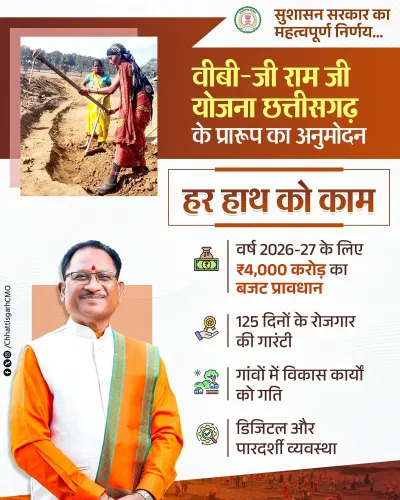
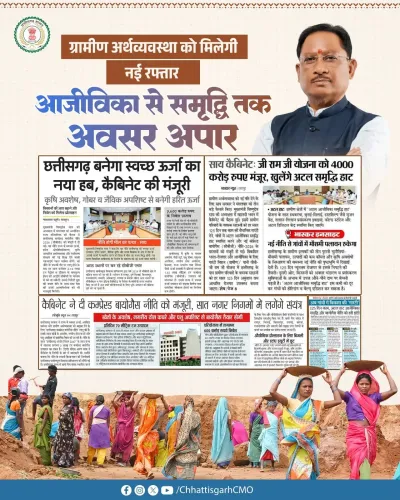
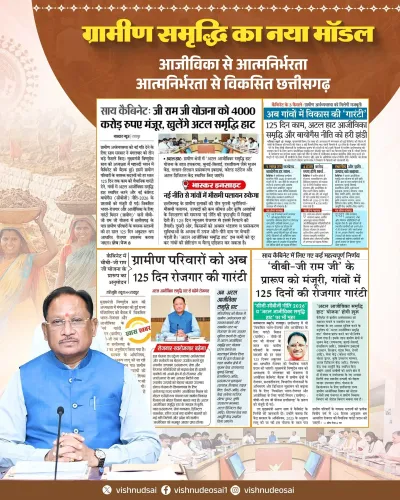
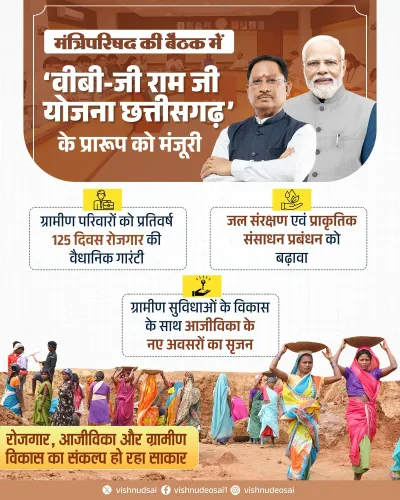
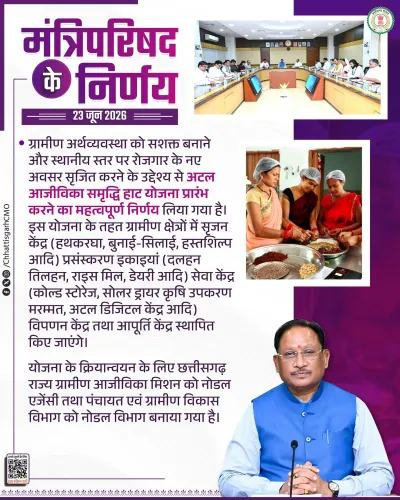
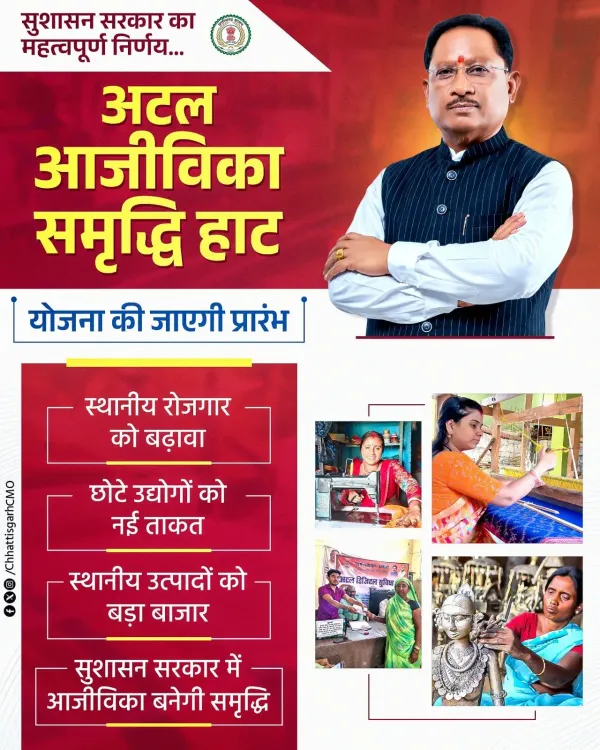
The Chhattisgarh government under CM Vishnu Dev Sai has announced the Atal Aajeevika Samriddhi Haat scheme to strengthen the rural economy by promoting local production, processing, and marketing, and creating employment within villages.
Key Takeaways
The Atal Aajeevika Samriddhi Haat scheme was announced by the Chief Minister's Office of Chhattisgarh on 24 June 2026 .
Chief Minister Vishnu Dev Sai is leading the initiative as part of the state's 'Sushasan Sarkar' governance agenda.
The scheme targets local production, processing, services, and marketing to generate employment and self-employment within villages.
It aims to provide better market access for local products and a formal identity for rural enterprises.
The initiative aligns with the national Atmanirbhar Bharat framework and the National Rural Livelihood Mission lineage.
Specific funding allocations and district-level rollout timelines are yet to be officially released.
The Chief Minister's Office of Chhattisgarh announced on Wednesday, 24 June 2026 that the state government under Chief Minister Vishnu Dev Sai has approved the Atal Aajeevika Samriddhi Haat scheme, a new initiative aimed at strengthening the rural economy by creating employment and self-employment opportunities within villages themselves.
Context
The official post, shared by the Chief Minister's Office, described the decision as another 'janhitaishi nirnay' (pro-people decision) of the 'Sushasan Sarkar' (good-governance government). The scheme, as stated in the announcement, will promote 'sthaniya utpadan, sanskaran, seva aur vipanan gatividhiyan' — local production, processing, services, and marketing activities — to generate new avenues of employment at the village level.
The announcement emphasised three core objectives: providing better market access for local products, giving rural enterprises a distinct identity, and accelerating the building of self-reliant villages under the Atmanirbhar Gaon vision.
Policy Backdrop
Chhattisgarh has a predominantly rural and tribal population, with agriculture, minor forest produce, and local crafts forming the backbone of livelihoods across districts. The state has historically grappled with seasonal migration as village-level markets lacked adequate infrastructure for aggregation and sale of locally produced goods.
The new scheme aligns with the national Atmanirbhar Bharat framework announced in 2020, which placed explicit emphasis on village-level production, processing, and marketing networks. It also draws on the lineage of the National Rural Livelihood Mission (NRLM), launched by the Government of India in 2011, which sought to build sustainable self-employment through self-help groups and market linkages. The haat — a traditional periodic rural market — has long served as a primary commerce platform in central Indian states, and the new scheme institutionalises this model with a structured policy framework.
Chief Minister Vishnu Dev Sai, who assumed office in December 2023 following the BJP's victory in the state assembly elections, has positioned rural economic empowerment as a key pillar of his administration's governance agenda.
Stakeholders and Impact
The primary beneficiaries of the Atal Aajeevika Samriddhi Haat scheme are expected to be rural producers, village-level entrepreneurs, artisans, and self-help group members who currently lack organised market access for their goods and services. By consolidating production, processing, and marketing under a single platform, the scheme aims to reduce dependence on intermediaries and improve returns for village-level producers.
Rural enterprises — including those involved in forest produce, handicrafts, agri-processing, and local services — stand to gain both market visibility and a formal identity through the initiative. The emphasis on swavalamban (self-reliance) at the village level could also help curb distress migration to urban centres, a persistent challenge in Chhattisgarh's interior and tribal regions.
What's Next
The state government is expected to release detailed operational guidelines, district-level rollout timelines, and budgetary allocations for the scheme through official channels and upcoming state budget or assembly sessions. Observers will watch for specific targets — such as the number of haats to be established, the districts to be covered in the first phase, and the mechanism for linking rural producers to wider markets beyond the village.
If implemented at scale, the Atal Aajeevika Samriddhi Haat could serve as a replicable model for other states seeking to formalise haat-based rural commerce within the broader national self-reliance framework — a signal that Chhattisgarh is positioning itself as a laboratory for village-economy policy innovation.
Point of View
Directly responding to the state's chronic rural migration problem. By framing it under the 'Sushasan Sarkar' brand, CM Sai is signalling a political differentiation from previous administrations while staying firmly within the national Atmanirbhar Bharat narrative — a dual-audience strategy aimed at both state voters and the central government. The scheme's long-term credibility will hinge on whether operational guidelines and budgetary commitments follow the announcement, a gap that has historically weakened similar state-level rural livelihood initiatives across India. If district-level implementation is robust, it could meaningfully reduce distress migration from Chhattisgarh's tribal heartland.
NationPress
24 Jun 2026
Frequently Asked Questions
What is the Atal Aajeevika Samriddhi Haat scheme in Chhattisgarh?
The Atal Aajeevika Samriddhi Haat is a new state government scheme announced by the Chhattisgarh government under CM Vishnu Dev Sai on 24 June 2026 to promote local production, processing, services, and marketing in rural areas, creating employment and self-employment opportunities within villages.
Who announced the Atal Aajeevika Samriddhi Haat scheme?
The scheme was announced by the Chief Minister's Office of Chhattisgarh, attributing the decision to Chief Minister Vishnu Dev Sai's administration.
How will the Atal Aajeevika Samriddhi Haat help rural people in Chhattisgarh?
The scheme aims to provide better market access for locally produced goods, give rural enterprises a formal identity, and generate new jobs and self-employment opportunities within villages, potentially reducing distress migration to cities.
Is the Atal Aajeevika Samriddhi Haat linked to the Atmanirbhar Bharat scheme?
The scheme aligns with the national Atmanirbhar Bharat framework announced in 2020, which emphasised village-level production, processing, and marketing networks, though it is a state-level initiative by the Chhattisgarh government.
When will the Atal Aajeevika Samriddhi Haat scheme be implemented?
Specific rollout timelines and district-level implementation details have not yet been officially released; observers expect further operational guidelines to emerge through state budget documents or assembly sessions.