CM Sai launches 'Gajrath Yatra Vol 2', honours forest staff
Synopsis
Chhattisgarh CM Vishnu Deo Sai launched 'Gajrath Yatra Vol 2' at Bagiya on 17 August 2026, honouring forest staff for human-elephant conflict management and calling public awareness the cornerstone of wildlife conservation.
Key Takeaways
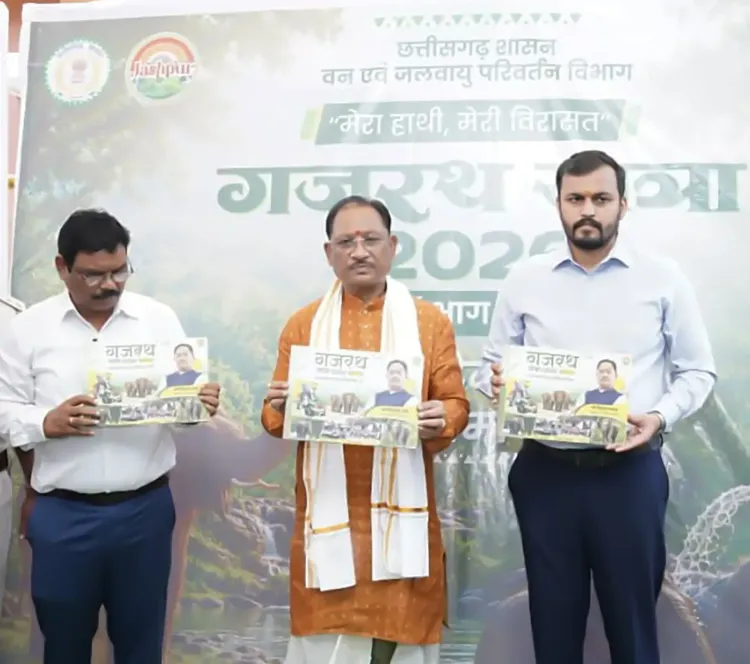
Gajrath Yatra Vol 2 was released by CM Vishnu Deo Sai at his camp office in Bagiya on 17 August 2026 .
The book is a state initiative to raise awareness in elephant-affected areas and reduce human-elephant conflict.
Forest department personnel who excelled in conflict management were formally honoured at the same event.
CM Sai framed safe human-elephant coexistence as essential to both public safety and wildlife conservation.
The Chief Minister emphasised that public awareness and sensitivity are critical tools in managing conflict.
Safe coexistence between humans and elephants is not just an ecological ideal — in Chhattisgarh, it is an urgent, daily reality. Chhattisgarh Chief Minister Vishnu Deo Sai on Monday, 17 August 2026, released the second volume of 'Gajrath Yatra' (Elephant Journey) at his camp office in Bagiya, his home village, and honoured forest department personnel who have shown outstanding work in managing human-elephant conflict.
What 'Gajrath Yatra' is, and why it matters
'Gajrath Yatra' is a state initiative designed to raise awareness in elephant-affected areas and reduce the friction — sometimes fatal — between local communities and wild elephant herds. The release of Volume 2 signals that the programme has moved past its pilot phase and is now being institutionalised as a continuing effort. CM Sai described safe human-elephant coexistence as 'the strong path for public safety and wildlife conservation,' underscoring that the two goals are inseparable, not competing.
Forest workers recognised at Bagiya camp
Alongside the book launch, forest department field staff who have performed exceptionally in human-elephant conflict management were formally felicitated at the event. Recognising ground-level workers — the people who actually track herds, warn villages, and manage corridors — sends a clear signal about where the state places operational responsibility. It also elevates a cadre that rarely receives public acknowledgement.
Awareness as the first line of defence
CM Sai stressed that 'janjaagrukta aur samvedanshilta' — public awareness and sensitivity — are essential to the mission. Chhattisgarh's forested districts, particularly in the northern and southern belts, have long recorded elephant-human conflict incidents, ranging from crop damage to human casualties. A publication that documents the journey of conflict-management efforts serves both as a record and as a field guide for communities living alongside elephant corridors. The kicker: when a state government puts a book in one hand and a citation in the other, it is making a bet that knowledge and recognition, not just enforcement, can turn the tide on one of India's most persistent wildlife-management challenges.
Point of View
Documented approach to human-elephant conflict — a shift that mirrors broader national efforts to formalise wildlife-community coexistence frameworks. By hosting the event in his home village of Bagiya, CM Sai lends personal and political weight to what might otherwise be a bureaucratic exercise. Honouring field-level forest workers is a deliberate political choice: it builds morale in an underfunded cadre while communicating that the state values on-the-ground execution. The initiative sits at the intersection of tribal welfare, forest rights, and wildlife policy — three fault lines that will only grow more contested as elephant corridors shrink.
NationPress
18 Aug 2026
Frequently Asked Questions
What is Gajrath Yatra in Chhattisgarh?
'Gajrath Yatra' is a Chhattisgarh state initiative aimed at raising awareness in elephant-affected areas and reducing human-elephant conflict through community sensitisation and documentation.
What did CM Vishnu Deo Sai do on 17 August 2026?
CM Vishnu Deo Sai released the second volume of 'Gajrath Yatra' at his camp office in Bagiya and honoured forest department staff for outstanding work in managing human-elephant conflict.
Where is Bagiya, the home village of Vishnu Deo Sai?
Bagiya is the home village of Chhattisgarh Chief Minister Vishnu Deo Sai, where he maintains a camp office and has hosted several official events.
Why is human-elephant conflict a problem in Chhattisgarh?
Chhattisgarh's forested districts have long recorded incidents of elephants straying into human settlements, causing crop damage and, at times, human casualties, making conflict management a persistent wildlife and public-safety challenge.
How does Chhattisgarh plan to reduce human-elephant conflict?
The state is focusing on public awareness, community sensitisation, documentation through initiatives like 'Gajrath Yatra', and recognising forest workers who manage conflict on the ground.