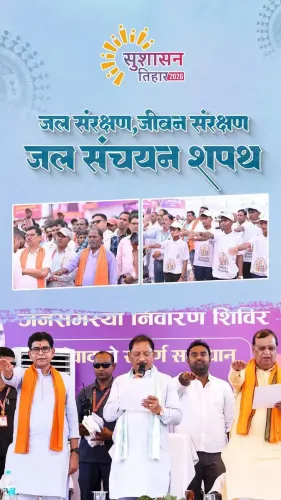
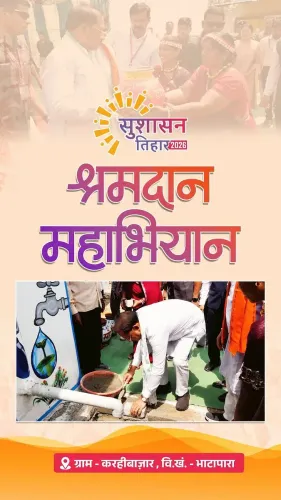
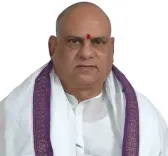
CM Sai Leads Water Conservation Pledge at Sushasan Tihar
Synopsis
Chhattisgarh Chief Minister Vishnu Deo Sai led a public water conservation pledge at Karhibazar in Baloda Bazar-Bhatapara on 22 May 2026 under Sushasan Tihar 2026, calling for a people's movement to protect groundwater for future generations.
Key Takeaways
CM Vishnu Deo Sai participated in a water harvesting and conservation pledge at Karhibazar, Baloda Bazar-Bhatapara on 22 May 2026 .
The event was held under the Sushasan Tihar annual public outreach programme of the Chhattisgarh government.
Sai called for water conservation to become a janaandolan (people's movement) driven by community participation.
He described water as 'the foundation of a secure future for coming generations,' not merely a resource.
Chhattisgarh has been part of the central Jal Shakti Abhiyan since 2019 , focusing on water harvesting structures in stressed blocks.
Progress on physical conservation works in the district during the 2026 monsoon season will be a key measure of follow-through.
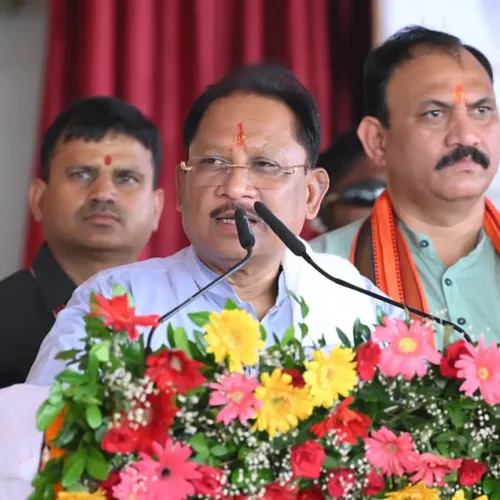
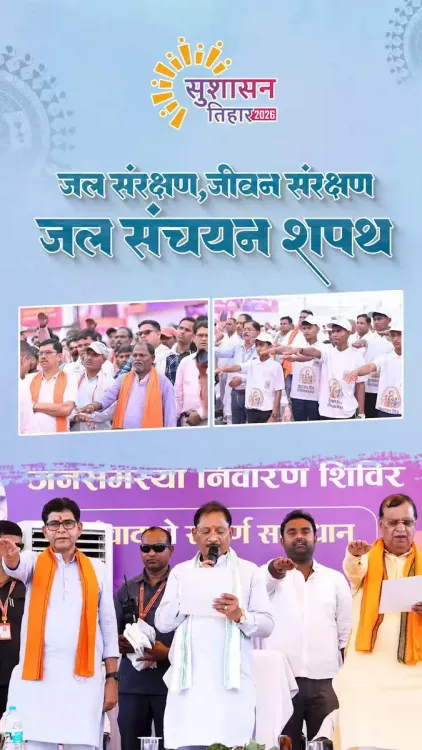
Chhattisgarh Chief Minister Vishnu Deo Sai on Friday, 22 May 2026, led a public pledge for water harvesting and groundwater conservation at Karhibazar in Baloda Bazar-Bhatapara district, alongside elected representatives and local residents as part of the ongoing Sushasan Tihar programme.
Context
Posting on X, CM Sai wrote: 'Jal sanrakshan, jeevan sanrakshan!' ('Water conservation is life conservation!'). He stated that a collective resolve for water harvesting was taken at Karhibazar under the Sushasan Tihar framework, with participation from public representatives and community members of the area.
In the post, Sai underscored that water is 'not merely a resource but the foundation of a secure future for coming generations,' and called for a people's movement — janaandolan — to save water and protect groundwater levels through community participation.
Policy Backdrop
Sushasan Tihar is an annual public outreach programme launched by the Chhattisgarh government following the formation of the BJP government in December 2023. The initiative holds district-level interactions on welfare and development themes, making it a platform for direct engagement between the administration and citizens.
Chhattisgarh has been a participating state in the central Jal Shakti Abhiyan since 2019, which focused on construction of water harvesting structures and awareness campaigns in water-stressed blocks. The broader Jal Jeevan Mission, also launched in 2019, aims at source sustainability including groundwater recharge alongside household tap connectivity.
Central Indian states, including Chhattisgarh, have recorded declining groundwater tables linked to monsoon variability and expanded agricultural irrigation. Community-pledge formats have increasingly been adopted by state governments to supplement central schemes and encourage local ownership of recharge infrastructure.
Stakeholders and Impact
Baloda Bazar-Bhatapara is a district in central Chhattisgarh with significant agricultural activity and heavy reliance on groundwater for both irrigation and drinking water. Rural farming communities and village residents stand as the primary stakeholders in any sustained groundwater conservation effort in the region.
The community-pledge model employed at Karhibazar mirrors similar public-participation drives seen across other states for environmental and natural resource management, aiming to build grassroots ownership rather than relying solely on top-down infrastructure investment.
What's Next
Observers will watch for progress reports on physical water conservation structures completed in Baloda Bazar-Bhatapara and neighbouring districts during the 2026 monsoon season. Any integration of pledges made at events like Sushasan Tihar 2026 with central funding under the Atal Bhujal Yojana will be a key indicator of whether community resolve translates into measurable on-ground action.
The state government's ability to convert district-level awareness events into verifiable improvements in groundwater levels will determine the long-term impact of this public outreach approach.
Point of View
District-level governance brand — connecting routine administration to a public-participation narrative. Framing water conservation as a 'people's movement' shifts rhetorical responsibility toward communities, which can build local ownership but also diffuses accountability for structural outcomes. The event's alignment with central schemes like the Jal Shakti Abhiyan and Atal Bhujal Yojana signals an intent to leverage existing funding pipelines rather than announce fresh state expenditure. Whether these pledge-based drives produce measurable groundwater improvements in Baloda Bazar-Bhatapara will be the real test of this governance model ahead of the 2026 monsoon.
NationPress
14 Oct 2026
Frequently Asked Questions
What is Sushasan Tihar in Chhattisgarh?
Sushasan Tihar is an annual public outreach programme launched by the Chhattisgarh government after the BJP came to power in December 2023, holding district-level interactions on welfare, governance, and development themes to promote direct citizen engagement.
What did CM Vishnu Deo Sai do at Karhibazar on 22 May 2026?
CM Vishnu Deo Sai led a public pledge for water harvesting and groundwater conservation at Karhibazar in Baloda Bazar-Bhatapara district, joined by elected representatives and local residents under the Sushasan Tihar 2026 programme.
Why is water conservation important in Baloda Bazar-Bhatapara?
Baloda Bazar-Bhatapara is an agriculturally active district in central Chhattisgarh that relies heavily on groundwater for irrigation and drinking water; declining groundwater tables linked to monsoon variability make conservation efforts particularly critical there.
What is the Jal Shakti Abhiyan and how does Chhattisgarh participate?
The Jal Shakti Abhiyan is a central government campaign launched in 2019 that focuses on building water harvesting structures and running awareness drives in water-stressed blocks; Chhattisgarh has been a participating state since the scheme's launch.
What is the Atal Bhujal Yojana?
The Atal Bhujal Yojana is a central government scheme aimed at sustainable groundwater management through community participation, and it represents a potential funding channel for integrating local water conservation pledges made at events like Sushasan Tihar into concrete infrastructure works.