CM Sai Meets 36 Fellows of Mukhyamantri Sushasan Fellowship
Synopsis
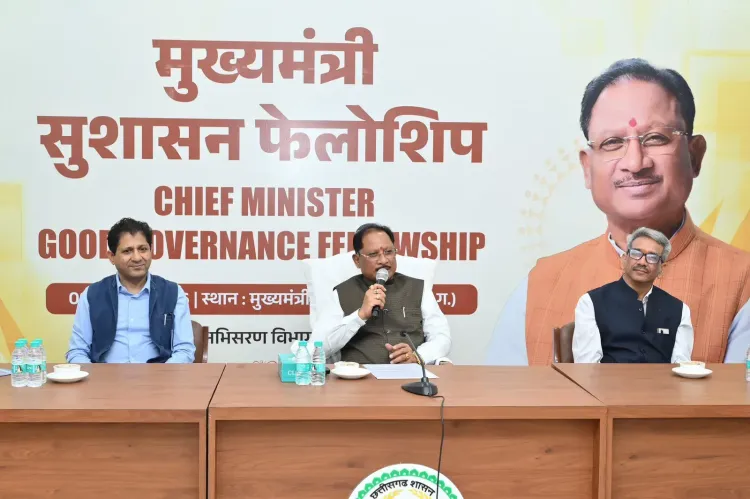
Chhattisgarh CM Vishnu Deo Sai met the 36 fellows of the second batch of the Mukhyamantri Sushasan Fellowship Yojana on October 9, calling on them to use their knowledge and innovation to become active builders of a developed Chhattisgarh.
Key Takeaways
CM Vishnu Deo Sai held a direct interactive session with fellows on Friday, October 9, 2026 .
The session involved the second batch of the Mukhyamantri Sushasan Fellowship Yojana , comprising 36 young fellows .
The CM called on fellows to connect their skills and ideas to public welfare as 'active participants' in building Viksit Chhattisgarh .
A second batch confirms the fellowship has moved beyond its pilot phase and is being scaled.
The Chief Minister's direct involvement signals high-level political backing, which strengthens fellows' standing within the state administration.
Thirty-six young professionals walked into the Chhattisgarh Chief Minister's office on Friday, October 9, 2026, not to petition the government — but to help build it. Chhattisgarh Chief Minister Vishnu Deo Sai held an interactive session with the second batch of the Mukhyamantri Sushasan Fellowship Yojana, listening to their ideas, fielding their curiosities, and issuing a clear challenge: put your knowledge to work for the people.
Posting on X in Hindi, CM Sai framed the moment with a line that doubles as a governing philosophy — 'Yuva shakti hi rashtra shakti hai' ('Youth power is national power'). He said he engaged in a 'heartfelt dialogue' with the fellows, getting to know their thoughts and questions, and called on them to 'connect their knowledge, skills, and fresh ideas to public welfare and become active participants in building a developed Chhattisgarh.'What the Sushasan Fellowship actually is
The Mukhyamantri Sushasan Fellowship Yojana — translating roughly as the Chief Minister's Good Governance Fellowship Scheme — is a state government initiative that embeds young, high-potential individuals within the machinery of Chhattisgarh's administration. The programme is designed to bridge the gap between formal governance structures and fresh, outside-in thinking, pairing fellows with district or department-level challenges that require both analytical rigour and on-the-ground engagement.
The fact that this is the second batch signals that the programme has survived its pilot phase and is being scaled. A cohort of 36 fellows represents a meaningful pool of ground-level governance capacity spread across the state.
The 'Viksit Chhattisgarh' pitch to a captive audience
CM Sai used the session to tie the fellowship directly into the state's larger development ambition, invoking the phrase 'Viksit Chhattisgarh' — a state-level echo of the Centre's 'Viksit Bharat' (Developed India) framing that has become a standard organising idea for BJP-governed states. The message to the fellows was explicit: your role is not peripheral. You are 'active participants' in that construction project.
He expressed confidence that 'the energy, talent, and innovation of youth will give new momentum to the bright future of the state.' The language is motivational, but the setting — a direct, closed-room conversation with the Chief Minister — carries institutional weight that a public speech would not.
Why direct access to the top matters
In most governance fellowship models globally, fellows interact primarily with mid-level bureaucrats. A direct audience with the Chief Minister early in a fellowship cycle does something specific: it signals to both the fellows and the broader administration that the programme has political backing at the highest level, which in turn affects how seriously department officials treat the fellows' recommendations. That signal, in practice, is often worth more than the fellowship stipend itself.
For Chhattisgarh — a state still deepening its post-Naxal stabilisation in several districts and working to translate mineral wealth into broad-based development — a cadre of trained young governance professionals embedded at the district level is a genuinely useful asset, not just optics.
If the second batch delivers on the promise the Chief Minister outlined on Friday, the real test will come when their district-level recommendations meet the inertia of established bureaucratic process. That is where youth energy either bends the system — or gets absorbed by it.
Point of View
Aspirational voters. CM Sai's direct engagement with just 36 fellows is an unusually high-touch move that serves two audiences at once: it motivates the cohort and publicly commits the CM's credibility to the programme's success. The 'Viksit Chhattisgarh' framing deliberately mirrors New Delhi's 'Viksit Bharat' vocabulary, cementing the state's alignment with the Centre's development narrative heading into a budget cycle. The real governance test is whether fellowship recommendations survive contact with district-level bureaucratic resistance — the gap where most such programmes quietly stall.
NationPress
9 Oct 2026
Frequently Asked Questions
What is the Mukhyamantri Sushasan Fellowship Yojana in Chhattisgarh?
The Mukhyamantri Sushasan Fellowship Yojana is a Chhattisgarh government scheme that embeds young, talented individuals within the state's administrative machinery to bring fresh ideas and skills to public governance and district-level problem-solving.
How many fellows are in the second batch of the Sushasan Fellowship?
The second batch of the Mukhyamantri Sushasan Fellowship consists of 36 fellows , who met Chief Minister Vishnu Deo Sai on October 9, 2026.
What did CM Vishnu Deo Sai say to the Sushasan Fellowship batch?
CM Sai urged the fellows to connect their knowledge, skills, and innovative ideas to public welfare and become active participants in building a developed Chhattisgarh, expressing confidence that youth energy will drive the state's bright future.
What does 'Viksit Chhattisgarh' mean?
'Viksit Chhattisgarh' means 'Developed Chhattisgarh' — a state-level development vision championed by the BJP government under CM Sai, aligned with the Centre's broader 'Viksit Bharat' (Developed India) framework.
Why is the second batch of the Sushasan Fellowship significant?
A second batch signals that the fellowship programme has successfully completed its pilot phase and is being expanded, demonstrating the Chhattisgarh government's continued commitment to youth-driven governance reform.