CM Sai: Naxal-Free India Goal Achieved Under PM Modi
Synopsis
On Independence Day 2026, Chhattisgarh Chief Minister Vishnu Deo Sai declared that the national goal of a Naxal-free India has been achieved, crediting Prime Minister Narendra Modi's leadership for ending decades of left-wing extremist insurgency centred in the state's Bastar region.
Key Takeaways
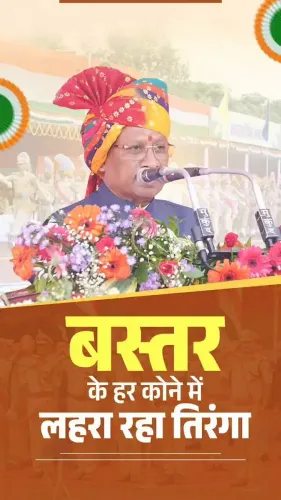
Chhattisgarh CM Vishnu Deo Sai declared on 15 August 2026 that the goal of a Naxal-free India has been fulfilled.
The announcement was made by the Chief Minister's Office of Chhattisgarh on Independence Day, India's most symbolically significant national occasion.
CM Sai attributed the achievement to Prime Minister Narendra Modi's 'courageous leadership.' Chhattisgarh's Bastar region has historically been the epicentre of Maoist-Naxalite insurgency in India for over two decades.
The government's anti-Naxal strategy combined intensified security operations with infrastructure and welfare delivery in affected districts.
Independent verification through official incident data and ground-level reporting will be key to assessing the declaration's full scope.
On India's Independence Day, 15 August 2026, Chhattisgarh Chief Minister Vishnu Deo Sai made a sweeping declaration — that the long-held national ambition of a Naxal-free India had been fulfilled. The announcement, posted by the Chief Minister's Office of Chhattisgarh, framed the milestone as the crowning achievement of this year's Independence Day anniversary.
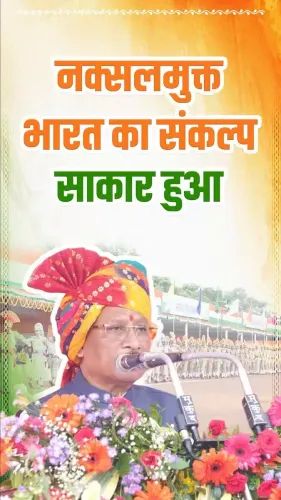
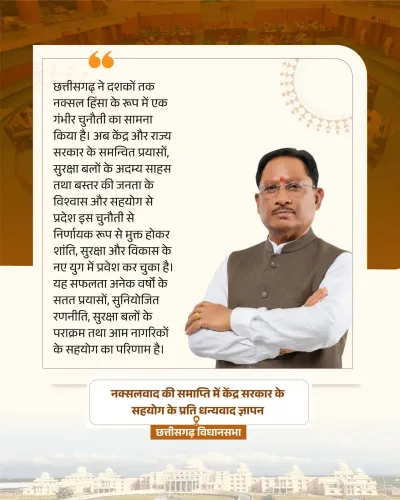
In his message, CM Sai stated: 'नक्सल मुक्त भारत का संकल्प पूरा हो चुका है' — 'The resolve of a Naxal-free India has been fulfilled' — crediting Prime Minister Narendra Modi's 'courageous leadership' for the outcome. The post carried the hashtags #NationFirst and #ViksitChhattisgarh, situating the claim within the broader national development narrative.
Decades of insurgency, one definitive claim
For more than two decades, left-wing extremism — rooted primarily in the dense forests of Chhattisgarh's Bastar region — has been one of India's most stubborn internal security challenges. Maoist insurgents, commonly called Naxalites, waged a sustained campaign that cost thousands of lives among civilians, security forces, and combatants alike. The conflict drew in successive governments at both the Centre and in states like Chhattisgarh, Jharkhand, and Odisha.
The response evolved into a twin-track strategy: intensified counter-insurgency operations by central and state police forces alongside infrastructure investment, road-building, and welfare delivery in affected districts. The logic was straightforward — deny the insurgency both its physical terrain and its political oxygen.
Sai's Chhattisgarh at the centre of the fight
Vishnu Deo Sai, who became Chief Minister after the BJP's victory in the 2023 Chhattisgarh assembly elections, inherited a state that had historically borne the heaviest cost of Naxal violence. His government accelerated security operations in Bastar and surrounding districts, and official figures in the years leading up to 2026 had shown a sustained decline in Naxal-related incidents. The Independence Day post represents the government's formal, public claim that the campaign has now reached its conclusion.
The claim is significant in political terms: framing the Naxal question as 'resolved' on Independence Day — the most symbolically loaded date in the Indian calendar — is a deliberate act of statecraft, tying security achievement to national identity and the Modi government's legacy.
What the declaration means on the ground
Official declarations of this kind are typically followed by data releases on incident counts, district-level de-escalation orders, and the withdrawal of special security designations from formerly affected areas. Residents of Bastar, Sukma, Bijapur, and Dantewada — districts that lived under the shadow of insurgency for a generation — stand as the most direct measure of whether the claim holds. Security forces who sustained casualties across decades of operations are the other face of this milestone.
If verified by independent incident data, a Naxal-free Chhattisgarh would mark one of the most consequential internal-security achievements in post-Independence India. The ground truth, as always, will be written not in posts but in the villages of Bastar.
Point of View
But such declarations invite scrutiny: governments have previously claimed progress on Naxalism only for violence to resurge. If backed by verifiable incident data, this would cement Chhattisgarh's transformation from the conflict's ground zero into a proof-of-concept for the dual security-development model. The political dividend, both for Sai in the state and for the BJP nationally, would be substantial.
NationPress
15 Aug 2026
Frequently Asked Questions
Has India become Naxal-free in 2026?
Chhattisgarh Chief Minister Vishnu Deo Sai declared on Independence Day, 15 August 2026, that the goal of a Naxal-free India has been achieved. Independent verification through official incident data is awaited to fully substantiate the claim.
What did CM Vishnu Deo Sai say on Independence Day 2026?
CM Sai stated that the resolve of a Naxal-free India has been fulfilled under Prime Minister Narendra Modi's courageous leadership, marking it as a landmark achievement of this Independence Day anniversary.
Which region of Chhattisgarh was most affected by Naxalism?
The Bastar region, including districts such as Sukma, Bijapur, and Dantewada, has historically been the epicentre of Maoist-Naxalite insurgency in Chhattisgarh and in India more broadly.
How did India fight the Naxal insurgency?
Successive central and state governments pursued a twin-track approach: intensified security and counter-insurgency operations by police and paramilitary forces, combined with infrastructure development and welfare delivery in affected districts to reduce insurgent influence.
Who is Vishnu Deo Sai?
Vishnu Deo Sai is a BJP leader who became Chief Minister of Chhattisgarh following the party's victory in the 2023 state assembly elections. He has overseen accelerated anti-Naxal operations in the state.