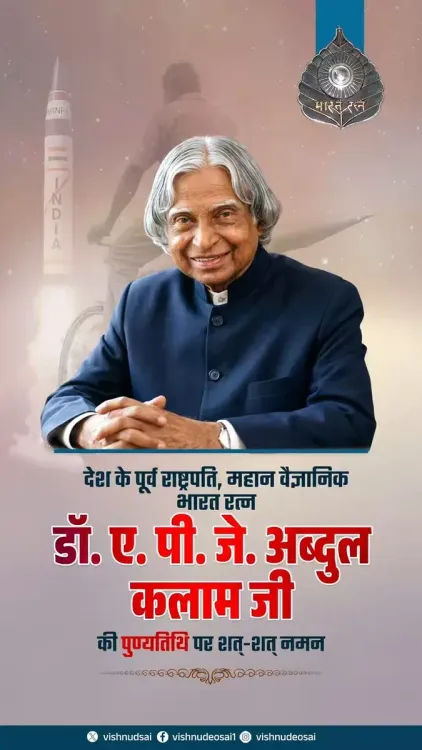
CM Vishnu Deo Sai Pays Tribute to APJ Abdul Kalam on Death Anniversary
Synopsis
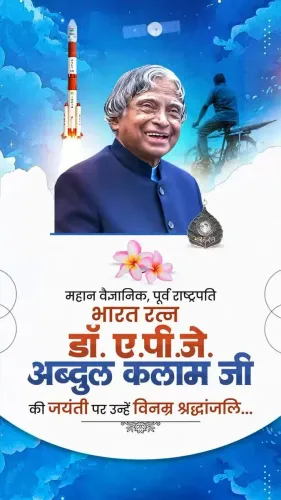
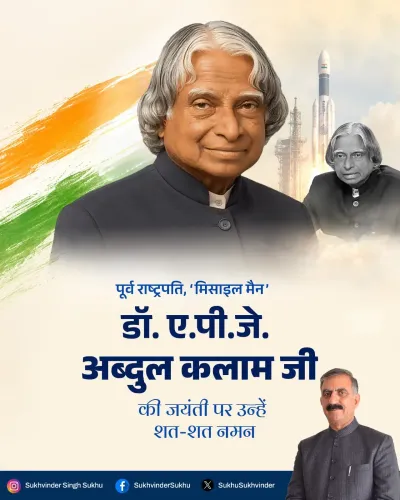
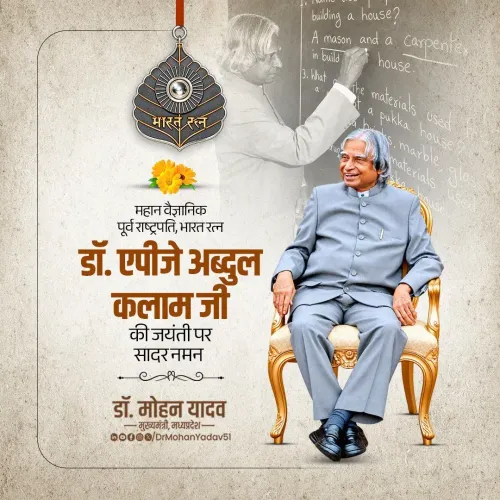
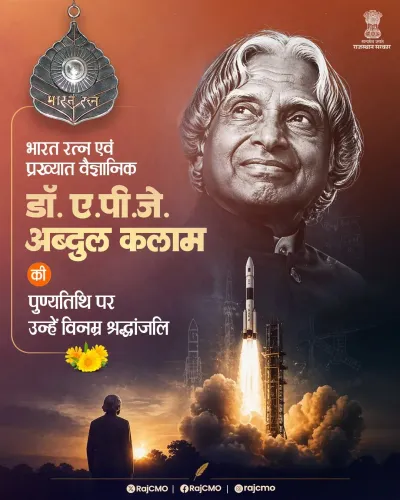
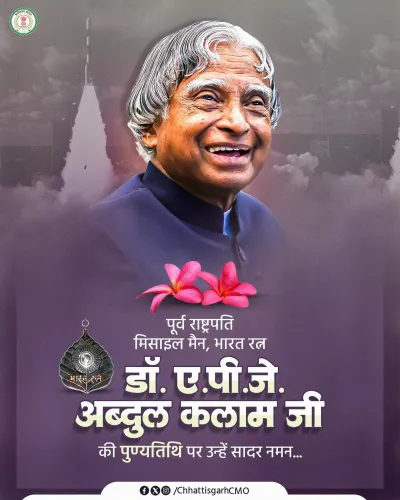
Chhattisgarh Chief Minister Vishnu Deo Sai paid tribute to former President and Bharat Ratna awardee Dr. A.P.J. Abdul Kalam on his death anniversary on 27 July, honouring his contributions to India's space and defence research and his vision of a developed India.
Key Takeaways
Chhattisgarh CM Vishnu Deo Sai paid tribute to Dr.
Abdul Kalam on 27 July , his death anniversary.
Kalam served as India's 11th President from 2002 to 2007 and was awarded the Bharat Ratna in 1997 .
He was the chief architect of DRDO's Integrated Guided Missile Development Programme and contributed to ISRO's SLV-3 project.
Sai's tribute highlighted Kalam's vision for a 'developed India', a reference to his landmark 1998 book India 2020 .
Annual tributes to Kalam by political leaders across parties reflect his enduring status as a symbol of indigenous scientific achievement.
Kalam's birth anniversary on 15 October is observed as World Students' Day , when further science-focused events are expected.
Chhattisgarh Chief Minister Vishnu Deo Sai on Monday, 27 July paid tribute to former President and scientist Dr. A.P.J. Abdul Kalam on his death anniversary, honouring his contributions to India's space and defence research and his vision of a developed India.
Context
In his post, Chief Minister Sai offered what he called 'vinम्र श्रद्धांजलि एवं शत-शत नमन' ('humble tribute and a hundredfold salutation') to Dr. Kalam, describing him as a former President of India, a great scientist, and a 'Bharat Ratna' recipient. He noted that Kalam's life — driven by the spirit of putting the nation above all — along with his invaluable contributions to Indian space and defence research, and his vision for building a developed India, would continue to guide future generations.
27 July marks the anniversary of Dr. Kalam's passing in 2015, when he died during a lecture at the Indian Institute of Management, Shillong. Political leaders across party lines observe the date with public tributes each year.
Policy Backdrop
Dr. Avul Pakir Jainulabdeen Abdul Kalam served as India's 11th President from 2002 to 2007, but built his national reputation as an aerospace and defence scientist over preceding decades. At ISRO, he played a central role in developing the SLV-3 satellite launch vehicle in the 1970s and 1980s. At DRDO, he was the chief architect of the Integrated Guided Missile Development Programme, overseeing projects including the Agni missile, after being appointed Director of DRDO's Defence Research and Development Laboratory in 1982.
In 1992, Kalam became Scientific Adviser to the Defence Minister, coordinating India's indigenous missile capability at the highest level. He was awarded the Bharat Ratna — India's highest civilian honour — in 1997 for his scientific contributions. His 1998 book India 2020 laid out a roadmap for technological self-reliance and a developed India, a vision that CM Sai's tribute directly references.
Stakeholders and Impact
Kalam's legacy spans the scientific community, defence researchers, and Indian youth, whom he famously championed through his post-presidential career as a teacher, speaker, and author. His work at ISRO and DRDO laid foundational infrastructure for India's current space and missile programmes, making annual tributes to him a convergence point for narratives around self-reliance and technological ambition.
For Chhattisgarh, as with other state governments, issuing such tributes is a regular practice on national anniversaries, reinforcing the ruling administration's alignment with broader national values of science, education, and indigenous development.
What's Next
The broader commemorative cycle around Dr. Kalam continues with his birth anniversary on 15 October, observed nationally as World Students' Day, when central and state governments typically announce or highlight science and technology initiatives aimed at youth. CM Sai's tribute, linking Kalam's vision to the goal of a 'developed India', signals continued political investment in that framing as a policy touchstone for the months ahead.
Point of View
As it consciously links Kalam's own 1998 vision to the current ruling dispensation's development narrative. Such tributes serve a dual function: honouring a genuinely revered national figure while reinforcing policy messaging around R&D, space, and defence. As India's space and missile programmes continue to expand, Kalam's memory remains a potent, cross-partisan symbol that political leaders across the spectrum find strategically valuable to cite.
NationPress
25 Oct 2026
Frequently Asked Questions
When did APJ Abdul Kalam die and why is 27 July observed?
Dr. A.P.J. Abdul Kalam passed away on 27 July 2015 while delivering a lecture at the Indian Institute of Management in Shillong, and the date is observed annually as his death anniversary across India.
What was APJ Abdul Kalam's contribution to ISRO and DRDO?
At ISRO , Kalam played a key role in developing the SLV-3 satellite launch vehicle in the 1970s–80s; at DRDO , he was the chief architect of the Integrated Guided Missile Development Programme , overseeing the development of missiles including Agni.
Why did Chhattisgarh CM Vishnu Deo Sai pay tribute to APJ Kalam?
CM Vishnu Deo Sai posted a tribute on 27 July 2026 to mark Kalam's death anniversary, honouring his scientific legacy and his vision of a developed India — a practice common among Indian political leaders on this date.
What is the Bharat Ratna and when did Kalam receive it?
The Bharat Ratna is India's highest civilian honour; Dr. Kalam was awarded it in 1997 in recognition of his outstanding contributions to science and national development.
What is APJ Abdul Kalam's 'India 2020' vision?
In his 1998 book India 2020 , Dr. Kalam laid out a roadmap for making India a developed nation through technological self-reliance, strong defence capabilities, and investment in education and science.