CM Sai Reaffirms Double Engine Push to Double Farmers' Income
Synopsis
Chief Minister Vishnu Dev Sai of Chhattisgarh has reaffirmed on 20 June 2026 that the double engine government is working with resolve to double farmers' incomes and make agriculture a means of prosperity in a state where farming employs nearly 70% of the workforce.
Key Takeaways
The Chief Minister's Office of Chhattisgarh posted a statement on 20 June 2026 attributed to CM Vishnu Dev Sai on agricultural welfare.
The post declared agriculture the 'strong foundation' of the economy and pledged to double farmers' incomes through 'double engine' governance.
Chhattisgarh agriculture contributes over 15% to the state's GSDP and employs nearly 70% of the workforce, with paddy as the dominant crop.
The farmers' income-doubling goal originates from a February 2016 national announcement by PM Narendra Modi , aligned with schemes such as PM-KISAN , e-NAM , and PMFBY .
The 'double engine government' framing signals expected faster fund flows and policy convergence between New Delhi and Raipur .
State budget allocations for 2026-27 and district-level implementation data will be the key metrics to watch.
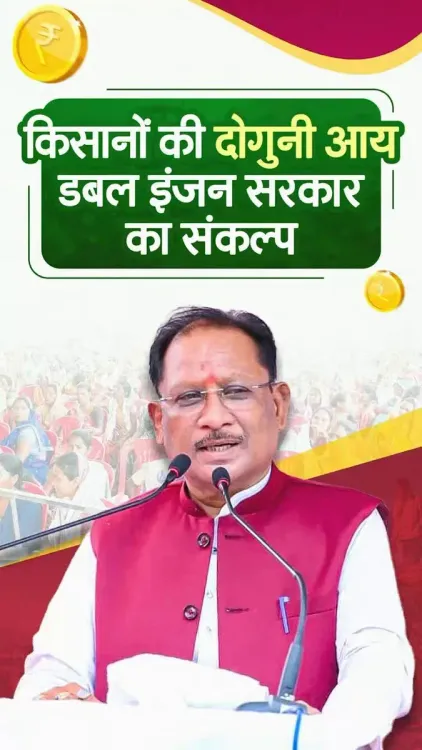
The Chief Minister's Office of Chhattisgarh, on behalf of Chief Minister Vishnu Dev Sai, posted on Saturday, 20 June 2026, reaffirming the state government's commitment to making agriculture the engine of prosperity and doubling farmers' income through coordinated 'double engine' governance.
The post, attributed directly to Chief Minister Vishnu Dev Sai, stated in Hindi: 'Krishi hamari arthvyavastha ka mazboot aadhar hai' — 'Agriculture is the strong foundation of our economy.' It declared that the double engine government is working with resolve to make agriculture a means of prosperity and to double farmers' incomes.
Context
Chhattisgarh is one of India's major rice-producing states, where agriculture contributes over 15% to the Gross State Domestic Product and employs nearly 70% of the workforce. Paddy remains the dominant crop, making farm welfare a central political and economic concern for every administration in Raipur.
Chief Minister Vishnu Dev Sai, a BJP leader representing the Surguja constituency, has helmed the state since December 2023. His government has positioned agricultural growth as a flagship priority, aligning state schemes with central programmes to accelerate rural income gains.
Policy Backdrop
The goal of doubling farmers' income has its roots in a national announcement made by Prime Minister Narendra Modi in February 2016, which outlined a seven-point strategy encompassing irrigation, crop insurance, and market reforms. Though the original target year was 2022, the policy objective has continued to guide both central and state agricultural planning.
The 'double engine government' framing — used by the BJP to describe coordinated rule at both the Centre and a state — carries the specific promise of faster fund flows and tighter policy convergence between New Delhi and Raipur. Central schemes such as PM-KISAN, e-NAM, and PMFBY form the scaffolding on which state governments build complementary interventions covering procurement, irrigation expansion, and direct benefit transfers.
Stakeholders and Impact
The primary beneficiaries of these commitments are Chhattisgarh's farming communities, who depend on assured procurement prices, timely input subsidies, and access to credit. Paddy farmers in particular have historically been sensitive to minimum support price revisions and the efficiency of state procurement machinery.
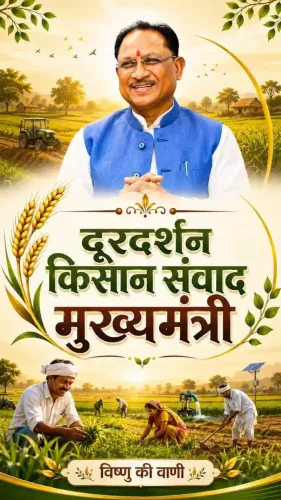
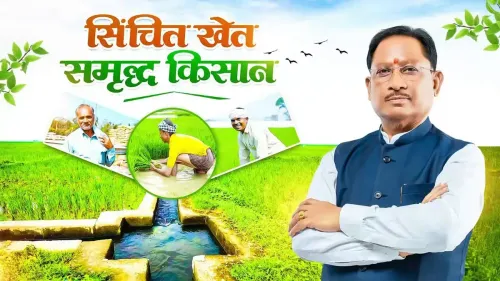
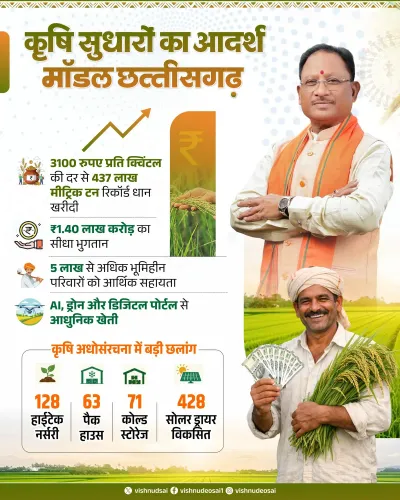
Broader rural stakeholders — including agricultural labourers, input dealers, and rural cooperative networks — stand to gain if the income-doubling agenda translates into measurable improvements in farm gate prices and post-harvest infrastructure. The post's video component, shared alongside the statement, signals an effort to carry this message directly to a grassroots digital audience.
What's Next
Observers will watch the Chhattisgarh state budget allocations for 2026-27 closely for concrete line items that back the income-doubling rhetoric with fiscal muscle. District-level implementation reports on irrigation coverage, crop insurance uptake, and direct benefit transfer disbursements will serve as the most tangible indicators of progress.
With agriculture remaining both an economic lifeline and an electoral touchstone in the state, the Chief Minister's renewed public commitment sets a benchmark against which the government's performance in the coming months is likely to be measured.
Point of View
The message carries both electoral weight and genuine policy stakes. The absence of specific targets or timelines, however, keeps the commitment aspirational rather than measurable, a pattern common to pre-budget political signalling. The real test will come when the 2026-27 state budget either backs the rhetoric with enhanced agricultural allocations or reveals it as routine reaffirmation.
NationPress
19 Sept 2026
Frequently Asked Questions
What did Chhattisgarh CM Vishnu Dev Sai say about farmers on 20 June 2026?
CM Vishnu Dev Sai stated that agriculture is the strong foundation of the economy and that the double engine government is committed to making agriculture a means of prosperity and doubling farmers' incomes in Chhattisgarh.
What is the double engine government in Chhattisgarh?
The 'double engine government' is a BJP term describing coordinated governance when the party controls both the central government and a state government, promising faster fund flows and better policy alignment between New Delhi and state capitals like Raipur.
What is the goal of doubling farmers' income in India?
Prime Minister Narendra Modi announced the national goal of doubling farmers' income in February 2016, outlining a seven-point strategy covering irrigation, crop insurance, and market reforms, with 2022 as the original target year.
How important is agriculture to Chhattisgarh's economy?
Agriculture contributes over 15% to Chhattisgarh's Gross State Domestic Product and employs nearly 70% of the state's workforce, with paddy being the dominant crop.
Which central schemes support farmers in Chhattisgarh?
Central schemes such as PM-KISAN, e-NAM, and PMFBY form the foundation of farm support in Chhattisgarh, complemented by state-level interventions in procurement, irrigation, and direct benefit transfers.