CM Sai Highlights Auto Mutation, Diversion Reforms in CG

Synopsis
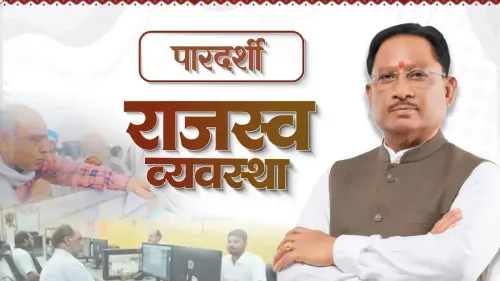
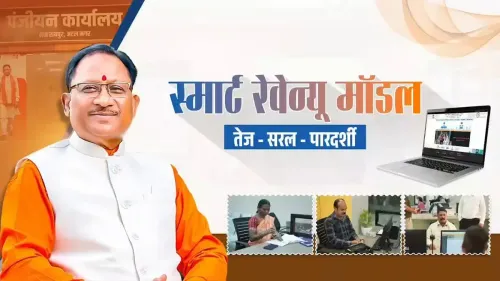
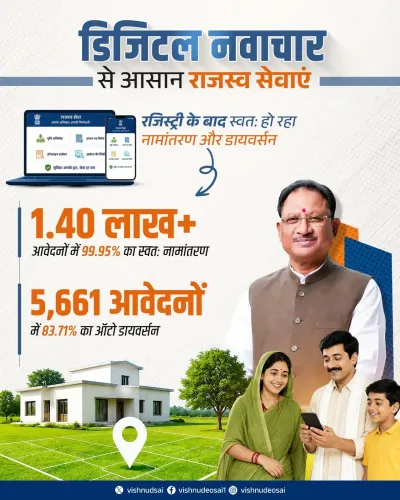
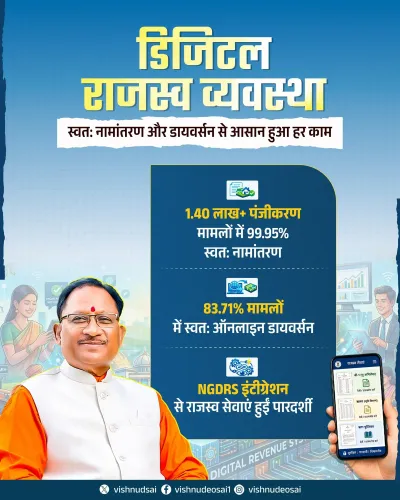
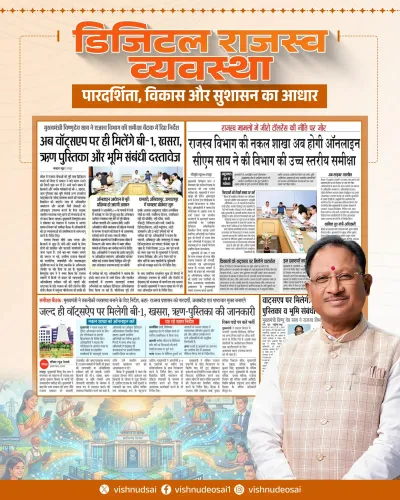
Chhattisgarh Chief Minister Vishnu Deo Sai on 10 July 2026 highlighted auto mutation and auto diversion as digital tools transforming the state's revenue services, reducing citizen hardship and boosting transparency in land-related processes under his government's e-governance push.
Key Takeaways
CM Vishnu Deo Sai on 10 July 2026 publicly highlighted auto mutation and auto diversion as flagship digital reforms in Chhattisgarh's revenue administration.
Both systems are designed to make land-ownership updates and land-use changes faster, time-bound, and free from unnecessary bureaucratic delays.
The reforms reduce the need for citizens — particularly landowners in rural areas — to make repeated visits to revenue offices.
The initiative is consistent with the national Digital India programme launched in 2015 and the National Land Records Modernisation Programme .
CM Sai has led the Chhattisgarh government since December 2023 , with e-governance positioned as a core administrative priority.
Future steps are expected to include integration of revenue portals with Aadhaar and state GIS platforms.
Chhattisgarh Chief Minister Vishnu Deo Sai on Friday, 10 July 2026, underscored his government's commitment to digitising revenue services, highlighting auto mutation and auto diversion systems as key tools to make land-related processes faster, more transparent, and accessible to ordinary citizens.
Context
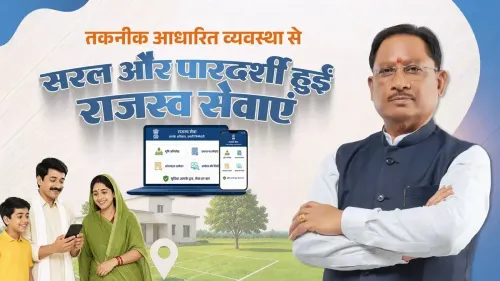
Posting in Hindi on X, CM Sai wrote: 'डिजिटलीकरण और नवाचार के माध्यम से जनसुविधाओं को सरल, सुगम और पारदर्शी बनाने की दिशा में हमारी सुशासन सरकार निरंतर कार्य कर रही है' — 'Our good-governance government is continuously working to make public services simple, accessible, and transparent through digitalisation and innovation.' He specifically cited auto mutation and auto diversion as digital mechanisms that have made land-related work faster, smoother, and time-bound.
Mutation refers to the updating of land ownership records after a transfer or inheritance, while diversion refers to the formal change of land-use classification — both processes that have historically required citizens to make repeated visits to revenue offices and navigate opaque bureaucratic channels.
Policy Backdrop
The push for digitised land records in Chhattisgarh sits within a long national arc. The Government of India launched the Digital India programme in 2015 to accelerate the computerisation of citizen services across states. Land records specifically have been a focus since the early 2000s, gaining further momentum under the National Land Records Modernisation Programme, which sought to create a single-window, tamper-proof system for property data.
Several Indian states have since rolled out automated land-record systems, and Chhattisgarh's adoption of auto mutation and auto diversion is consistent with this broader national pattern. The Chhattisgarh government, led by CM Sai since December 2023, has positioned e-governance reform as a signature priority of its administration.
Stakeholders and Impact
The primary beneficiaries are landowners and rural citizens who previously had to make multiple trips to revenue offices — often losing wages and time — to complete routine land transactions. By automating mutation and diversion workflows, the state government aims to eliminate unnecessary physical visits and reduce the scope for delays or corrupt intermediation.
CM Sai framed the broader philosophy clearly: 'तकनीक तभी सार्थक है, जब वह आम नागरिक का जीवन आसान बनाए' — 'Technology is meaningful only when it makes the life of the common citizen easier and becomes a powerful medium for delivering good governance to every household.' This citizen-first framing aligns with the BJP's national 'ease of living' narrative.
What's Next
Analysts watching Chhattisgarh's revenue reforms expect the next phase to involve deeper integration of the state's revenue portals with Aadhaar authentication and state GIS platforms, which would allow real-time geo-tagged verification of land parcels. Such integration would further reduce human discretion in the mutation and diversion pipeline.
The state's trajectory suggests that digital revenue services will remain a central plank of the Sai government's governance agenda through its term, with the administration likely to announce further milestones as the system matures.
Point of View
Maximum governance' messaging into verifiable, ground-level outcomes in Chhattisgarh. Land records have historically been among the most friction-heavy citizen-state interfaces in India, making them a high-visibility arena for e-governance wins. By foregrounding technology as a vehicle for 'susha shasana' (good governance), the Sai administration is also building a replicable narrative ahead of future electoral cycles. The move fits a broader pattern of BJP-governed states using digital public infrastructure to demonstrate administrative competence distinct from welfare-scheme politics.
NationPress
8 Oct 2026
Frequently Asked Questions
What is auto mutation in Chhattisgarh's revenue system?
Auto mutation is a digital process in Chhattisgarh that automatically updates land ownership records after a transfer or inheritance, removing the need for citizens to manually apply and follow up at revenue offices.
What is auto diversion of land in Chhattisgarh?
Auto diversion is a digitised mechanism that processes the formal change of a land parcel's use classification — for example from agricultural to residential — in a faster, more transparent manner without repeated office visits.
What did Chhattisgarh CM Vishnu Deo Sai say about digital governance?
On 10 July 2026, CM Vishnu Deo Sai said that technology is meaningful only when it makes the common citizen's life easier, and highlighted auto mutation and auto diversion as examples of how his government is achieving that goal in revenue services.
How does Chhattisgarh's land digitisation connect to Digital India?
Chhattisgarh's auto mutation and auto diversion reforms build on the national Digital India programme launched in 2015 and the National Land Records Modernisation Programme, which have pushed all states to computerise and automate land-record services.
Who benefits from Chhattisgarh's auto mutation and auto diversion systems?
Landowners and ordinary citizens — especially in rural areas — benefit most, as they no longer need to make multiple trips to revenue offices for routine land transactions, saving time and reducing exposure to bureaucratic delays.