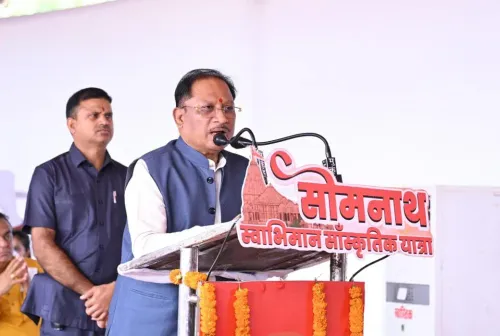
CM Sai flags off 1,000 pilgrims on Somnath Swabhiman Yatra

Synopsis
Chhattisgarh Chief Minister Vishnu Deo Sai on 22 June 2026 flagged off 1,000 devotees carrying sacred water from the state's holy rivers to the Somnath Jyotirlinga in Gujarat under the Somnath Swabhiman Sanskritik Yatra, a cultural pilgrimage initiative linking Chhattisgarh's riverine heritage with one of Hinduism's holiest Shiva shrines.
Key Takeaways
1,000 devotees from Chhattisgarh departed on 22 June 2026 under the Somnath Swabhiman Sanskritik Yatra .
Pilgrims carry sacred water-pots ( jal kalash ) drawn from Chhattisgarh's holy rivers to offer at Somnath temple, Gujarat .
Chief Minister Vishnu Deo Sai announced the departure on X, extending blessings with the invocation 'Har-Har Mahadev' .
The Somnath Jyotirlinga is one of twelve holiest Shiva shrines in India, rebuilt and consecrated in May 1951 .
The yatra reflects a broader pattern of BJP-governed states organising inter-state religious pilgrimages to pan-Indian temple centres.
The initiative aligns with the Union government's PRASAD scheme (launched 2014-15) for developing pilgrimage infrastructure at sites including Somnath.
Chhattisgarh Chief Minister Vishnu Deo Sai on Monday, 22 June 2026 announced the departure of 1,000 devotees from the state on the Somnath Swabhiman Sanskritik Yatra — a cultural pilgrimage in which the faithful carry sacred water drawn from Chhattisgarh's holy rivers to offer at the Somnath Jyotirlinga temple in Gujarat.
Posting on X, Chief Minister Sai wrote: 'Somnath Swabhiman Sanskritik Yatra ke antargat aaj Pradesh ke 1,000 shraddhaluon ne Chhattisgarh ki pavitra nadiyon ka jal kalash lekar Baba Somnath ke divya darshan ke liye rawaana hue.' [Under the Somnath Swabhiman Cultural Journey, today 1,000 devotees of the state have departed carrying sacred water-pots from the holy rivers of Chhattisgarh for the divine darshan of Baba Somnath.] He concluded with the invocation 'Har-Har Mahadev' and extended his best wishes to all pilgrims for a blessed journey.
Context
The Somnath temple, situated at Prabhas Patan in Gujarat, is counted among the twelve Jyotirlingas — the holiest shrines of Lord Shiva — and holds deep significance in the Hindu devotional tradition. The temple was rebuilt and consecrated in May 1951 after centuries of repeated destruction, and its reconstruction became an enduring symbol of cultural and civilisational revival in independent India. The Somnath Swabhiman Sanskritik Yatra frames the pilgrimage explicitly around this identity of cultural pride (swabhiman), connecting Chhattisgarh's riverine heritage with the national shrine.
Policy Backdrop
The yatra sits within a wider pattern of BJP-governed states organising inter-state religious journeys that link regional sacred sites with pan-Indian temples — a form of cultural connectivity that runs parallel to central infrastructure support for pilgrimage destinations. The Union government's PRASAD scheme, launched in 2014-15, has directed funds toward developing amenities at major pilgrimage sites including Somnath, creating an enabling environment for state-organised pilgrim movements. Chhattisgarh, a state with significant tribal communities and revered rivers such as the Mahanadi, the Hasdeo, and the Indravati, draws on these sacred waterways as the ritual source of the jal kalash — the holy water-pots carried by pilgrims.
Stakeholders and Impact
The immediate beneficiaries are the 1,000 Shiva devotees from Chhattisgarh undertaking the journey, for whom the yatra represents both spiritual fulfilment and a state-facilitated pilgrimage experience. Pilgrimage tourism operators along the Chhattisgarh–Gujarat corridor also stand to benefit from organised group travel of this scale. For Chief Minister Sai, who has emphasised cultural and religious outreach since assuming office in December 2023, the initiative reinforces his government's positioning on heritage and identity ahead of any future electoral cycle.
What's Next
Observers will watch for official welcome events or coordination meetings when the Chhattisgarh contingent arrives at Somnath, as well as any announcements of similar water-offering yatras from other BJP-ruled states. The success of this pilgrimage could encourage the state government to institutionalise the Somnath Swabhiman Sanskritik Yatra as an annual cultural programme, deepening the religious and symbolic ties between Chhattisgarh and one of India's most iconic Shiva shrines.
Point of View
Linking Chhattisgarh's riverine identity to one of Hinduism's most symbolically charged shrines. Chief Minister Vishnu Deo Sai, who took office in December 2023, is consolidating a religious-outreach narrative that has become a consistent feature of BJP state governments seeking to deepen their cultural footprint. The framing of 'swabhiman' (self-respect or pride) in the yatra's name signals that the pilgrimage is positioned as an assertion of civilisational continuity, not just piety. This follows a well-established playbook visible across multiple BJP-ruled states, where inter-state yatras serve simultaneously as governance optics, community mobilisation, and soft electoral groundwork.
NationPress
21 Sept 2026
Frequently Asked Questions
What is the Somnath Swabhiman Sanskritik Yatra?
The Somnath Swabhiman Sanskritik Yatra is a cultural pilgrimage initiative organised in Chhattisgarh in which devotees carry sacred water from the state's holy rivers to offer at the Somnath Jyotirlinga temple in Prabhas Patan, Gujarat.
How many pilgrims departed from Chhattisgarh for Somnath on 22 June 2026?
1,000 devotees from Chhattisgarh departed on 22 June 2026 under the Somnath Swabhiman Sanskritik Yatra, carrying holy water-pots from the state's sacred rivers.
Who is Vishnu Deo Sai and what is his role in this yatra?
Vishnu Deo Sai is the Chief Minister of Chhattisgarh and a BJP leader who has held the post since December 2023. He announced the departure of the 1,000 pilgrims on X and extended his blessings for the journey.
Where is the Somnath temple located and why is it significant?
The Somnath temple is located in Prabhas Patan, Gujarat, and is one of the twelve Jyotirlingas — the holiest shrines of Lord Shiva in Hinduism. It was rebuilt and consecrated in May 1951 after repeated historical destruction, making it a powerful symbol of cultural revival.
Which rivers in Chhattisgarh are considered sacred for this pilgrimage?
Chhattisgarh's major rivers regarded as sacred in local tradition include the Mahanadi, the Hasdeo, and the Indravati. Pilgrims on the Somnath Swabhiman Yatra carry water drawn from these rivers as a devotional offering.