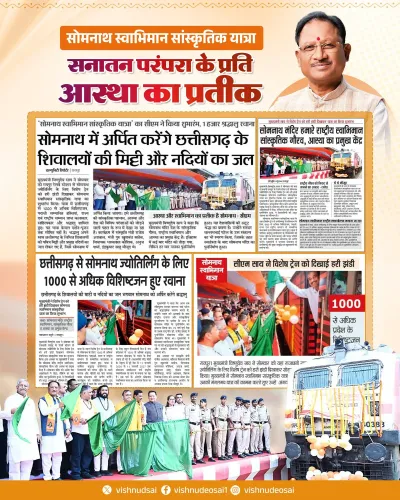
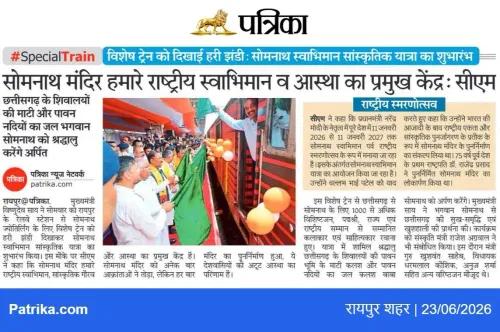
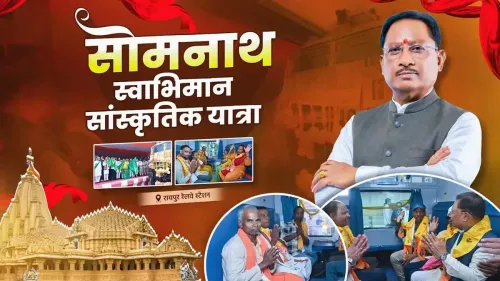
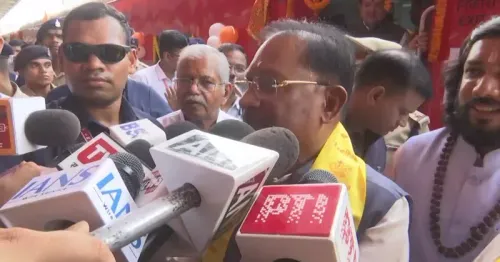
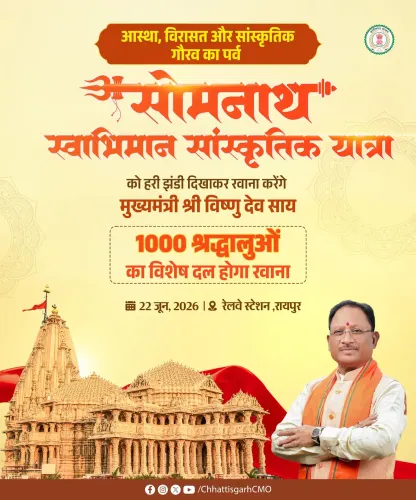
CM Sai flags off Somnath Swabhiman Yatra from Raipur
Synopsis
Chief Minister Vishnu Deo Sai on 22 June 2026 flagged off a special train from Raipur carrying 1,000 participants on the Somnath Swabhiman Sanskritik Yatra to Gujarat, framing it as a celebration of India's cultural heritage, spiritual consciousness, and national unity under the Ek Bharat Shreshtha Bharat framework.
Key Takeaways
CM Vishnu Deo Sai personally flagged off the special train from Raipur Railway Station on 22 June 2026 .
1,000 distinguished participants from Chhattisgarh are travelling to Somnath Temple in Gujarat .
The yatra is officially described as a vehicle for India's cultural heritage, spiritual consciousness, and national unity messaging.
The initiative aligns with the Centre's Ek Bharat Shreshtha Bharat scheme, launched in 2015 to foster inter-state cultural ties.
The programme is intended to give Chhattisgarh's folk traditions and cultural identity a national platform.
The Chief Minister's Office of Chhattisgarh announced on Monday, 22 June 2026, that Chief Minister Vishnu Deo Sai flagged off a special train carrying 1,000 distinguished participants from Raipur Railway Station, launching the Somnath Swabhiman Sanskritik Yatra — a state-organised cultural pilgrimage to the Somnath Temple in Gujarat.
Context
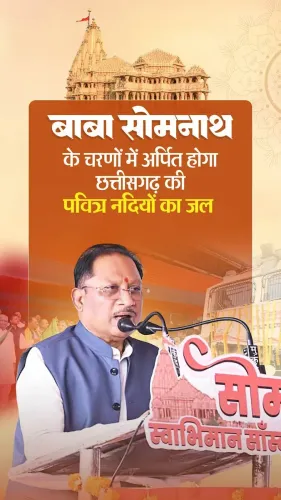
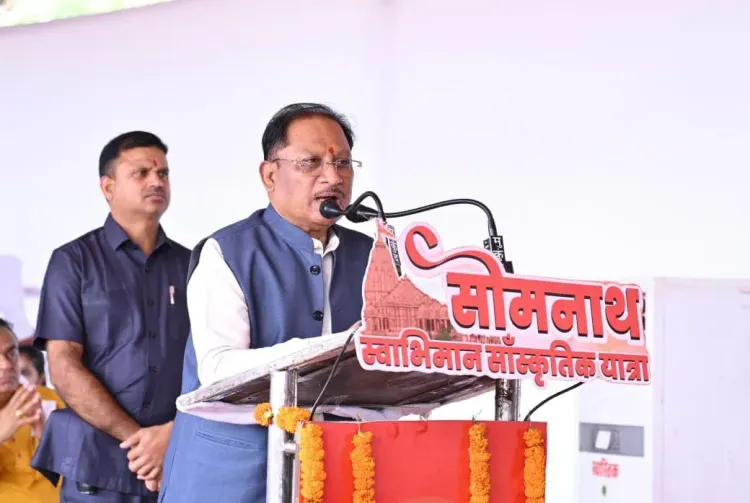
Speaking at the inauguration ceremony, CM Sai described the yatra as a 'living celebration of India's cultural self-respect, faith, and integrity.' The post stated that the 1,000 eminent participants from Chhattisgarh would travel to Somnath Dham as 'carriers of the message of India's glorious cultural heritage, spiritual consciousness, and national unity.'
The journey is framed not merely as a pilgrimage but as a platform to project Chhattisgarh's rich folk traditions and cultural pride onto a national stage, the official post noted.
Policy Backdrop
The yatra aligns closely with the Centre's Ek Bharat Shreshtha Bharat initiative, launched in 2015 to promote inter-state cultural linkages and national integration through paired state partnerships and exchange programmes. Chhattisgarh and Gujarat — home to the Somnath Temple — represent a natural pairing under such cultural connectivity drives.
Indian states, particularly those governed by the BJP, have increasingly organised theme-based special trains and heritage yatras to major religious sites as part of this broader framework. These initiatives weave together religious tourism, cultural messaging, and national-unity outreach into a single state-sponsored programme.
The Somnath Temple, one of the twelve Jyotirlingas dedicated to Lord Shiva, carries deep symbolic weight in Indian public discourse as an emblem of cultural resilience — having been repeatedly destroyed and rebuilt over centuries before its modern reconstruction, completed in 1951.
Stakeholders and Impact
The 1,000 participants described as vishishtajan (distinguished persons) from Chhattisgarh are the primary beneficiaries of this state-funded cultural journey. The selection of eminent individuals — rather than a general public ballot — signals an intent to create cultural ambassadors who can carry the yatra's messaging back to their communities.
The initiative also benefits the broader pilgrimage and religious tourism ecosystem, reinforcing Raipur's role as a hub for state-organised cultural mobility and strengthening rail connectivity between Chhattisgarh and Gujarat.
What's Next
The Chhattisgarh government's use of a dedicated special train and large-scale participant mobilisation suggests this yatra could serve as a template for subsequent cultural journeys to other heritage sites. Observers will watch whether the state announces additional phases of the Somnath Swabhiman Yatra or expands similar programmes under the Ek Bharat Shreshtha Bharat framework to other paired states. The yatra's reception at Somnath Dham and its cultural programming along the route will determine its long-term impact as a vehicle for Chhattisgarh's national cultural identity.
Point of View
Cultural nationalism, and inter-state connectivity into a single political-cultural statement. By personally flagging off the train and mobilising 1,000 eminent citizens, CM Sai positions himself as a steward of both Chhattisgarh's distinct cultural identity and its alignment with the Centre's Ek Bharat Shreshtha Bharat framework. The choice of Somnath — a temple whose symbolic resonance in the BJP's political imagination is well-documented — is unlikely to be incidental. This yatra pattern, replicated across BJP-ruled states, is steadily building a repertoire of state-sponsored cultural diplomacy that doubles as grassroots political outreach.
NationPress
20 Sept 2026
Frequently Asked Questions
What is the Somnath Swabhiman Sanskritik Yatra?
The Somnath Swabhiman Sanskritik Yatra is a state-organised cultural pilgrimage launched by the Chhattisgarh government on 22 June 2026, in which 1,000 distinguished participants travel by special train from Raipur to the Somnath Temple in Gujarat to promote cultural heritage and national unity.
Who flagged off the Somnath Yatra special train?
Chief Minister Vishnu Deo Sai flagged off the special train from Raipur Railway Station on 22 June 2026 at the inauguration ceremony of the yatra.
How many people are travelling on the Somnath Swabhiman Yatra from Chhattisgarh?
1,000 distinguished participants, referred to as vishishtajan, from Chhattisgarh are travelling on the special train to Somnath Dham in Gujarat.
What is Ek Bharat Shreshtha Bharat and how does this yatra relate to it?
Ek Bharat Shreshtha Bharat is a Central Government initiative launched in 2015 to promote inter-state cultural exchanges and national integration. The Somnath Swabhiman Yatra aligns with this framework by fostering cultural connectivity between Chhattisgarh and Gujarat.
Why is Somnath Temple significant for this yatra?
The Somnath Temple in Gujarat is one of the twelve Jyotirlingas dedicated to Lord Shiva and is widely regarded as a symbol of India's cultural resilience. Its choice as the destination underscores the yatra's emphasis on cultural pride and national heritage.